Koko Head Crater Trail (Koko Head Stairs): What The Hike Is Really Like
The Koko Head Crater Trail is a stair climb up an old tramway on Oʻahu's dry southeast corner, and it is one of the hardest short walks on the island. Here is what it actually involves.
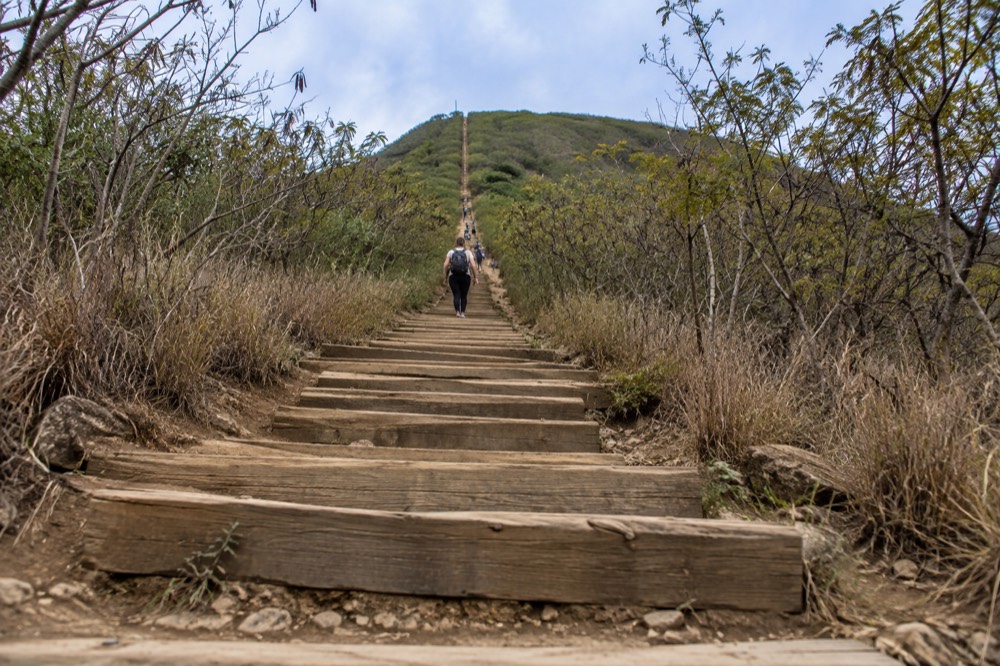
Short answer
The Koko Head Crater Trail, usually called the Koko Head Stairs, is a steep climb up a disused tramway on the crater's inner wall near Hawaiʻi Kai. There is no ticket and no reservation system. It is a hard, exposed stair hike best done early, and the panoramic reward at the top is real.
The Koko Head Crater Trail is the climb most visitors underestimate on Oʻahu. It has no ticket, no booth and no reservation website, which makes it sound casual. It is not. The trail is the bed of an old tramway, a staircase of disused railway ties running straight up the inner wall of Koko Crater on the island's dry southeast corner, and it gains height with very little mercy. Locals run it before work. Visitors crawl up it at noon and regret it.
This guide covers what the hike actually involves: how hard it is, what it costs, when to go, what to carry, how it compares with the Diamond Head hike, and an honest verdict on whether the view at the top earns the burn in your legs. The site's name for the trail is the one the state uses, the Koko Crater Railway Trail, but almost everyone calls it the Koko Head Stairs, and both names point at the same line of ties.
What Is The Koko Head Crater Trail?
The Koko Head Crater Trail, officially the Koko Crater Railway Trail, is a staircase built on the trackbed of a former tramway climbing the inside wall of Koko Crater near Hawaiʻi Kai in east Honolulu. The route is a single sustained line of old railway ties, with a short span bridging a gap partway up. There is no loop, no shade and no alternate route: you go up the ties and you come back down them. The tramway's original purpose was to service facilities at the summit, and the rails are long gone; what remains is the ties themselves, worn smooth by decades of feet. The crater sits within Koko Head District Park, and the botanical garden on the crater floor is a separate, flatter attraction people often confuse with the stair climb. They are different visits with different effort levels, and only one of them will leave you sore the next day.
The setting matters as much as the structure. Koko Head is on the leeward, dry side of the island's southeast corner, in the rain shadow of the Koʻolau range. The vegetation on the crater wall is scrubby and low, there is no tree cover at any point on the climb, and the rock radiates heat from mid-morning onward. That dryness is also why the trail exists in such a raw state: no rainforest reclaiming the trackbed, no mud, just ties, gravel and sun.
One naming note before you navigate. The crater is Koko Crater, the broader headland is Koko Head, and the neighbouring promontory to the east is Mākapuʻu. Signs and mapping apps use all three interchangeably and wrongly. Searching for the Koko Head Stairs will get you to the right trailhead anyway, because there is only one famous staircase out here.
How Hard Is The Koko Head Hike?
The Koko Head hike is genuinely hard, and it is short, which is a deceptive combination. The climb is a relentless stair ascent with no flat sections, no shade and no water. Most reasonably fit hikers need 30 to 45 minutes to reach the summit, with plenty of stops. The descent is its own challenge, steep and jarring on the knees, and it is where most people injure themselves.
The difficulty is not technical. There is no scrambling, no exposure to a drop on the main line, and no route-finding. The difficulty is purely cardiovascular and thermal. Your legs lift your body weight up step after step with almost no relief, and the sun does the rest. On a typical Honolulu morning the wall starts heating by 9 a.m., and by late morning the ties are hot to the touch.
Two features of the route deserve specific warning. The first is the bridge, a section partway up where the ties span a gap in the trackbed. It is the part of the hike people photograph and the part that turns some hikers around. The ties are spaced, the drop beneath is real, and there is a bypass path around it that adds a little distance and a lot of safety. If the bridge bothers you, take the bypass; the summit does not care which way you arrived. The second is the false summit: the track bends near the top and the angle eases just enough to make you think you are done. You are not done. Budget your energy accordingly.
Honest fitness framing helps here. If you walk regularly and can handle stairs at a normal pace, you can finish this hike, slowly, with breaks. If you get winded on a couple of flights of stairs, this trail will be miserable, and doing it at midday will make it dangerous. The people who struggle worst are not the unfit, they are the moderately fit who assume a short trail cannot hurt them and start too fast in the heat.
Recovery is a real consideration for itinerary planning. Your calves and quads will tell you about this climb the next day, which matters if you have a big excursion booked. Do not schedule the Koko Head Stairs the morning before a long day of walking around Pearl Harbor or a North Shore circuit, or at least accept that you will feel it.

What Does It Cost To Hike Koko Head?
There is no entrance fee for the Koko Head Crater Trail and no reservation system of any kind. You do not book anything, you do not buy a ticket, and there is no gate. The costs that do exist are indirect: parking in the Koko Head District Park area, getting there by bus or rideshare, and the water and sun protection you must carry. Anyone selling you a Koko Head ticket is selling you something the trail does not require.
That no-fee status is worth pausing on, because Oʻahu's two famous crater hikes are opposites in this respect. Diamond Head State Monument charges non-residents for entry and for parking, and requires a reservation for both, a rule in force since May 2022 with no on-site sales. Koko Head charges nothing and reserves nothing. The trade is that Diamond Head gives you a maintained path, railings, restrooms and staff, while Koko Head gives you ties, sun and self-reliance.
Because there is no official fee schedule for this trail, treat any dollar figure you see quoted for it online with suspicion. The verified costs in this part of the island are the ones attached to other sites: Diamond Head's entry and parking fees are published by state parks, Hanauma Bay's reservation fee is on the city's page, and this trail simply has no price list to check. Bring cash only for the bus, which takes exact fare, or nothing at all if you are driving.
If the no-reservation freedom appeals to you but the difficulty does not, the honest middle path is paying someone to handle the easier crater. A guided Diamond Head option with the entry ticket and shuttle included removes the two things people most often get wrong there, the reservation and the timing, and leaves you with a walk almost anyone can finish. That is the trade this site recommends for travellers who want the crater experience without the Koko Head grind.
When Is The Best Time To Do The Koko Head Hike?
The best time to hike Koko Head is at or shortly after sunrise, and the reason is heat, not crowds. The trail is fully exposed, the crater wall faces the morning sun, and Honolulu's sunrise runs between roughly 5:50 a.m. in June and 7:11 a.m. in mid-January, so the start time shifts with the season.
By 9 a.m. the wall is already warm; by late morning the climb is unpleasant and, for some people, unsafe.
The sunrise numbers above come from published sun tables for Waikīkī, a few miles west, and they carry a planning insight most visitors miss: Oʻahu's day length swings only about two and a half hours across the whole year, and the latest sunset of the year is around 7:17 p.m. There are no long summer evenings here the way there are at high latitudes. A "sunset hike" of Koko Head means starting the climb in the late afternoon with enough margin to get down before dark, not lingering at the top until the sun dips.
Crowds follow the sun, in reverse. The trail is busiest in the early morning, because that is when locals train on it and savvy visitors climb it, and quietest, dangerously so, in the heat of the day. If you want the trail nearly to yourself, the honest answer is that the quiet hours are the wrong hours. Do not trade safety for solitude here.
A few timing rules of thumb:
| Window | Conditions | Verdict |
|---|---|---|
| Sunrise to 8 a.m. | Coolest wall, busiest trail, best light for photos | Best overall |
| 8 to 10 a.m. | Warming fast, still manageable with water | Acceptable |
| 10 a.m. to 3 p.m. | Wall radiating heat, high strain, few people | Avoid |
| 3 to 5 p.m. | Cooling, lower sun, descending in daylight needs care | Second-best |
| After sunset | Dark stairs, uneven ties, no lighting | Do not |
Weather timing matters less than you might think, and that is a fact about Oʻahu's geography rather than a guess. The island's rainfall is wildly uneven by location: the official climate normals put Honolulu's airport at about 16 inches of rain a year, while the Lyon Arboretum station in Mānoa, five miles inland, records over 150 inches. Koko Head sits on the dry leeward southeast corner, closer to the airport's regime than the valley's. A rainy morning in Mānoa does not mean a rainy morning at Koko Head, and vice versa. Check the forecast for the east side of Honolulu specifically, not for the island generally.
What Should You Bring To The Koko Head Stairs?
Bring more water than feels reasonable, sun protection, and shoes with real grip, and bring nothing heavy. There is no water fountain on the trail, no shade to rest in, and no services of any kind on the climb, so everything you need for the round trip goes on your back. A litre per person is the sensible minimum on a warm morning; two is better.
Shoes with grip matter most, because the ties are worn smooth and the descent is steep.
The packing list for this hike is short because the trail punishes weight. Every extra kilogram goes up a few hundred steps with you.
| Item | Why it matters on this trail |
|---|---|
| Water, 1 to 2 litres per person | No water source anywhere on the route; heat exposure doubles your need |
| Shoes with grip | Worn ties and gravel; flip-flops are the main cause of slips here |
| Hat and sunscreen | Zero shade from trailhead to summit |
| Small snack | Summit rest is the one place you will want it |
| Phone, charged | Coverage is good; it is your map, camera and emergency line |
| What to leave behind | Drones are prohibited in state parks without a written permit, and this is parkland; leave it home |
Two things not to bring deserve their own sentences. Do not bring a drone: unmanned aircraft are prohibited in Hawaiʻi state parks without a written permit, and the crater is parkland, not open land. And do not bring loose rock souvenirs off any Oʻahu shoreline site; removing sand, rock and coral from the shoreline is prohibited under state law, and the reason is legal, not folklore. The old story about a curse following lava rock is a twentieth-century invention, not a Hawaiian belief, and this site does not repeat it. Everything else covered here is indexed on Oahu Travel Guide.
Koko Head Or Diamond Head: Which Crater Hike Should You Do?
Diamond Head is the easier, safer, more regulated walk, with a fee, a mandatory reservation for non-residents and a wide maintained path to a tunnel-and-bunker viewpoint. Koko Head is free, unregulated and much harder, a raw stair climb to an open ridgeline with the island's best panorama of the east coast. If you want one iconic crater morning with minimal risk, choose Diamond Head. If you want a workout and a wilder view, choose Koko Head.
The comparison is worth a table because the two trails are the two most-asked-about hikes on the island and they answer different questions.
| Koko Head Stairs | Diamond Head (Lēʻahi) | |
|---|---|---|
| Effort | Hard, sustained stairs | Moderate, paved and graded path |
| Fee | None | Entry and parking fees for non-residents, card only |
| Reservation | None | Required for non-residents, up to 30 days ahead |
| Shade | None at all | Very little, but some sections near the top |
| Surface | Railway ties, gravel, one bridged gap | Paved path, stairs, tunnels, railings |
| Best for | Fitness, big panorama, sunrise | Families, first-timers, the classic crater view |
| Main risk | Heat and the descent | Crowds and midday heat |
The honest tiebreaker is honesty about yourself. Diamond Head's reservation system, in force since May 2022 with no on-site sales for non-residents, is a mild hassle that exists precisely because the trail is suitable for nearly everyone. Koko Head's freedom is the freedom to get into trouble: nobody checks whether you brought water, and nobody stops you starting at noon. If you are travelling with kids, with anyone with knee trouble, or on your first day on the island before you have adjusted to the heat, the choice is Diamond Head, and the Diamond Head State Monument guide covers that hike in full.
If you want the guided version of the easier crater, handles the entry reservation and the shuttle in a single booking, which removes the two most common Diamond Head mistakes, booking too late and misjudging the walk from Waikīkī.
How Do You Get To The Koko Head Trailhead Without A Car?
The trailhead sits at Koko Head District Park in Hawaiʻi Kai, at the end of the island's southeast corner, and it is reachable by public bus from Waikīkī, by rideshare, or by car. There is no rail option: the Skyline train has no Waikīkī station and does not reach the east side.
A visitor staying in Waikīkī without a car is looking at a bus journey or a taxi, and driving takes you along the south shore through Kāhala and past the Sandy Beach coast.
The bus is cheap and slow, and the fare structure is genuinely good for visitors: TheBus and Skyline share one fare system, a cash single ride is $3.25 with no transfers, but a HOLO card caps your spend at $7.50 per day no matter how many rides you take. For a day that pairs the Koko Head climb with anything else in Honolulu, the daily cap makes the bus an easy call. Fares and passes are published by the city's transportation department at the official transit fares page.
The practical catch with bus-plus-hike is timing. The whole reason to climb Koko Head is to do it early, and early buses from Waikīkī toward Hawaiʻi Kai add friction to that plan. A rideshare at dawn costs more but puts you at the trailhead as the sun clears the ridge, which is the experience you came for. Split a ride with your group and the arithmetic improves.
One thing not to do: do not plan to combine the Koko Head climb with a swim at Sandy Beach or a drive out to Mākapuʻu in the same morning without accounting for how the stairs hit your legs. The Hawaiʻi Kai area guide covers what else is out on this corner, and the honest advice is to treat the hike as the morning's main event and let everything else be optional.
What Is At The Top, And Is The Koko Head Hike Worth It?
At the top you get a panorama that few spots on Oʻahu match: the whole east coast from Hanauma Bay to the Mokulua islets off Kailua, the Koʻolau range running north, Diamond Head and Waikīkī to the west, and the summit plateau itself, old concrete structures from the site's military past, weathered and fenced. Is it worth it? If you are reasonably fit and go early, yes, unambiguously.
If you are not, the view does not pay for heat exhaustion, and the island has easier lookouts.
The summit structures are a reminder that this tramway was built for a reason: installations once sat up here, and the concrete remains of them still do. Treat them as you would any historic military site, which means do not climb on them, and do not cross the fences around them. The ground drops away steeply on the seaward side and the rails of the old line end at the top of the wall you just climbed.
The view is the payoff, and it is a view with a specific character: you are looking down the island's windward coastline from a vantage almost nothing else offers. Hanauma Bay sits below you to the south, and if you have booked a snorkelling morning there, seeing it from above the day before adds a strange amount of context. The Hanauma Bay Nature Preserve guide explains that site's reservation rules, which are strict and worth knowing well in advance.
If the summit panorama whets your appetite for viewpoints without the climb, collects seven of Honolulu's best lookouts in a half-day guided loop, which is the sensible alternative for travellers whose knees have voted against stairs.
What If The Weather Turns, Or The Hike Is Too Much?
If rain reaches the trail, or the heat is already punishing when you arrive, the right move is to skip the climb rather than push it, because the ties get slick when wet and the exposure does not forgive overexertion.
The crater floor's botanical garden is a flat alternative on the same site, and the wider area has swaps: the Mākapuʻu lighthouse path is paved and gentle, and a rainforest waterfall walk in Mānoa is the opposite of this dry, sun-blasted ridge. Koko Head will be there tomorrow morning.
The rain logic is counterintuitive for Oʻahu. This trail is on the dry side, so rain is less likely here than almost anywhere else on the island, but the island's rain is hyperlocal: a downpour in Kailua can coexist with blue sky over Koko Head. Check the east Honolulu forecast, not a generic island forecast. And if the trades stop, which happens in summer, the still air on that wall is worse than any rain.
For a completely different hike on a different day, takes you into the Mānoa rainforest instead, and the contrast is the point: that valley records over 150 inches of rain a year against the airport's 16, so you would be trading the driest walk on the island for one of its wettest. The Mānoa Falls trail guide covers the self-guided version.
For broader planning, the full Things to Do in Oahu roundup places this hike against everything else on the island, and the best hikes on Oʻahu overview ranks it against trails you may prefer. This site's standing advice about Oʻahu hiking applies double here: heat and hydration decide more outcomes than terrain does, and the Oʻahu ocean safety guide mindset, respect the conditions rather than fight them, belongs on land too.
Common Questions About The Koko Head Hike
Most questions about the Koko Head hike come down to four things: the climb's difficulty, the fact that it is free and unreserved, the heat and the timing, and the comparison with Diamond Head. The short answers are that it is hard but short, it costs nothing and books nothing, it should be done at sunrise with more water than you think you need, and Diamond Head is the better choice for families and first-time visitors.
How long does the Koko Head hike take?
Most hikers need 30 to 45 minutes up and 20 to 30 minutes down, plus rest time at the summit. A relaxed round trip with a long summit stay runs about two hours. Fit locals training on it finish far faster, but that is not the pace to plan around.
Do you need a reservation for the Koko Head Stairs?
No. There is no reservation system, no ticket and no gate. This is the opposite of Diamond Head, where non-residents must reserve entry and parking in advance. Anyone selling a Koko Head reservation is selling something that does not exist.
Is the Koko Head hike safe for beginners?
It depends on the beginner. The trail is technically simple, no scrambling and no route-finding, but it is a sustained, exposed stair climb. A beginner who walks regularly and starts at sunrise will manage it slowly. A beginner unused to stairs or heat should choose Diamond Head instead.
What is the bridge on the Koko Head trail?
Partway up, the railway ties span a gap in the trackbed. The drop beneath is real, and there is a bypass path around it. If the bridge worries you, take the bypass; it adds a little distance and no difficulty at the summit.
Can kids do the Koko Head hike?
Older, active kids who are used to hiking can, with close supervision on the bridge and the descent. Small children should not attempt it: the steps are uneven, the exposure is real, and there is no way down except the way you came up.
Is Koko Head harder than Diamond Head?
Yes, clearly. Diamond Head is a moderate, paved path with railings, staff and facilities. Koko Head is a raw stair climb with none of those things. The reward at Koko Head is bigger, and so is the effort.
The Koko Head Crater Trail rewards exactly one kind of preparation: an early start, a full water bottle and an honest assessment of your own legs. Get those three right and the summit panorama over the east coast is one of the best minutes you will spend on Oʻahu, earned the hard way, with the whole windward shore laid out below you and nothing between you and the horizon but the trade winds.