Diamond Head Hike: What A Visit To Lēʻahi Actually Involves
Diamond Head State Monument is Oʻahu's most-hiked landmark, and since May 2022 it has also been one of the few Hawaii trails where out-of-state visitors cannot simply turn up and pay at the gate. Here is what the climb, the cost and the reservation system actually involve.
Short answer
Out-of-state visitors pay $5 per person plus $10 per vehicle to hike Diamond Head, and a reservation made in advance is mandatory, with no on-site sales. The trail is short but climbs steadily to the summit, steep in sections, and the park is open 6 a.m. to 6 p.m. with last entry at 4:30 p.m.
The crater the signs call Diamond Head is, in Hawaiian, Lēʻahi, and the name is the first honest thing to get right on this page. The state monument that surrounds it sits at the eastern end of Waikīkī, close enough that most visitors walk out of their hotel, look up, and decide on the spot to climb it. That instinct is sound. The execution is where people come unstuck, because since 12 May 2022 the park has required out-of-state visitors to hold a reservation before they arrive, with no ticket sales at the gate. Plenty of guides still describe the old turn-up-and-pay system. This page describes the current one.
The hike itself is short by trail standards, but it climbs about 170 metres from the crater floor to the summit platform, much of it on switchbacks and two long flights of stairs, one of them inside a disused military tunnel. The payoff is a panorama that takes in Waikīkī, Kāneʻohe Bay across the Koʻolau range, and, on a clear morning, Mānoa and the ocean beyond. For most first-time visitors it is the single best hour-and-a-half of walking on the island, and this guide covers the cost, the booking system, the trail itself, and how to reach the trailhead without a car. The Oahu Travel Guide covers the rest of the island if the climb hooks you.
What Is Diamond Head State Monument?
Diamond Head State Monument is a state park inside a tuff crater on Oʻahu's southern coast, managed by Hawaii DLNR's Division of State Parks, with a paved and stepped trail to a summit lookout. It is a National Natural Landmark, and the trail follows the route of a coastal artillery path built by the US Army. The park is open daily from 6 a.m. to 6 p.m. except Christmas and New Year's Day.
The crater formed in a single explosive eruption, and the Hawaiian name Lēʻahi refers to the shape of the crater's brow, which from the ocean resembles the forehead of a fish. The English name came later, from calcite crystals in the lava that sailors mistook for diamonds. Both names are in use today, and the park's own signage carries both. The site is a state monument, not a city park, which matters because the fee and reservation rules are set by DLNR, not by the City and County of Honolulu, and they differ from anything you will read about Koko Head or Mānoa Falls.
The military history is visible the whole way up. The trail passes concrete bunkers and the long tunnel staircase, built when the summit was a fire-control station for the coastal guns below. Those structures are why the trail is as developed as it is: this was engineered as a maintenance route, not a wilderness path, and the paving, railings and stairs are original to that purpose. It also explains why the trail is manageable in ordinary running shoes, which is one of the main reasons it has become the island's default visitor hike.
Expect company. The monument is the most-visited trail on an island that received 5,679,047 air visitors in 2025, and the reservation system exists partly to manage that pressure. If you arrive for the first slot of the day the path still has a steady stream on it. Anyone hoping for a solitary sunrise walk is on the wrong trail; the quiet alternatives on Oʻahu exist, but they are elsewhere on this site.
How Much Does The Diamond Head Hike Cost?
Out-of-state visitors pay $5 per person to enter, plus $10 per vehicle if driving in and parking inside the crater, and both are charged to a credit card only, with no cash accepted at the gate. Hawaii residents enter and park free with a state ID or driver's licence. Children aged 3 and under enter free. The entry fee and the parking fee are separate charges, and both are booked through the same reservation.
The two-charge structure is the single most common point of confusion. A party of two who drive in and park inside the crater pays $10 in entry fees plus $10 for the vehicle, $20 in total, and all of it must be reserved in advance because there are no on-site sales for non-residents. Walkers and cyclists arriving without a vehicle pay only the per-person fee. Commercial vehicles pay more, tiered by passenger count, which is why organised tours carry their own cost structure.
Here is the full fee picture at a glance:
| Who / what | Cost | Notes |
|---|---|---|
| Non-resident adult or child 4+ | $5 per person | Reservation required, card only |
| Non-resident vehicle parking | $10 per vehicle | Booked with the entry reservation |
| Hawaii resident, with ID | Free entry and parking | No reservation needed |
| Child 3 and under | Free | |
| Commercial vehicle, 1–7 passengers | $25 | Tour operator tier |
| Commercial vehicle, 8–25 passengers | $50 | |
| Commercial vehicle, 26+ passengers | $90 |
One comparison worth making: the per-person fee is small against the rest of an Oʻahu day. Hanauma Bay charges non-residents $25 to snorkel, and Waimea Valley charges $26 to walk to its waterfall. Diamond Head's $5 is close to the cheapest paid outdoor experience on the island, and the view from the top is not a lesser one. If cost is the deciding factor, it should not be.
For visitors who would rather not manage the booking themselves, a guided option exists that bundles the entry ticket, the shuttle from Waikīkī and a short guided commentary into one purchase. It costs more than walking in on your own, but it removes the two failure points: the reservation and the transport.
Do You Need A Reservation For The Diamond Head Hike?
Yes, if you are not a Hawaii resident. Non-residents must reserve both entry and, if driving, parking, up to 30 days ahead through the official booking system, and there are no on-site sales. Hawaii residents with a state ID or driver's licence do not need a reservation and enter free. The rule has been in force since 12 May 2022, so older guides describing walk-up entry are out of date.
The official booking channel is the state parks reservation site linked from the DLNR Diamond Head page, and that is the only place to buy. Third-party resellers do not sell the state's entry tickets; tour operators hold commercial allocations that are part of their own products. When you reserve, you choose a date and an entry window, and the window matters more than people expect: last reservation is 4 p.m. and last entry is 4:30 p.m., because the gates lock at 6 p.m. sharp and the park clears everyone out by then.
Timing advice that holds up in practice:
| Booking window | What to expect |
|---|---|
| 30 days ahead | Full choice of dates and early slots |
| 1–2 weeks ahead | Mid-morning slots usually still open |
| 2–3 days ahead | Limited; sunrise slots gone |
| Same day | Often nothing; do not plan on it |
| Residents | No reservation, free entry with ID |
The early slots are the ones everyone wants, and for a good reason covered further down: heat and crowding both rise through the morning. If you are travelling in peak season and want a 6 a.m. entry, set a reminder for the 30-day mark and book that morning.
What Is The Diamond Head Hike Actually Like?
The trail climbs roughly 170 metres from the crater floor to the summit platform, on a mix of paved path, dirt switchbacks, a spiral staircase of 99 steps, a dark tunnel and a final steep staircase to the lookout. Most visitors take 40 to 60 minutes up and 30 to 40 down. It is a moderate walk, not a scramble, and no section requires hands or scrambling.
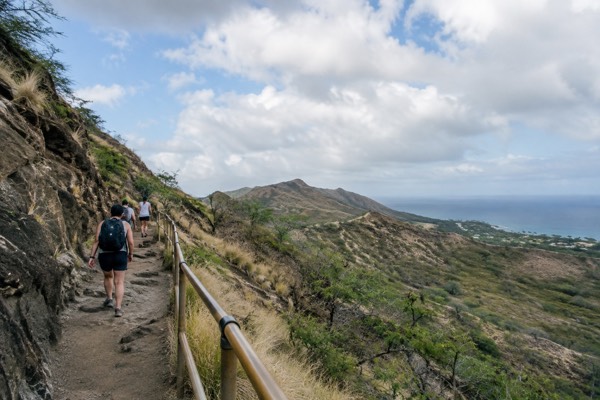
The first ten minutes are the easiest and the most misleading. A wide paved path runs gently up the crater floor toward the far wall, and people set off at strolling speed. The character changes at the first switchback section, where the pavement gives way to a steeper dirt-and-gravel climb with a railing in places. There is almost no shade on this stretch, and on a mid-morning start the crater walls radiate heat back onto the path. This is where most of the turning-around happens, and it is worth knowing before you start that the hard part is finite: the switchbacks end at a plateau with the first real view.
From there the route turns military. A concrete staircase leads up to a narrow tunnel, long enough to be genuinely dark in the middle, and then the famous 99-step spiral staircase inside the old fire-control structure. The stairs are steep but well built, with railings, and there are passing places. The final section is a short, exposed climb to the lookout platform at the top, where the payoff arrives all at once: Waikīkī laid out below, the Koʻolau range behind, and the coastline running away in both directions.
The descent deserves a word of caution. The stairs are the same stairs coming down, and tired legs on a spiral staircase with a queue behind you is where the monument's minor injuries happen. Take the tunnel slowly, and if you are prone to knees trouble, a walking pole is not out of place on a trail this developed.
If the reservation and the logistics sound like more admin than you want from a morning, the guided option linked above handles the ticket and the shuttle in one booking, which is the main reason it exists.
When Is The Best Time To Hike Diamond Head?
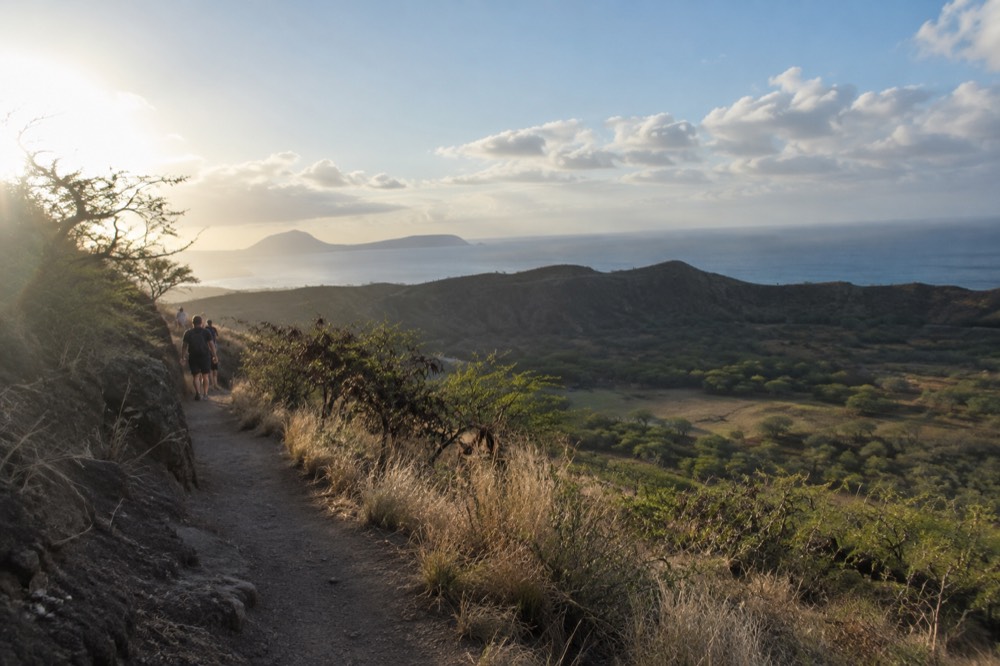
The best time is the first entry slot at 6 a.m., when the air is coolest, the crowds thinnest and the light best for photographs over Waikīkī. The next-best window is the last entry at 4:30 p.m., which puts you near the summit at sunset, though you must be out by the 6 p.m. gate lock.
Mid-morning to early afternoon is the worst combination: the hottest hours, the most people and the flattest light.
The heat argument is not a soft one. The crater's interior is a bowl with little shade, and the switchback section faces into the sun for most of the morning. Honolulu's leeward coast is the dry side of the island, the airport station records just 16.41 inches of rain a year, but that dryness cuts both ways on a exposed climb: clear skies mean full sun. Bring more water than feels reasonable for a short round trip, at least a litre per person, and drink before the stairs.
The light argument matters to photographers. The summit looks west over Waikīkī and Honolulu, so a morning arrival gives you the sun behind you and the city lit up ahead. Afternoon arrivals get the golden side of the skyline but risk haze, which builds through the day on the south shore. The trade-off with the late slot is the hard gate at 6 p.m.: the park locks, and the descent is not a place to rush.
A note on the seasons: Oʻahu's day length varies by only about 2 hours 35 minutes across the year, and sunset never gets later than about 7:17 p.m., so there is no long summer evening to rescue a late start. A 4:30 p.m. entry in December means summiting into a fading sky. Plan the late slot for the brighter months, and take the 6 a.m. slot the rest of the year.
How Do You Get To The Trailhead Without A Car?
The trailhead is inside the crater, reachable through a tunnel off Diamond Head Road, and the two practical car-free options are TheBus and a shuttle or tour transfer. TheBus routes serving the area stop on Diamond Head Road, a roughly 15-minute walk from the entrance. There is no Skyline station nearby, since the rail line does not reach Waikīkī or the island's eastern end.
The bus option is the cheap one. A single adult cash fare on TheBus is $3.25, but a HOLO card is better value for a day of sightseeing: rides cost $3.00 with two hours of unlimited transfers, and the daily cap is $7.50, after which the rest of the day's rides are free. Routes from Waikīkī toward Kapiʻolani Community College and Diamond Head run frequently through the morning, and the walk from the nearest stops to the monument entrance adds a modest, mostly flat stretch along Diamond Head Road. Check current route numbers on the transit agency's site before you travel, because numbering changes.
The shuttle and tour options solve a different problem: they arrive with your entry already booked. Several operators run morning pickups from Waikīkī hotels, and the guided product on this site includes the ticket, which means you are not coordinating a bus timetable against a reservation window you could not move. For a family or anyone travelling in the hottest months, that combination, transport plus a guaranteed early slot, is worth real money.
| Option | Best for | Watch out for |
|---|---|---|
| Walk or bike from Waikīkī | Budget travellers, early risers | Adds distance and heat before the trail |
| TheBus | Cheap, frequent | Stop is a walk from the entrance; check routes |
| Hotel shuttle or tour | Families, anyone without a booking | Costs more than the bus |
| Rental car | Combining with Hanauma Bay or the East Side | $10 parking fee, also needs a reservation |
Driving, for completeness: the parking fee is $10 per non-resident vehicle, it is booked with the entry reservation, and the lot inside the crater is small enough that late arrivals in peak season can find it full even with a valid ticket. If you drive, book the parking and the entry together, and arrive early.
What Should You Bring, And What Should You Leave Behind?
Bring at least a litre of water per person, sunscreen, a hat, shoes with grip and your reservation confirmation on your phone; the park checks reservations at the gate and the trail has no water fountains or shade structures. Leave behind drones, which are prohibited in Hawaii state parks without a written permit, and anything you would be upset to carry up the stairs in the heat.
The water point cannot be stressed enough. There is no drinking water on the trail and no shop inside the crater beyond the small concession near the entrance, which is not open for every slot. On a 6 a.m. start the heat is manageable with a single bottle; on a 10 a.m. start in August, a litre per person is a floor, not a suggestion. Electrolyte tablets weigh nothing and fix the most common cause of the dizzy spells people report on the stairs.
Footwear is the other honest one. The trail is paved or gravelled almost throughout, so running shoes are fine, but the descent on loose gravel punishes worn tread. Sandals with smooth soles are the footwear most likely to turn an easy hike into a slow one. A light layer is worth carrying for the tunnel, which stays cool, and for the summit, where the trade wind is constant and stronger than it looks from below.
On drones: state parks rules prohibit operating them without a written permit, and Diamond Head is a state park, inside controlled airspace near Honolulu, so the answer to "can I fly one at the summit" is no on two separate grounds. The same applies to the rock-stacking temptation sometimes seen on the crater walls: DLNR discourages it, it disturbs archaeological surfaces, and cairns mislead other hikers about the route. Take photographs, leave everything where it lies. That applies to the crater's rocks themselves; removing rock or sand from Hawaii's shoreline is prohibited by law, and the reasons are legal rather than folkloric.
Is The Diamond Head Hike Worth It?
For most first-time visitors, yes, and the reason is efficiency: no other Oʻahu trail packs a genuine summit panorama, military history and a manageable 90-minute round trip this close to Waikīkī for a $5 entry fee. The honest counter-argument is crowding; if you have hiked elsewhere on the island and dislike queues on stairs, the Koko Head or Mānoa Falls trails offer a quieter morning, each with a different character.
The case for it is straightforward. The view from the platform is one of the two or three defining images of Oʻahu, the trail is short enough to fit before breakfast, and the infrastructure, railings, stairs, a defined route, means it is one of the few island hikes that works equally well for a fit twenty-something and a cautious grandparent. The fee is trivial next to almost anything else in a Waikīkī day. If you visit once, this is a good use of the morning.
The case against is also honest. You will share the stairs. The tunnel and the spiral staircase bottleneck at peak hours, and the summit platform holds more people than the photographs suggest. Anyone who has already done a quieter Oʻahu trail may find the experience more commute than escape. The alternatives are real: the Koko Head railway trail is a harder, hotter climb with a fraction of the crowd, and Mānoa Falls trades the summit view for rainforest shade, a trade that looks better the hotter the morning. For a fuller picture of what else the island offers, the things to do in Oahu page is the site's master list.
For a different kind of morning entirely, Hanauma Bay sits a short drive down the coast and is the island's defining snorkelling spot, though its own reservation system, opening two days ahead at 7 a.m. HST, is even tighter than Diamond Head's. Pairing the two in one day is a classic Oʻahu move: the crater early, the bay after.
If hiking twice in one trip sounds appealing rather than punishing, the rainforest waterfall option above is the natural second walk: shaded, cool and entirely different country from the crater's dry bowl.
And if you would rather see the island's viewpoints from a seat than from a trail, the lookouts tour covers seven of them in a half day, which suits travellers whose knees have opinions about stairs.
Common Questions About The Diamond Head Hike
Most questions about the Diamond Head hike come down to three things: the reservation rule, the fee structure and the physical demands of the trail. Non-residents need a booked reservation with no gate sales, pay $5 per person plus $10 to park, and face a moderate climb with stairs but no scrambling. Everything else, timing, transport and what to pack, follows from those three facts.
How hard is the Diamond Head hike?
It is a moderate walk. The trail climbs about 170 metres over a short, steady distance, with paved sections, dirt switchbacks and two staircases, the longest a 99-step spiral. No section requires hands or scrambling. Most visitors in reasonable shape take 40 to 60 minutes to the summit, and the heat matters more than the gradient, so an early start does most of the work.
Do Hawaii residents need a reservation for Diamond Head?
No. Residents with a Hawaii driver's licence or state ID enter free without a reservation, and park free as well. The reservation and fee requirements apply to out-of-state and international visitors only, and have been in force since 12 May 2022.
Can you walk into Diamond Head without a reservation?
Not as a non-resident. There are no on-site sales for out-of-state visitors, so arriving without a booked entry means being turned away at the gate. Book through the official state reservation site, up to 30 days ahead, and bring the confirmation on your phone.
How long does the Diamond Head hike take?
Plan on 1.5 to 2 hours for the round trip at a comfortable pace, plus time at the summit. The park's last entry is 4:30 p.m. and the gates lock at 6 p.m., so a late-afternoon start leaves a firm ceiling on your time at the top.
Is Diamond Head suitable for children?
Generally yes for school-age children, since the trail is developed and railings run along the exposed sections. The staircases are steep and the spiral staircase bottlenecks in busy hours, so keep children close on the descent. Children 3 and under enter free; ages 4 and up pay the $5 entry fee.
What is the best time of day to hike Diamond Head?
The 6 a.m. first slot, for cooler air, thinner crowds and the best light over Waikīkī. The 4:30 p.m. last entry is the alternative for sunset views in the brighter months, but the 6 p.m. gate lock means the descent cannot be lingered over. Avoid mid-morning to early afternoon, which combines the day's worst heat with the day's biggest crowds.
Done early, booked properly and started before the sun gets high, the Diamond Head hike is one of the most reliable mornings on Oʻahu, and the view from the platform is the one most visitors take home.