Hanauma Bay Nature Preserve: Tickets, Timing And What A Visit Actually Involves
Hanauma Bay is the most-visited snorkeling site on Oʻahu, and it is also one of the most tightly managed. Here is exactly what a visit involves in 2026: the two-day reservation window, the $25 entry fee, the Monday and Tuesday closures, and whether the reef still justifies the planning.
Short answer
Hanauma Bay requires an online reservation made two days ahead at 7:00 a.m. HST, costs $25 per non-resident adult plus a service fee, and is closed Mondays and Tuesdays. Residents enter free with Hawaii ID and do not need a reservation.
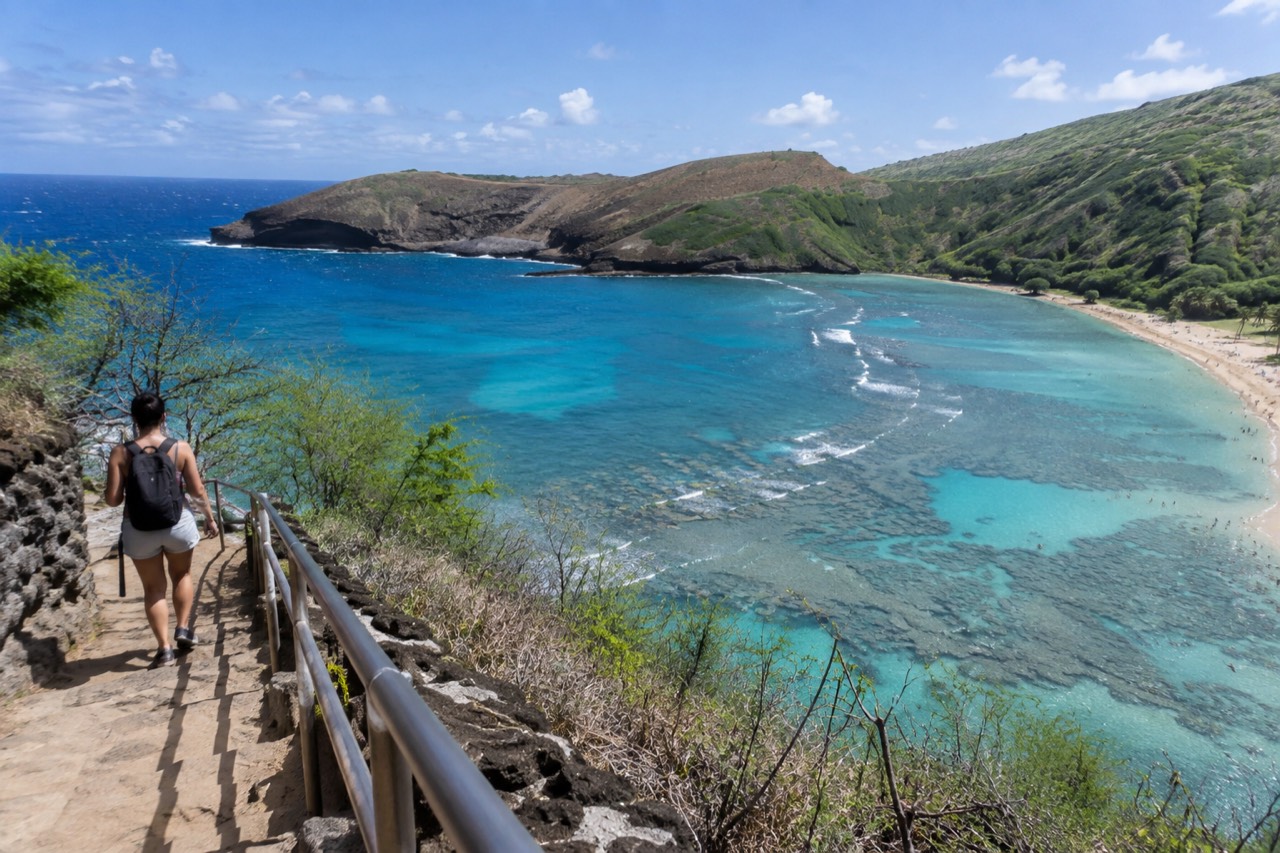
Hanauma Bay Nature Preserve sits inside a volcanic crater on Oʻahu's southeast coast, a curved bay of reef and sand that the state manages as a marine life conservation district rather than a beach. The distinction matters. Entry is capped, the bay closes two days a week, everyone must watch a safety video before going down to the water, and the whole visit runs on a reservation system that catches out a remarkable number of visitors who assumed they could just drive in.
This guide covers what a visit actually involves: the reservation window and how it works, what entry costs, when the bay is closed, what the snorkeling is really like, and how to get there without a car. The short version for anyone planning fast: non-residents need an online reservation, released two days ahead at 7:00 a.m. Hawaii time, entry is $25 per person plus a 2.35% online service fee, and the bay is closed every Monday and Tuesday. Hawaii residents enter free with state ID and do not need a reservation at all.
What Is Hanauma Bay Nature Preserve?
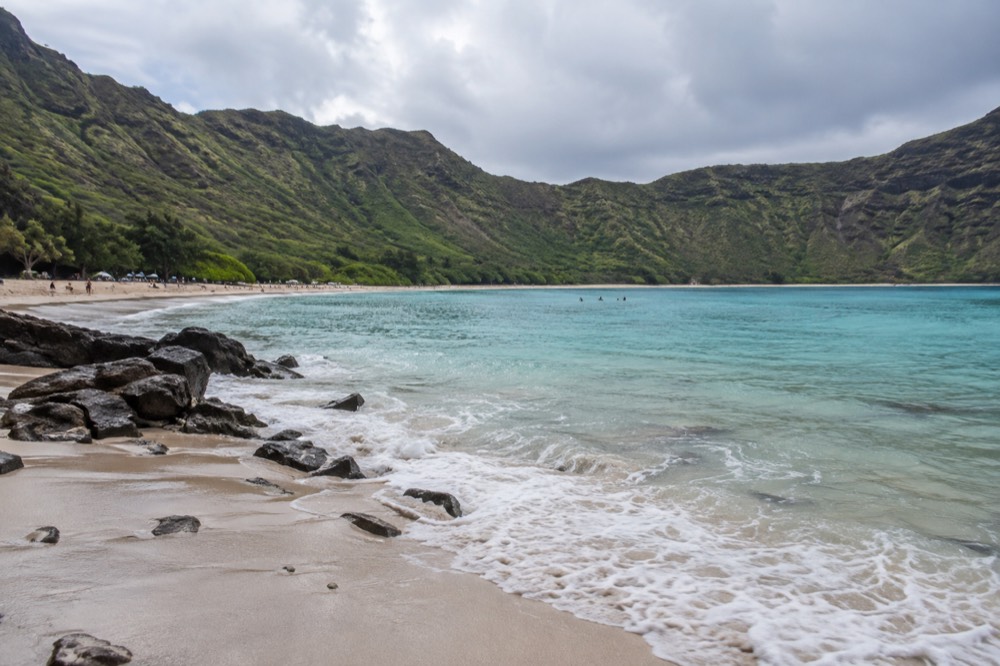
Hanauma Bay is a flooded volcanic crater on Oʻahu's southeast shore, managed by the City and County of Honolulu as a nature preserve and marine life conservation district rather than an ordinary beach park. The bay formed when a tuff cone's seaward wall collapsed and the ocean flooded in, leaving a sheltered reef inside a steep green bowl.
Because it is a conservation area, visitor numbers are capped, everyone watches a mandatory orientation video before entering the water, and the park closes two full days each week so the reef and the beach get a break from foot traffic. That management is the reason the bay still has living coral at all, given the pressure it carries.
The scale of that pressure is worth understanding. Oʻahu received 5,679,047 visitors by air in 2025 according to Hawaii DBEDT's preliminary figures, down about 2% on 2024, and Hanauma Bay absorbs a large share of them. Before the reservation system and the weekly closures, daily attendance ran high enough that the reef was visibly degrading. The current rules, including the two quiet days and the capped entry, are a direct response.
The bay is also a genuinely good place to learn to snorkel. The inner reef is shallow and calm on most mornings, fish are abundant close to shore, and the water clarity inside the bowl is usually better than the more exposed snorkeling spots around the island. For a wider picture of where else you can get in the water, see our best snorkeling spots on Oʻahu roundup.
How Much Does It Cost To Enter Hanauma Bay?
Non-resident adults pay $25 per person to enter Hanauma Bay, plus a 2.35% online service fee on the reservation, and children 12 and under enter free. Parking is separate and paid in cash at the lot: $3 for non-residents and $1 for Hawaii residents. Hawaii residents enter free with a current Hawaii driver's licence, state ID or Hawaii school student ID, and they do not need a reservation.
US military and dependents also enter free with military ID. There is no walk-up ticket option for non-residents; if you do not have a reservation, you do not get in.
Here is the full cost picture in one table, verified against the City and County's official Hanauma Bay page:
| Item | Non-resident | Hawaii resident / military |
|---|---|---|
| Entry per person | $25 + 2.35% online service fee | Free with HI ID or military ID |
| Children 12 and under | Free | Free |
| Parking per vehicle | $3, cash only | $1, cash only |
| Reservation required | Yes, online only | No |
The $25 is not a rip-off in context. It funds the preserve's operations, the mandatory orientation program and the reef monitoring that keeps the bay functioning as a conservation area rather than a bare beach. Still, for a family of four with two adults and two teenagers, entry plus parking plus the service fee adds up quickly, and that is before snorkel rentals. If you are watching costs across the whole trip, our Oʻahu on a budget guide lists genuinely free alternatives, including several good shore-snorkeling spots that need no ticket at all.
One warning worth its own paragraph: a persistent online claim says Hanauma Bay is closed for sewer or construction work until a date in 2026. The official City and County page carries no such notice. The only stated closures are Mondays, Tuesdays, Christmas Day and New Year's Day. Do not plan around a closure that does not exist, and do plan around the two that do.
How Does The Hanauma Bay Reservation System Work?
Reservations open exactly two days ahead at 7:00 a.m. HST, and the official phrasing is that on Monday at 7 a.m. you can begin reserving a time slot for Wednesday. There is no 48-hour rolling window, no week-ahead release and no three-day release; those figures circulate widely online and all of them are wrong.
You book online, you pay the entry fee and the 2.35% service fee at booking, and each reservation covers a specific time slot on a specific day. Hawaii residents skip all of this and walk in with ID.
The practical consequence is that you need to be awake, online and ready at 7:00 a.m. Hawaii time two days before your visit. For visitors from the US mainland that is early but survivable: 7 a.m. HST is 10 a.m. Pacific and 1 p.m. Eastern. Set an alarm. Time slots for popular mornings go fast, and the people who miss out are almost always the people who assumed they could book the night before.
| Your visit day | Reservation opens (7:00 a.m. HST) |
|---|---|
| Monday | Not possible, bay closed |
| Tuesday | Not possible, bay closed |
| Wednesday | Monday |
| Thursday | Tuesday |
| Friday | Wednesday |
| Saturday | Thursday |
| Sunday | Friday |
Because the two-day window is short, the reservation system punishes rigid plans. If your itinerary only allows one possible Hanauma Bay day and it happens to be a Monday or Tuesday, the bay simply is not an option that day. Build in a fallback. The other thing the system punishes is sleeping in: the early entry slots, 6:45 a.m. onward, are the ones with the best water clarity, the calmest wind and the fewest people on the sand.
If you would rather not run the 7 a.m. booking sprint at all, there is a guided alternative. The Hanauma Bay snorkeling tour from Waikīkī includes your entry and round-trip transport, which removes both the reservation scramble and the parking problem in one move, and it is the option we point most first-time visitors toward. Check availability
When Is Hanauma Bay Open, And When Should You Go?
Hanauma Bay is open Wednesday through Sunday, closed every Monday and Tuesday plus Christmas Day and New Year's Day, with entry permitted from 6:45 a.m. to 1:30 p.m. and everyone out of the park by 4:00 p.m. The last-entry cutoff is the detail people miss: this is not a beach you can arrive at in mid-afternoon. If you show up at 2 p.m. you will be standing at the top of the crater looking at a closed gate. Go in the morning, both because the law of the entry window forces you to and because the snorkeling is better then anyway.
Mornings at Hanauma Bay give you three compounding advantages. The wind is typically lighter before midday, which keeps the surface calm and the visibility high. The sun is lower behind you rather than overhead glare. And the crowd builds through the day, so the earliest slots put you in the water with the fewest other fins. The 6:45 a.m. slots are the prize, and they are also the ones that sell out first when the reservation window opens.
| Time | What happens |
|---|---|
| 6:45 a.m. | First entry slots; calmest water, best clarity |
| 1:30 p.m. | Last entry permitted |
| 4:00 p.m. | All visitors must be out of the park |
| Monday, Tuesday | Closed entirely |
| Dec 25, Jan 1 | Closed entirely |
Season matters less than you might think. Water temperature at Honolulu Harbor, the nearest long-term NOAA station, ranges from a mean of 78.0°F in February to 82.7°F in August, so the bay is swimmable year-round; note those are harbor readings and run warm against open water off the reef. What actually changes through the year is surf and rain. The bay's position inside the crater shields it from most of it, but heavy rain in the Koʻolau range muddies the water a day or two later, and the south shore sees its largest surf in summer while the north shore peaks in winter. Our best time to visit Oʻahu guide unpacks the seasonal trade-offs in detail.
Is The Snorkeling At Hanauma Bay Actually Worth It?
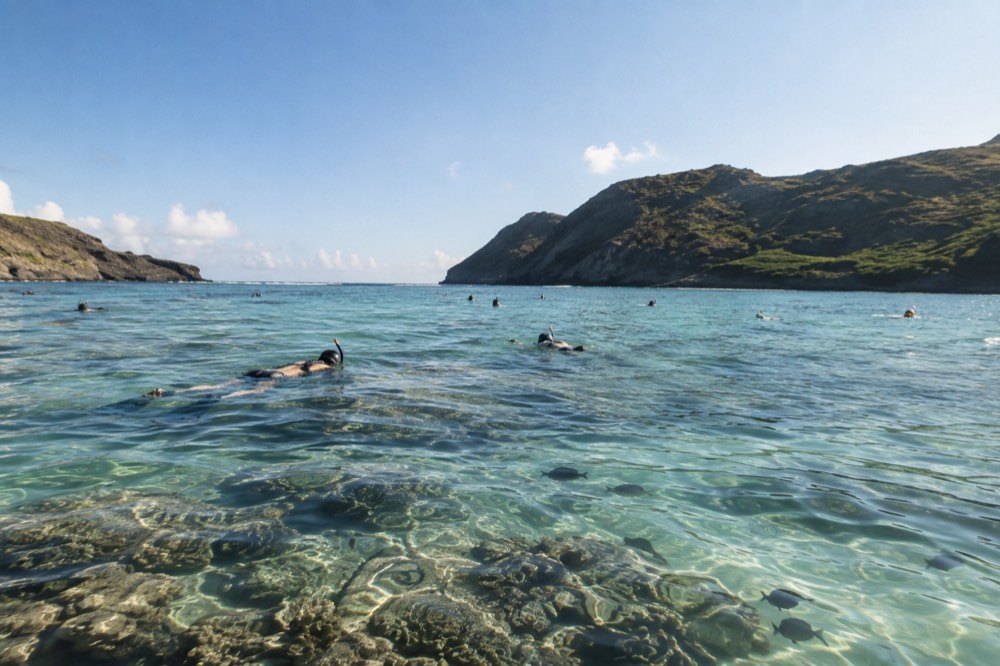
For first-time snorkelers and anyone who wants guaranteed fish in calm, shallow water, Hanauma Bay remains one of the best experiences on Oʻahu, and the reef inside the bowl still supports abundant reef fish close to shore. The honest qualification is that the inner reef, the part most visitors never leave, is also the part that has carried decades of foot traffic, and veteran snorkelers will find the outer reef areas noticeably better than the crowded shallows.
If you swim out toward the reef's far side, past where most of the crowd turns back, the coral improves, the fish schools thicken and the experience changes character entirely.
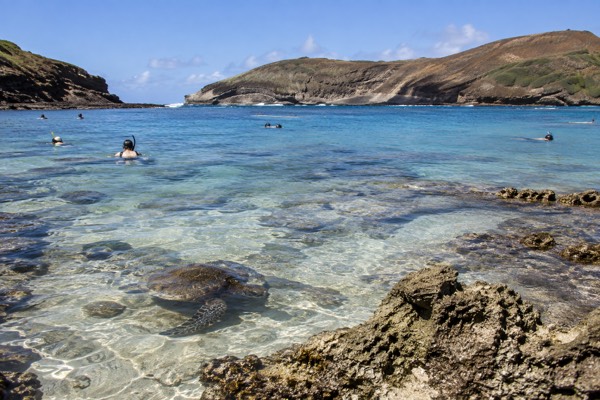
What you will see depends partly on where in the bay you are. The shallows hold schools of convict tangs, yellow tangs and triggerfish in numbers that genuinely delight children and nervous first-timers. Deeper areas add wrasse, butterflyfish and the occasional reef shark resting under ledges. Green sea turtles, honu, appear in the bay as well; if you see one, keep the recommended 10-foot distance, and understand that approach distances for turtles and monk seals are guidelines backed by law against harassment rather than a statutory distance in themselves. Never touch, chase or stand on coral, and never stand up in shallow reef areas; fins down, float, and let the water hold you.
The mandatory orientation video covers reef etiquette, safety and the preserve's rules, and it is not optional. After watching it you walk down to the beach, or ride the shuttle down the crater road if the climb back up in the midday heat does not appeal. That climb is real: the road from the beach back to the entrance is a sustained grade, and the tram exists for a reason. Budget your energy, especially with kids.
For visitors who want a strong wildlife experience without the reservation complexity, there are two other options on the island worth weighing. The Waikīkī Turtle Canyon snorkel runs from the beach with a turtle guarantee and no entry-cap system to fight, which makes it the easier half-day for many travelers.
What Should You Bring To Hanauma Bay, And What Should You Leave Behind?
Bring reef-safe sunscreen applied before you arrive, cash for parking, your reservation confirmation, and snorkel gear either rented on site or brought with you; leave behind anything you cannot carry down the crater road and back up again. Hawaii law requires reef-safe sunscreen, and the preserve enforces the spirit of it as much as the letter, because sunscreen residue is one of the measurable stresses on a reef carrying this many swimmers.
Apply it before you get to the gate, and bring more water than you think you need: the walk back up from the beach in the middle of the day is hot, exposed and longer than it looks from the top.
| Bring | Why | Leave behind |
|---|---|---|
| Reservation confirmation | Entry is checked against the list | Drones, prohibited in the park |
| Cash for parking | The lot does not take cards | Glass containers |
| Reef-safe sunscreen | Required by Hawaii law | Ordinary sunscreen, banned for sale in the state |
| Water and snacks | The climb out is hot | Fins you cannot walk in comfortably |
| Towel and dry bag | Limited shade on the beach | Expectations of a quiet, empty beach |
A few practical notes on gear. Snorkel sets are available to rent at the preserve, which saves you carrying equipment across the island, though quality varies and the queues form early. If you already own a mask that fits, bring it; a leaking rental mask ruins a snorkeling session faster than anything else. Prescription-mask wearers should check rental availability in advance or bring their own. And if your swimming confidence is low, the bay's shallow inner area is genuinely the best classroom on the island, but consider a lesson first: a beginner surf lesson in Waikīkī builds the ocean comfort that makes Hanauma Bay far more fun.
One more thing to leave behind: any plan to take sand or coral home. Removing sand, dead coral, coral rubble or rock from the shoreline is prohibited under Hawaii law, specifically HRS §205A-44. The reason is legal, not folklore, and it applies to every beach on the island, not just this one.
How Do You Get To Hanauma Bay Without A Car?
Driving yourself means parking in the preserve's lot for $3 cash as a non-resident, but the lot fills on busy mornings, and the alternative is TheBus route 23 from Waikīkī, which stops within walking distance of the entrance. The bus is the budget answer and it removes the parking scramble entirely, at the cost of a longer journey and carrying your gear on board. A single adult cash fare on TheBus is $3.25, and a HOLO card caps your total daily spend at $7.50 across TheBus and the Skyline rail combined, which makes a multi-stop day affordable. Note there is no Skyline station in Waikīkī; the rail does not reach the neighborhood, so the bus is the practical transit option from there.
Rideshare and taxis work too, with the usual caveat that the crater road's parking area gets congested mid-morning and drivers sometimes drop at the top gate regardless. If you take a guided tour, transport is handled for you, which is a large part of why the tour option suits visitors who would rather not think about any of this. Our do you need a car on Oʻahu guide covers the island-wide picture, including when a rental genuinely pays off and when transit does the job.
Whichever way you arrive, aim to be at the gate for your slot time, not after it. Late arrivals can forfeit the slot, and the entry window's hard 1:30 p.m. cutoff leaves no slack for a slow morning. The whole visit rewards early risers: better water, easier parking, cooler climb out.
Common Questions About Hanauma Bay Nature Preserve
Most questions about Hanauma Bay come down to three things: the two-day reservation window that opens at 7:00 a.m. HST, the Monday and Tuesday closures that remove two days from every visiting week, and the $25 non-resident fee that is paid online at booking rather than at the gate. Get those three right and the visit runs smoothly, because the preserve itself is well organized once you are inside the entrance.
The questions below cover the details visitors ask most often, with answers drawn from the official City and County page.
Do you need a reservation for Hanauma Bay?
Yes, if you are not a Hawaii resident. Non-residents must book online, with slots released two days ahead at 7:00 a.m. HST. Hawaii residents enter free with a current Hawaii driver's licence, state ID or Hawaii school student ID, and do not need a reservation.
How much does it cost to get into Hanauma Bay?
Entry is $25 per non-resident plus a 2.35% online service fee, with children 12 and under free. Parking is $3 per non-resident vehicle, cash only, or $1 for residents. US military and dependents enter free with military ID.
What days is Hanauma Bay closed?
Every Monday and Tuesday, plus Christmas Day and New Year's Day. There is no construction closure; the only closures stated on the official page are these. Plan your week around them.
What time does Hanauma Bay open and close?
Entry is permitted from 6:45 a.m. to 1:30 p.m., and all visitors must be out of the park by 4:00 p.m. The earliest slots have the calmest water and the smallest crowds, and they sell out first.
Can you swim with turtles at Hanauma Bay?
Green sea turtles do appear in the bay, though the turtle-guaranteed experiences on the island are the boat snorkels, notably the Waikīkī Turtle Canyon tour. Keep the recommended 10-foot distance from any honu you see, never touch or chase one, and remember harassment of protected species is illegal regardless of the guideline distance.
Is Hanauma Bay worth it in 2026?
For first-time snorkelers, families and anyone who wants calm, shallow water with abundant fish, yes, and the management system is the reason the reef is still worth seeing. Experienced snorkelers should swim out past the crowded inner shallows to the outer reef, where the coral and fish improve markedly.
Hanauma Bay rewards the visitors who take its rules seriously, and it does not reward the ones who treat it as a drop-in beach. Book two days out at 7 a.m., go early, respect the closed days, and swim past the crowd to where the reef actually lives. For everything else on the island, start with our full Oahu Travel Guide and the things to do in Oahu roundup, which place the bay in the context of a whole trip.