Best Snorkeling Spots On Oahu: Where To Actually Get In The Water
Oahu's best snorkeling is not one beach but a handful of very different ones, and the right choice depends on the season, the swell and whether you can get a reservation. Here is what the official sources actually say.
Short answer
Hanauma Bay is Oahu's best-known snorkeling spot and needs a reservation two days ahead at 7 a.m. HST; Sharks Cove and the North Shore are summer-only; Turtle Canyon off Waikiki is the most reliable place to see green sea turtles; and the windward beaches at Kailua and Waimanalo are the easiest all-round options.
Oahu took 5,679,047 visitors by air in 2025, and a large share of them packed a mask and fins. Most of them went to exactly one reef. That concentration is the single biggest problem with snorkeling on this island: the famous spot is under pressure, the quiet spots are quiet for a reason, and the difference between a great swim and a disappointing one is usually timing rather than location.
This guide is built from official sources: the City and County's Hanauma Bay page, the DLNR state parks notices, NOAA's wildlife guidance and the National Weather Service surf forecasts. The Oahu Travel Guide approach is that a snorkeling recommendation is only as good as the day you can actually swim it, so each spot below comes with the conditions that make it work.
What Are The Best Snorkeling Spots On Oahu?
The best snorkeling spots on Oahu are Hanauma Bay on the south shore, Sharks Cove and Three Tables on the North Shore in summer, Turtle Canyon just off Waikiki, and the reef-protected waters at Kailua and Waimanalo on the windward side. Hanauma Bay has the most fish per square metre but requires a reservation, the North Shore is only safe from roughly May through September, and the windward beaches trade coral quality for dependable calm water.
That ranking hides the real decision, which is seasonal. Oahu's shores run out of phase with each other: the north-facing coast takes its biggest surf in winter, while the south shore peaks in summer, and the National Weather Service publishes a daily Oahu surf table split exactly along those four aspects. On a September day in 2026 the south shore was running four to six feet while the north shore sat at one to three, the complete inversion of the January pattern. A snorkeling guide that does not tell you which shore to pick in which month is not a guide, it is a list.
The other honest caveat is that Oahu is not the Big Island. The water is warm and the fish are plentiful, but live coral cover is thinner here than at the Big Island's signature sites, and several of the best Oahu experiences, like swimming at Turtle Canyon, are about the animals rather than the reef. Set expectations accordingly and the island delivers very well.
| Spot | Shore | Best season | Access | Best for |
|---|---|---|---|---|
| Hanauma Bay | South | Year-round, closed Mon and Tue | Reservation required, $25 entry | Reef fish, first-timers |
| Turtle Canyon | South, off Waikiki | Year-round | Boat or catamaran from the beach | Green sea turtles |
| Sharks Cove | North | Summer only | Free, beach park | Rock formations, intermediate swimmers |
| Three Tables | North | Summer only | Free, roadside | Shallow reef shelves |
| Kailua and Lanikai | Windward | Year-round with trade-wind caution | Beach park at Kailua | Easy, family swimming |
| Waimanalo Bay | Windward | Year-round | Beach park | Long sandy entry, quiet |
| Ko Olina lagoons | West | Year-round | Limited public parking | Small children, zero waves |
Is Hanauma Bay Worth It, And How Do You Actually Get In?
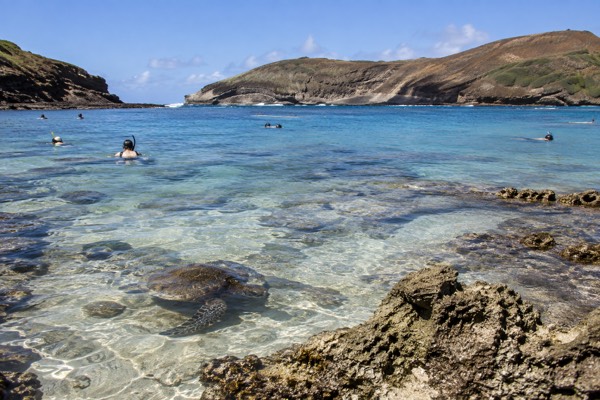
Hanauma Bay is Oahu's most famous snorkeling spot and remains worth visiting, but the barrier is logistics rather than price: it closes every Monday and Tuesday, entry is capped, and reservations open exactly two days ahead at 7:00 a.m. HST on the City's booking site. Non-resident entry costs $25 plus a 2.35% online service fee, children 12 and under are free, and Hawaii residents enter free with a local ID and no reservation at all.
The reservation window is the part that trips people up. The official phrasing is that on Monday at 7 a.m. you can begin reserving a time slot for Wednesday, which means you cannot book a week out or a month out. If your trip is short, set an alarm for 7 a.m. two days before you want to swim. Entry is allowed from 6:45 a.m. and the last entry is 1:30 p.m., with everyone out of the bay by 4 p.m. Arriving early matters for a second reason: the water is at its clearest before the day's swimmers stir things up.
The bay is a Nature Preserve, not a swim park, and the rules reflect that. First-time visitors watch a short orientation video about reef protection before going down to the sand, standing on the coral is prohibited, and the reef is genuinely the point. The bay sits inside a volcanic crater breached by the ocean, the inner reef is sheltered and shallow, and fish density is the highest of any shore site on the island. Our full Hanauma Bay Nature Preserve guide covers the snorkel zones, the tram down the hill and what the closed days mean for an itinerary.
One planning note that most coverage gets wrong: there is no construction closure at the bay. The official City page lists only Mondays, Tuesdays, Christmas and New Year's Day as closures, and any claim of a months-long shutdown circulating online is stale. Check the official page the week you travel, but do not let a rumour push you off the island's best reef.
Which North Shore Spots Are Safe For Snorkeling?
Sharks Cove and Three Tables, side by side in Pupukea, are the North Shore's snorkeling sites, and both are summer-only: safe roughly May through September, genuinely dangerous in winter when the same beaches that host big-wave surfing pump heavy surf onto the rocks. Entry is free, parking is at the beach park, and the cove is a rocky basin best for confident swimmers rather than small children.
The seasonal warning deserves its own sentence. Winter surf on the north-facing coast is the reason the North Shore is famous, and that surf does not negotiate with snorkelers. The National Weather Service surf forecast is the authoritative check: if the north-facing row reads above about four feet, swim somewhere else that day, even in June, because the numbers move fast. In summer the cove becomes a clear, boulder-framed aquarium with tide pools at the south end that work for kids who cannot yet swim.
Nearby, Sharks Cove sits a short walk from Waimea Bay and Foodland Pupukea, which makes it easy to fold into a North Shore day. Down the coast, Laniakea Beach is the turtle-watching stop rather than a snorkeling stop; the parking arrangement there has been changing with an ongoing highway project, so treat it as a look-don't-swim stop unless you have checked the current setup. Our North Shore day trip from Waikiki guide sequences all three.
A note on Kaʻena Point, which sometimes appears on snorkeling lists: it is currently closed. The DLNR notice dated 9 September 2026 closed Kaʻena Point State Park's Mokuleʻia and Keawaʻula sections until further notice for hurricane repairs, along with Nuʻuanu Pali State Wayside and Wahiawā Freshwater. Do not plan a swim there without rechecking the DLNR notices, and in any case the point is a place to walk and watch, not a place to snorkel.
Where Can You Snorkel With Turtles On Oahu?
The most reliable place to see green sea turtles while snorkeling is Turtle Canyon, a cleaning station a short boat ride off Waikiki, where turtles gather to have their shells cleaned by reef fish. From shore, turtles are seen at Laniakea, at the reefs near Kailua and at Waimanalo, but shore sightings are luck while the canyon is close to a sure thing. Keep 10 feet away from any honu and never touch, chase or feed one.
That 10-foot figure is a guideline rather than a statutory distance, and this site is careful about the difference. What is unambiguously illegal is take and harassment: green sea turtles are protected under the Endangered Species Act and Hawaii law, and touching one is not a grey area. The practical version for a snorkeler is simple: if the turtle swims toward you, hold still and let it pass; if it swims away, do not follow.
The boat option is the one we point most visitors at, because it compresses the best of Oahu's in-water wildlife into two hours without needing a car. The Waikiki Turtle Canyon guided snorkel runs from the beach with a turtle guarantee, and it is the related tour for this guide.
If the guarantee is what sells it to you, the booking itself is simple: the operator's live listing shows current departure times from Waikiki, and the two-hour window leaves the rest of the day free for the beach.
Ready to swim with turtles off Waikiki? Book a guided snorkel tour here.
For a from-shore alternative, Waimanalo Bay Beach Park on the windward coast regularly produces turtle sightings along its reef edges, and the long sandy entry makes it a comfortable swim even for cautious snorkelers. The trade-off is water clarity: after rain, the windward side's streams stain the nearshore water brown, and the same valley rainfall that keeps it green empties into the bays. Check the water visually before you commit.
What About Kailua, Lanikai And The Windward Beaches?
Kailua Beach Park and Lanikai on the windward side are the easiest snorkeling beaches on Oahu for families: sandy entries, protective reef shelves and dependable calm in the mornings. The catch is infrastructure, not surf: Lanikai has no public parking lot at all, with no-parking zones on its main residential streets and towing enforcement, so the practical plan is to park at Kailua Beach Park and walk or bike the last stretch.
Kailua's water is not Hanauma's water. The reef is patchier and the fish counts are lower, but the swimming is gentler, the sand is superb, and the Mokulua islands sit offshore as a constant backdrop. Kayakers head for those islands; snorkelers do better staying near the protective rocks at either end of the beach. Our Kailua guide covers the parking reality and the beach-park facilities, and the Lanikai Beach guide goes deeper on why the no-parking rule is enforced so firmly: it is a residential street carrying enormous visitor pressure, and the city's transportation plan is designed to keep it livable.
One legal wrinkle worth knowing: a City and County ordinance prohibits commercial tour activity and recreational stops by commercial operators at Kailua Beach Park and Kalama Beach Park. If a tour product promises a beach stop at Lanikai, read the fine print, because the ordinance shapes what operators can legally sell in this area.
Waimanalo, further south on the same coast, is the quieter sibling: a long crescent with a beach park, restrooms and usually a fraction of Kailua's crowd. The snorkeling is modest but the swimming is easy, and it is the windward choice when the trade winds have picked up and Kailua's afternoon chop has ruined the visibility.
When Is The Best Time Of Year To Snorkel On Oahu?
Any month works somewhere on Oahu, because the shores' surf seasons run in opposite directions: north-facing coasts are calm in summer and dangerous in winter, south-facing coasts the reverse. Water temperature barely matters, ranging from about 78.0 to 82.7 degrees Fahrenheit across the year at Honolulu Harbor, so the real planning variables are the surf forecast, the trade winds and Hanauma Bay's closed days rather than the calendar.
That temperature range comes with a caveat we carry everywhere on this site: the readings are from NOAA's Honolulu Harbor station, which runs warm against open ocean off Waikīkī. Treat the table as a fair annual picture, not a precise forecast for the water you will actually float in. No wetsuit is needed at any time of year; most people snorkel in a rash guard for sun protection more than warmth.
| Month | Mean water temp (Honolulu Harbor) | Month | Mean water temp |
|---|---|---|---|
| January | 78.2°F | July | 81.3°F |
| February | 78.0°F | August | 82.7°F |
| March | 78.2°F | September | 82.4°F |
| April | 79.3°F | October | 82.5°F |
| May | 79.7°F | November | 81.2°F |
| June | 80.6°F | December | 80.4°F |
The wind matters more than the warmth. Trade winds blow strongest through the middle of the day and they are the reason locals snorkel early: by afternoon the windward and east-facing beaches are chopped up and the visibility drops. The south shore, Waikiki included, is more wind-tolerant, which is one more quiet argument for basing a short trip there.
Rain is the other variable, and it is wildly uneven across the island. The official climate normals put Honolulu airport at 16.41 inches of rain a year, while the Lyon Arboretum station in Mānoa, five miles from Waikīkī, records 150.96 inches, and every single month there is wetter than the airport's wettest. What that means for a snorkeler is that a rainy day in town says nothing about the North Shore, and runoff after heavy rain is the main thing that ruins water clarity in the bays.
What Gear Do You Need, And What Are The Wildlife Rules?
You need a mask, snorkel and fins, and everything else is optional: a rash guard for sun, reef-safe sunscreen by law in Hawaii, and water shoes for the rocky North Shore entries. The wildlife rules are specific: keep 100 yards from humpback whales and 50 yards from spinner dolphins, both federal law, stay 10 feet from green turtles and 50 feet from Hawaiian monk seals, which are recommended distances, and never touch, feed or chase anything that swims.
Hawaii's sunscreen law is worth taking seriously, because oxybenzone and octinoxate products cannot legally be sold on the islands and they damage the coral you came to see. Buy reef-safe before you arrive or at any island shop, and reapply as directed; a rash guard does more for you than a third coat of lotion anyway.
The distance rules have a legal structure that matters, and sloppy guides flatten it. Whales and spinner dolphins carry federal approach distances with the force of regulation behind them. Monk seals and honu distances are guidance, but the underlying prohibition on take and harassment is law, and monk seals are among the most endangered mammals on earth. If a seal hauls out on the beach where you planned to enter the water, swim somewhere else and count yourself lucky to have seen one.
| Animal | Distance | Law or guideline | Notes for snorkelers |
|---|---|---|---|
| Humpback whale | 100 yards | Law (50 CFR 224.103) | Season runs November through April |
| Hawaiian spinner dolphin | 50 yards | Law (2021 federal rule) | Swimming with or approaching them is prohibited |
| Hawaiian monk seal | 50 ft (150 ft for mother and pup) | Guideline; harassment itself is illegal | Never block a hauled-out seal's path to the water |
| Green sea turtle (honu) | 10 ft | Guideline; protected under ESA and Hawaii law | Let turtles approach you, never the reverse |
| Reef and coral | Do not stand on or touch | Rule at Hanauma Bay; damage is the issue | Only rest on sand, never on coral |
If you want to go deeper than a snorkel allows, Oahu has a well-established option for that. A beginner scuba experience runs about ninety minutes with instruction and gear included, needs no certification, and is one of the most-reviewed water products on the island.
Should You Book A Tour Or Snorkel From Shore?
Book a tour if your trip is short, your swimming is weak or turtles are the priority, because a boat puts you over the best site in an hour with gear included and a crew watching the conditions. Snorkel from shore if you have a car, a full day and confidence in the water, because Hanauma Bay and the North Shore cost little to enter. Most first-time visitors do one of each.
The tour case is strongest for Hanauma Bay specifically, because the reservation system is the bottleneck. A shuttle-and-entry product handles the booking window, the transport and the timing, which matters when you have three days on the island and cannot afford to lose a 7 a.m. alarm. The trade-off is control: you swim on the operator's schedule, not yours.
From shore, the plan is straightforward. Pick your shore by season, check the National Weather Service surf forecast the morning of, enter the water before the trade winds build, and never snorkel alone. Our Oahu ocean safety guide covers the hazards that matter here, including box jellyfish arrival dates, and the best snorkeling spots overview goes site by site in more depth than this page.
For fitting snorkeling into a wider trip, the circle-island tours below are the efficient way to see the North Shore, the windward coast and the lookouts in one day, leaving your other days free for the water.
Common Questions About Snorkeling On Oahu
Most questions about snorkeling on Oahu come down to four things: which shore is calm this month, whether Hanauma Bay's reservation system will let you in, how close you may legally get to the animals, and whether the North Shore is safe on the day. Get those right and almost any beach on the island will show you fish; get the season wrong and even the famous spots will show you churned water instead.
Where is the best snorkeling on Oahu?
Hanauma Bay for reef fish, Sharks Cove in summer for rock formations, Turtle Canyon off Waikiki for turtles, and Kailua or Waimanalo for easy family swimming. The best one on any given day is whichever faces away from the current swell.
Do you need a reservation to snorkel at Hanauma Bay?
Yes, unless you are a Hawaii resident with a local ID. Reservations open two days ahead at 7:00 a.m. HST, entry costs $25 for non-residents plus a small online service fee, and the bay closes Mondays and Tuesdays.
Can you snorkel the North Shore in winter?
Not safely in most conditions. The north-facing coast takes its largest surf from roughly October through March, and Sharks Cove and Three Tables are rock-basin sites where even moderate surf becomes dangerous. Save them for summer and check the daily NWS surf forecast.
How close can you get to turtles while snorkeling?
Stay about 10 feet away, which is the recommended distance, and never touch, chase or feed a turtle. Turtles sometimes approach snorkelers at Turtle Canyon; hold still and enjoy it, and let them leave when they choose.
Is snorkeling on Oahu safe for beginners?
Yes, at the right spots: Hanauma Bay's inner reef, Kailua and the Ko Olina lagoons are all gentle entries with sheltered water. Take the usual precautions, check the surf forecast, snorkel with a buddy and read the ocean safety guidance before your first swim.
Do you need to book a snorkel tour on Oahu?
No, but tours solve real problems: the Hanauma Bay reservation bottleneck, transport from Waikiki, gear and turtle reliability. If you have a car and a full day, shore snorkeling is cheap and rewarding; if you have two or three days total, one tour is usually worth it.
Snorkeling is one of the best free-adjacent experiences on an island that can otherwise drain a budget fast, and it pairs naturally with the beach days in our things to do in Oahu planning page. Pick your shore by the season, get in the water early, give the animals their space, and Oahu's reefs will do the rest.