Oahu Vacation Cost Breakdown: What A Trip Really Costs In 2026
Oahu is the most visited island in Hawaii, and it is also the one where a budget can quietly double if you do not know where the fees sit. This breakdown pulls the real numbers: the tax that rose in January 2026, the entry fees at the major sites, the transit fares, and what the island's most-booked tours actually sell for.
Short answer
Accommodation is the largest line in an Oahu vacation budget and taxes add a fixed percentage to every night, with the Transient Accommodations Tax rising to 11% on hotel stays in 2026. Park entry is mostly cheap or free, but reservation systems, not price, are the real planning constraint.
Oahu welcomed 5,679,047 visitors by air in 2025, down about two percent on the year before, and every one of those visitors met the same wall of small numbers: a hotel tax here, a reservation fee there, a parking charge that quietly exceeds the entry fee it serves. The island is not uniformly expensive. It is unevenly expensive, and the difference between a lean trip and a costly one is mostly knowledge of which sites are free, which are cheap, and which will cost you more in logistics than in dollars.
This page is the breakdown. It uses only verified figures: the state tax documents, the official park and transit pages, and live operator listings. Where a number is not confirmed, we say so rather than guess, because the single most repeated error in current Hawaii coverage is a tax that gets described as something it is not.
What Does An Oahu Vacation Cost Overall?
Accommodation is the biggest line in any Oahu budget, and taxes add a fixed percentage to every night you book, with the state Transient Accommodations Tax rising from 10.25% to 11.00% on 1 January 2026. Entry fees at the major sites are mostly modest and several are free. The real constraint on Oahu is reservation systems rather than ticket prices, so plan around booking windows more than around prices.
Two structural facts shape every Oahu budget. First, the island concentrates its visitors: Oahu took roughly 59.8% of all statewide air arrivals in 2025, which is why the busy sites are genuinely busy and why advance booking has real value. Second, most Oahu visitors do not island-hop. In July 2026, of 499,197 visitors to the island, 387,063 saw only Oahu, so a typical budget does not need to carry interisland airfare.
The daily shape of a budget is a planning exercise, not a fixed number. A traveler sleeping in a Waikiki hostel, eating from plate lunch spots and grocery stores, and hiking free trails can hold costs far below a traveler who books a luau, a helicopter and a catamaran in the same week. The sections below itemize where the money goes so you can pick your own position on that range.
For a broader planning frame, our cost of a trip to Oahu guide covers trip-level totals, and the Oahu Travel Guide homepage carries the current surf, weather and reservation picture.
How Much Do Hotels And Taxes On Oahu Really Cost?
The state Transient Accommodations Tax is 11.00% as of 1 January 2026, up from 10.25%, and it applies to the gross rental on hotel rooms, vacation rentals and timeshare units alike. There is no separate "green fee" collected at the airport or on arrival. Act 96 is a tax increase on accommodations, and Oahu levies a county surcharge and general excise tax on top, so budget the tax line rather than discovering it at checkout.
The green fee confusion is worth two more sentences because it is the most common bad number in Hawaii coverage right now. Act 96, passed in 2025, raised the existing TAT by 0.75 percentage points and extended the same tax to cruise ship operators' gross fares. A federal court declined to block it in December 2025, and it took full effect on 1 January 2026. If you read that Hawaii now charges a standalone tourist entry fee at the airport, that is wrong.
The state TAT of 11% is solid, sourced from the Department of Taxation's own announcement. Ask the property, or read the taxes-and-fees line on the booking, before you assume.
On the room rate itself, it varies enormously by season and neighborhood. What we can say from the visitor data is when the pressure is highest: January 2026 was the island's biggest month so far at 527,241 visitors, while February was the softest at 436,756. Shoulder months are where the same room costs less.
What Do Oahu Attractions And Entry Fees Cost?
The headline sites split into three tiers: Pearl Harbor's USS Arizona Memorial program is free with a $1 per-ticket reservation fee, Diamond Head charges non-residents $5 per person plus $10 to park, and Hanauma Bay charges $25 entry with children 12 and under free. Hawaii residents enter most state and city sites free with ID, and the Pearl Harbor visitor center itself costs nothing. The catch at every reserved site is the booking window.
Here is the verified entry-fee picture at the sites most visitors actually go to:
| Site | Non-resident entry | Residents | The catch |
|---|---|---|---|
| Pearl Harbor National Memorial / USS Arizona program | Free; $1 per-ticket fee on recreation.gov | Same | Bags prohibited; paid storage exists, price unstated |
| Diamond Head State Monument (Lēʻahi) | $5 per person, card only | Free with Hawaii ID | Reservation required for non-residents since May 2022, up to 30 days ahead |
| Diamond Head parking | $10 per vehicle | Free with ID | Booked with the entry reservation, not separately |
| Hanauma Bay Nature Preserve | $25 plus 2.35% online service fee | Free, no reservation, with HI ID | Closed Mondays and Tuesdays; reservations open 2 days ahead at 7 a.m. HST |
| Waimea Valley | $26 adult, $18 child 4-12 | $10 adult kamaʻāina/military | Closed Mondays |
| Mānoa Falls trail | Free | Free | Parking is a private lot; fee unverified |
Three notes that save real money. The Pearl Harbor visitor center, museums and grounds are free; only the boat program to the memorial uses the reservation system, and it is a war grave, so treat the visit accordingly. Hanauma Bay's $1 resident parking and $3 non-resident parking are cash only, a detail that catches people every morning. And the Diamond Head reservation rule has been in force since 12 May 2022; a large share of competing guides predates it and will tell you to just turn up, which no longer works for out-of-state visitors.
If you would rather not manage individual reservations at all, the guided Diamond Head option bundles the ticket and the shuttle, so the reservation logistics are handled for you before you land.
That solves the one site where a reservation is genuinely mandatory. The bigger question for a multi-activity trip is whether to keep buying individual tickets at all, because the pass product covers a large block of paid sites in one purchase and turns an open-ended activity spend into a number you know in advance.
How Much Does Getting Around Oahu Cost?
Public transit on Oahu is unusually cheap for an American tourist destination: $3.25 for a single cash bus ride, but a HOLO card caps your spending at $7.50 per day no matter how many rides you take, and a monthly cap sits at $90. TheBus and the Skyline rail system share the same fare structure and the same card.
The gap to watch is that Skyline has no Waikiki station, so you transfer to a bus for the last leg.
The full verified fare table from the City and County:
| Fare product | Price | Notes |
|---|---|---|
| Adult cash single ride (TheBus) | $3.25 | No transfers, exact fare |
| HOLO 2-Hour Pass | $3.00 | Unlimited transfers, bus and rail |
| 24-Hour Pass / daily cap | $7.50 | Max charged per day, then free |
| 3-Day Pass | $20.00 | 72 hours from first tap |
| 7-Day Pass | $45.00 | 168 hours from first tap |
| Monthly cap | $90.00 | |
| HOLO card itself | $2.00 | Initial and replacement |
| Child 5 and under | Free | With a paying rider |
For a visitor staying four or more days without a car, the arithmetic is decisive: a 7-Day Pass at $45 costs less than two days of typical rental-car spend before you add parking, and Waikiki hotel parking rates are volatile numbers we do not publish unverified. The trade-off is time. TheBus is frequent on the core routes but slow across the island. Plan a North Shore day around the bus schedule, not against it.
The hop-on trolley system is the third option, aimed squarely at visitors and priced accordingly, and it is covered in our Waikiki trolley and getting-around pages, alongside the Honolulu Skyline rail guide if you want the station-by-station detail.
How Much Does Food Cost On Oahu?
Food is the most flexible line in an Oahu budget and the one where local knowledge pays the most: plate lunch spots, food trucks and grocery stores can hold a day's eating to a fraction of what resort dining costs, while a single Waikiki strip dinner can match a full day of cheap eats. Hawaii's general excise tax applies to meals, and tipping sits on top.
Oahu does not have a food price problem so much as a visitor-corridor price problem.
Treat any eating budget as a planning figure and check menus. What we can say from sourcing is structural: the highest cost of living in the United States is a real constraint here, and the restaurants clustered on the visitor corridors price for people who will never come back. Two streets inland, the same food costs less. Our best food on Oahu guide and the North Shore shrimp trucks guide map where the value actually sits, and the Oahu on a budget guide builds full days around cheap eats.
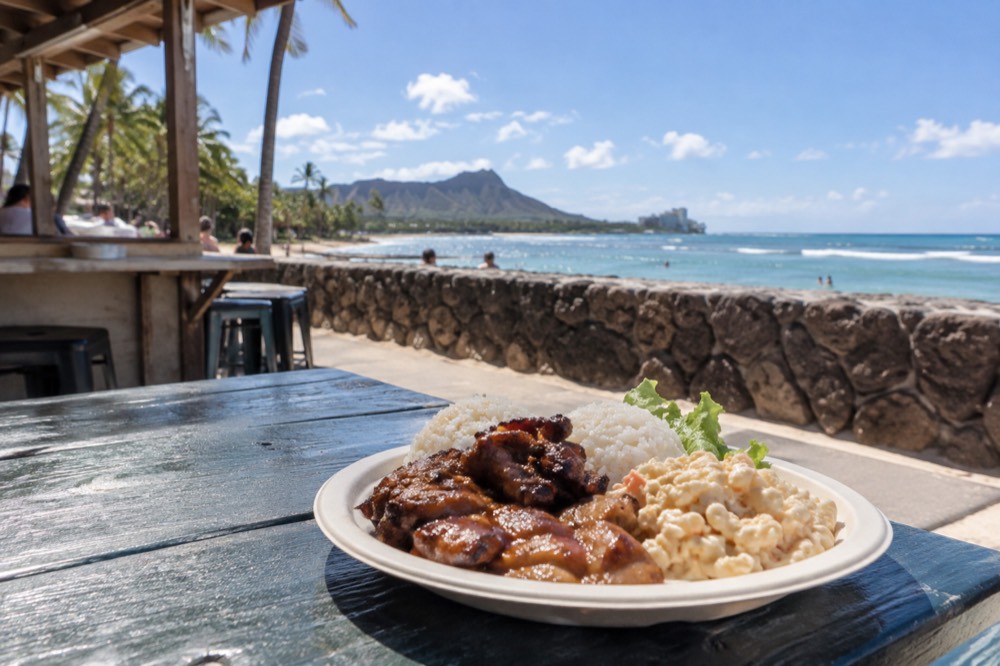
One cost that surprises first-timers is breakfast. Hotel breakfast in Waikiki is priced like a luxury; the local equivalent is a convenience-store spam musubi or a bakery counter, and the difference across a week is a tour ticket. The pattern repeats at lunch: the plate lunch, two scoops of rice and macaroni salad alongside a protein, is the island's default value meal and has been for generations of working residents.
What Do Oahu Tours Cost Compared To Doing It Yourself?
Oahu's most-booked tours run from $22 for a hop-on trolley day pass up to $540 for a doors-off helicopter flight, with the big circle-island day tours and luaus sitting in the middle of that range. Ratings across the island's tier-one products run from 4.5 to a perfect 5.0 on thousands of reviews, so the question is less whether the quality is there and more which experiences justify their price for your trip.
The verified price picture from live listings:
| Tour | Operator | Duration | Rating | From (per person) |
|---|---|---|---|---|
| Waikiki trolley hop-on hop-off day pass | E Noa Tours | 1 hour 50 minutes | 4.7 | $22 |
| Diamond Head hike with tickets and shuttle | Kaimana Tours | 3 hours | 4.8 | $35 |
| Waikiki turtle canyon snorkel | listed operator | 2 hours | 4.8 | $79 |
| Circle island grand tour | Star of Honolulu | 6 hours 30 minutes | 5.0 | $100 |
| Toa Luau at Waimea Valley | Toa Luau LLC | varies | 4.9 | $145 |
| Mauka Warriors luau | Mauka Warriors Luau | 4 hours | 4.8 | $146 |
| Hidden gems circle island with Byodo-In | Go Tours Hawaii | 9 hours | 4.9 | $159 |
| North Shore 8-line zipline | Climb Works Keana Farms | 2 hours 30 minutes | 5.0 | $204 |
| 60-minute doors-off helicopter | Rainbow Helicopters | 1 hour | 4.8 | $540 |
Read that table against your own trip shape. A family of four can spend more on one luau than on four days of bus fares and park entries combined, and that is a legitimate choice, but it should be a choice. The circle-island tours look expensive until you price what they replace: a rental car, fuel, parking at every stop and the cognitive cost of driving an unfamiliar island on a two-lane highway. The helicopter is the one line item that is genuinely hard to justify on a budget, and equally hard to regret.
The pass product at the bottom of the value stack works the other way: it front-loads cost and pays off only if you actually visit enough included sites. Our free things to do on Oahu guide is the counterweight, because the island's best beaches, trails and lookouts cost nothing, and a trip built on them needs almost no activity budget at all.
How Can You Lower Your Oahu Vacation Cost?
The four biggest levers are travel dates, accommodation tax awareness, transit over rental cars, and the free-attraction layer. February and the late-summer shoulder weeks carry lower visitor pressure than January's peak, the 11% state TAT applies to every night so fewer nights means less tax, the $7.50 daily transit cap replaces a rental car outright, and Oahu's beaches, trails and lookouts are free.
Booking reserved sites yourself, direct through official systems, avoids markups on things that are cheap at the source.
The date lever deserves the data. January 2026 brought 527,241 visitors to the island, the highest month in the workbook; February brought 436,756, the lowest. That is nearly a hundred thousand visitors of difference between adjacent months, and rates follow. The best time to visit Oahu guide unpacks the weather side, and the Oahu weather by month guide carries it month by month.
The booking-direct lever matters more on Oahu than most places because so much of the island's core product is government-priced. The USS Arizona program costs a dollar in fees on the official reservation system. Hanauma Bay's $25 is set by the city. Diamond Head's $5 is set by the state. Third-party resellers exist for all of these, and every dollar of markup buys you nothing the official system does not. Reserve yourself, two days ahead at 7 a.m. HST for Hanauma Bay, up to 30 days ahead for Diamond Head.
The pass lever is the one place where pre-payment genuinely caps a budget. If your list includes several paid sites, a single pass converts an open-ended activity spend into a fixed number you can plan around before you fly.
Common Questions About Oahu Vacation Costs
Most questions about Oahu vacation costs come down to three things: the tax that rose to 11% in January 2026, the difference between free and reserved sites, and whether a rental car is worth its price against a $7.50 daily transit cap. Everything else, food and souvenirs and splurges, is under your control in a way the fixed costs are not. The answers below take each recurring question in turn.
Is there a tourist fee to enter Hawaii?
No. The widely repeated "green fee" is actually an increase to the existing Transient Accommodations Tax, from 10.25% to 11.00%, effective 1 January 2026, applied to accommodation and cruise fares. Nothing is collected from visitors on arrival at the airport.
How much is the USS Arizona Memorial?
The memorial program itself is free; the only charge is a $1 non-refundable management fee per ticket when reserving through the official recreation.gov system. Parking at the visitor center is $7 per day. Bags are prohibited and paid storage exists nearby, though its price is not published.
What does it cost to get into Diamond Head?
Out-of-state visitors pay $5 per person plus $10 per vehicle to park, credit card only, and a reservation is required for both, bookable up to 30 days ahead. Hawaii residents enter and park free with state ID. The reservation rule has been in force since May 2022.
Why is Hanauma Bay $25?
The $25 entry funds the nature preserve's management, and it is set by the City and County of Honolulu, not by a tour company. Children 12 and under enter free, Hawaii residents enter free without a reservation, and non-resident parking is $3 cash. The preserve closes Mondays and Tuesdays.
Do I need a rental car on Oahu?
Not necessarily. TheBus and Skyline share a fare structure with a $7.50 daily cap on a HOLO card, and a 7-day pass costs $45. A car wins for North Shore flexibility and multi-stop days, but in Waikiki it mostly wins you a parking bill. Weigh it against your itinerary rather than by default.
What is a realistic daily budget for Oahu?
Start from the fixed costs: accommodation plus its 11% state tax, then the $7.50 transit cap, then entry fees that are mostly $5 to $26 or free. Add food and whichever paid tours from the table above fit your trip. Budget travelers using free beaches and trails can keep the total low; a helicopter, luau and dinner-cruise week will run far higher.
The through-line of this breakdown is that Oahu rewards travelers who separate the fixed costs, taxes and reservation fees and entry charges, from the discretionary ones. The fixed layer is small and knowable. The discretionary layer is where a trip doubles, and it is entirely your call. Build the free layer first, add the two or three paid experiences that matter to you, and let the transit cap handle the movement between them.