Honolulu Skyline Rail Guide: Fares, Stations And How To Ride Oʻahu's Train
Oʻahu finally has a train. The Skyline rail line now reaches the airport, shares fares with TheBus, and caps your daily spending at $7.50 on a HOLO card, but it still has no Waikīkī station, so most visitors will ride it for a few specific trips rather than as their whole transport plan.
Short answer
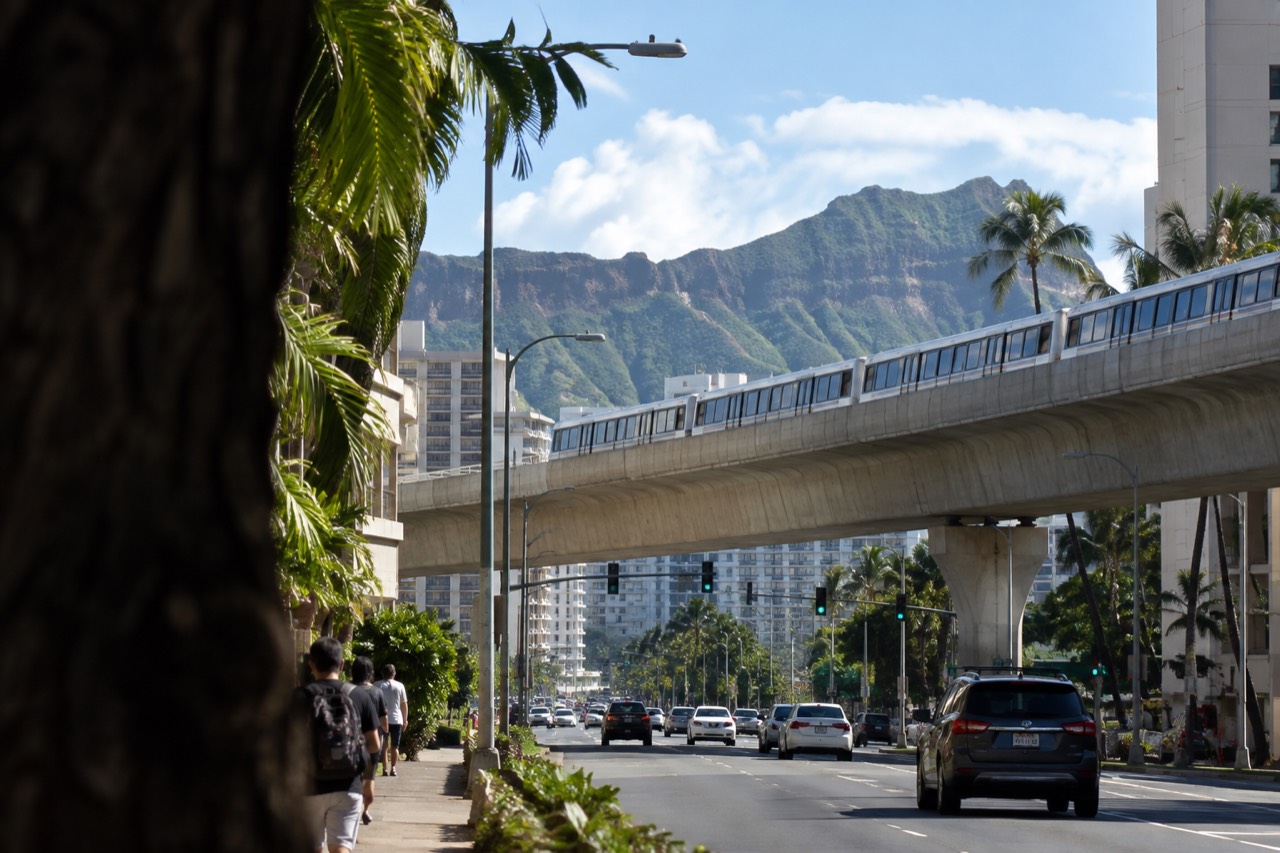
The Honolulu Skyline is an elevated rail line that shares its fare system with TheBus: $3.00 for a two-hour pass on a HOLO card, a $7.50 daily cap, and free transfers between train and bus within the pass window. The line reaches Daniel K. Inouye International Airport and stops at Hālawa for Pearl Harbor, but there is no Waikīkī station, so a bus transfer is always required from the resort strip.
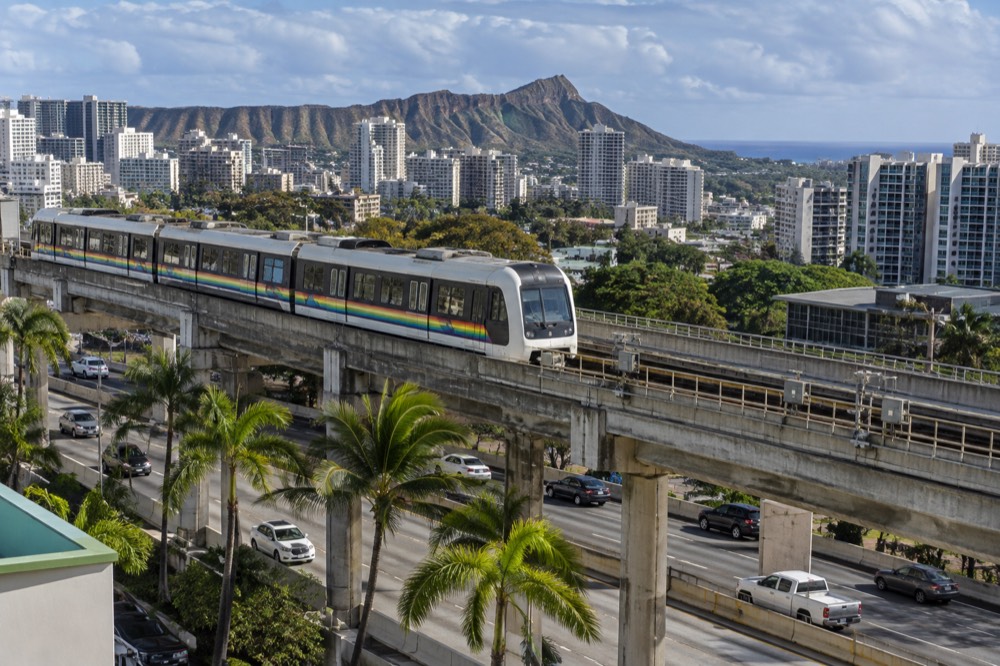
Oʻahu's rail line, called Skyline, is the first passenger train the island has had in generations, and it changes the answer to a question this site gets constantly: do you need a rental car on Oʻahu? Not entirely, but more of the arithmetic now favours transit than it did a few years ago. The line runs on an elevated guideway above the H-1 freeway corridor on the west side of Honolulu, and the City & County's own fare page states plainly that "TheBus and Skyline use the same fare structure." That single sentence is the most useful thing to know about the whole system, because it means a bus transfer is not an extra cost the way it is in most American cities.
This guide covers what is verified as of the research behind this site: fares from the City & County of Honolulu's transit fares page, the station list from the official Skyline page, and the honest limits of the line for a visitor. Where something is not confirmed from an official source, it says so rather than guessing.
What Is The Honolulu Skyline Rail Line?
Skyline is an elevated, driverless rail line run by the City & County of Honolulu, riding above the H-1 corridor on the island's leeward side. It shares one fare system with TheBus, so a single HOLO card tap covers both, and the line now serves Daniel K. Inouye International Airport. It is a commuter train rather than a scenic one, and its value to a visitor is price and connections, not the view.
The project took decades of argument to build, and that history is visible in every compromise along the route. The line was planned as congestion relief for the H-1 corridor, where west-side commuters sit in some of the worst traffic in the country, and the station spacing reflects that: park-and-ride lots and residential neighbourhoods rather than hotel doors. For a visitor staying in Waikīkī, that geometry matters more than any fare table, because the resort strip is the one part of town the guideway does not touch.
What the train does well, it does very well. The trains are frequent, the stations are elevated and weather-protected, and the fare integration with TheBus is genuinely generous: a two-hour pass covers unlimited transfers across both systems for less than the cash price of a single bus ride. If your itinerary includes the airport, Pearl Harbor or the Aloha Stadium Swap Meet, Skyline is worth learning. If it does not, TheBus alone will do the same work.
Where Does Skyline Go, And Can You Ride It From The Airport?
Yes, the line reaches the airport: the official Skyline page names a Lelepaua Daniel K. Inouye International Airport station, plus an Āhua Lagoon Drive station, with bus transfers onward. It also names Hālawa Aloha Stadium Station as the stop for Pearl Harbor and the Aloha Stadium Swap Meet, which runs Wednesday, Saturday and Sunday. Treat any fuller station map found elsewhere as unverified until you check the official one.
The airport connection is the piece visitors ask about most, and it is real but partial. Skyline gets you from the airport corridor toward town, but the line does not enter Waikīkī, so the last leg is always a bus: the official page names a W Line transfer to Waikīkī, an A Line to Downtown and a U Line to UH Mānoa. If you are travelling with a family and four suitcases, that transfer is worth weighing against a shuttle or taxi for the whole journey, and our Honolulu airport to Waikīkī transfer guide works through that comparison in detail.
The Pearl Harbor stop deserves special mention because of what it costs. Park entry is free, and the Arizona Memorial program itself is free apart from a $1 per-ticket management fee when you reserve on the national reservation system, while parking at the memorial runs $7 per day. A $7.50 capped transit day is more than the $7 parking charge alone. Compare fares for every passenger with the full driving cost, including rental and fuel where applicable. At Hālawa, the official Skyline page directs visitors across Kamehameha Highway to the ocean side, then east toward the visitor center; routes 40, 42 or 51 can cover the final stop. Check the current route and pedestrian instructions before travel.
One honest limit worth stating early: Skyline covers a corridor, not the island. The North Shore, Kailua, the Koʻolau lookouts and Haleʻiwa are nowhere near a rail station and never will be on the current alignment. Visitors who try to build a whole Oʻahu trip on the train end up frustrated, while visitors who use it for the airport, Pearl Harbor and stadium trips and then book a guided day for everything beyond the corridor tend to be the happiest with both.
A sightseeing service can complement rail when its actual stops fit your plans. It does not replace every route or guarantee access to every attraction.
How Much Does It Cost To Ride Skyline?
A two-hour pass on a HOLO card costs $3.00 and includes unlimited transfers on both Skyline and TheBus, while a 24-hour pass is $7.50, a 3-day pass $20.00 and a 7-day pass $45.00, with the monthly cap at $90.00. The card itself costs $2.00. One child aged five or under rides free with each paying rider when not occupying a seat, and the daily cap means you never pay more than $7.50 in a day.
Those figures come straight from the City & County's transit fares page, and the structure rewards one specific behaviour: getting a HOLO card before your first ride. The cash fare on TheBus is $3.25, which is more than the card's two-hour pass, and cash buys no transfers. The card's daily cap is the quiet star of the table, because it turns a day of scattered trips into a flat $7.50, cheaper than a single airport shuttle seat and comparable to an hour of resort parking, if you can find it.
| Fare product | Price | What it covers |
|---|---|---|
| Adult cash single ride (TheBus only) | $3.25 | One ride, no transfers, exact fare required |
| HOLO 2-Hour Pass | $3.00 | 2 hours of unlimited transfers on TheBus and Skyline |
| 24-Hour Pass | $7.50 | A full day from first tap |
| Daily cap | $7.50 | Maximum charged per day, then free |
| 3-Day Pass | $20.00 | 72 hours from first tap |
| 7-Day Pass | $45.00 | 168 hours from first tap |
| Monthly cap / Monthly Pass | $90.00 | One month of unlimited rides |
| HOLO card fee | $2.00 | Initial card and replacements |
| Child 5 and under | Free | With a paying rider, not occupying a seat |
The card can be loaded at holocard.net, by phone on 808-768-4656, or at any HOLO retail location, so there is no reason to ride cash-fare even once. Youth HOLO cards cover ages 6 to 17, extending to 19 with proof of high-school enrolment, which matters for families with teenagers.
Before locking in any guided day, it is worth checking what the rail fare arithmetic looks like for your group, because the two decisions feed each other: a family that saves on parking by riding Skyline has more room in the budget for a circle-island tour day.
Do You Need A HOLO Card, Or Can You Just Tap A Credit Card?
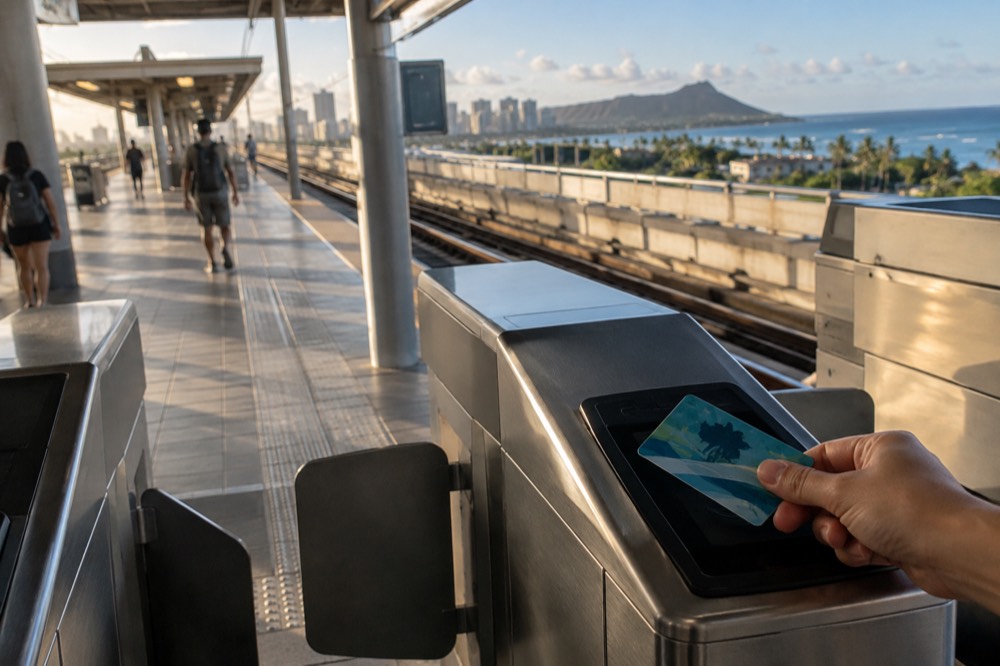
You need a HOLO card. Skyline and TheBus share the HOLO fare system, and every published pass, the $3.00 two-hour, the $7.50 daily cap and all the multi-day products, exists only when you tap the card. The $3.25 cash fare is TheBus only, buys no transfers, and does not apply to the train at all. The card costs $2.00 and pays for itself quickly.
The card is the system, and there is no visitor-facing workaround that the official fare page acknowledges. Buy it at the airport or a retail location on day one, load a day pass or a multi-day pass depending on your plans, and the rest of the trip is tap-and-go. The $2.00 card fee is a one-time cost, and since the two-hour pass alone undercuts the cash fare by a quarter, eight separate rides saving $0.25 each would recoup the $2 card fee; transfers and capping can change that comparison. The wider set of guides lives on Oahu Travel Guide.
Which load to choose depends on the shape of your week. A visitor doing one rail-and-bus day out of seven should just load money and let the daily cap do its work. A visitor who has decided against a rental car entirely, the kind of traveller our 3 days in Oʻahu without a car itinerary is written for, should look hard at the 7-day pass at $45.00, which breaks even at about six capped days.
| Your trip pattern | Best fare product | Why |
|---|---|---|
| One or two transit days in a week | Load money, rely on the $7.50 daily cap | No upfront commitment, cap protects you anyway |
| Three concentrated transit days | 3-Day Pass, $20.00 | Cheaper than three capped days |
| A full week without a car | 7-Day Pass, $45.00 | Breaks even at roughly six capped days |
| Staying near a station, commuting daily | Monthly cap, $90.00 | Compare actual use within the calendar month |
| Arriving with kids under 6 | Check the child fare rule | One child aged 5 or under per paying rider, not occupying a seat |
One practical note the fare page does not spell out: the two-hour pass window starts at your first tap, so tap deliberately. A tap at 9:58 a.m. covers you to 11:58 a.m., and a transfer boarded at 11:55 a.m. still counts. Riders who tap casually at a station and then linger over breakfast waste the window they paid for.
How Does Skyline Connect To TheBus And To Waikīkī?
There is no Skyline station in Waikīkī, and the official page is explicit that a transfer is required, naming the W Line as the bus connection to Waikīkī, an A Line to Downtown and a U Line to UH Mānoa. Because both systems share one fare structure, the transfer is free within your pass window. From Waikīkī, Skyline is always a two-step trip: bus first, then train.
That two-step is the honest cost of the line's alignment, and no marketing changes it. The guideway runs along the freeway corridor west of town, and Waikīkī sits east of it, on the other side of downtown. For trips toward the airport or Pearl Harbor, the bus-then-train combination is fast and cheap. For trips within the Waikīkī, Ala Moana and downtown zone, TheBus on its own is usually the better answer, since you skip the transfer entirely, and our TheBus Oʻahu guide covers those direct routes.
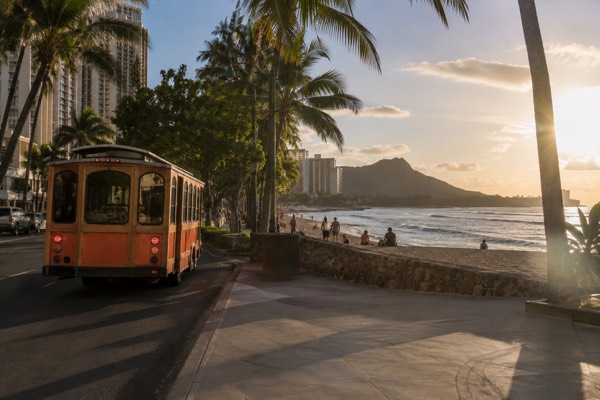
Visitors who find the bus-plus-train choreography unappealing have a middle option that is not a bus at all: the hop-on hop-off trolley network centred on Waikīkī. It serves a different purpose, sightseeing rather than commuting, with open-air cars and commentary on the routes through downtown and the Ala Moana corridor. For a first day of orientation it does work that neither transit system attempts.
The trolley and the train are complements, not competitors. Use Skyline to move cheaply between the airport, Pearl Harbor and the stadium. Use the trolley, or a guided day, for the parts of Oʻahu where the rails end and the scenery starts. Visitors who try to make one system do both jobs tend to be the ones writing disappointed reviews.
Is Skyline Actually Useful For Tourists Visiting Oʻahu?
For three specific trips, yes: the airport connection, Pearl Harbor via Hālawa Aloha Stadium Station, and the Aloha Stadium Swap Meet on Wednesday, Saturday or Sunday. For everything else a visitor wants, the line's reach runs out, with no Waikīkī, North Shore or windward service on the current alignment. Treat Skyline as a cheap, reliable tool for the west-of-town corridor and nothing more.
The Pearl Harbor case is the strongest one, and the numbers make it themselves. Parking at the memorial is $7 per day, paid by mobile app or QR code, while a capped HOLO day is $7.50 and includes the bus from Waikīkī to the transfer and the train to Hālawa. The parking fee alone is lower than even one capped transit day. The total comparison still depends on the fares actually needed, group size, fuel and whether you would rent the car anyway. Our Pearl Harbor day trip planner walks through that whole decision with the reservation timings, which are the part of a Pearl Harbor visit that actually causes trouble.
The swap meet is the sleeper hit. It runs Wednesday, Saturday and Sunday, and the official Skyline page names Hālawa Aloha Stadium Station as its stop, which puts a huge open-air market of local vendors a train ride from the airport corridor. Visitors who want souvenirs that are not airport plastic will find the stall rows a better use of a morning than another beach hour, and the rail fare is close to nothing against the day cap.
Beyond those, the arithmetic sours. The island's marquee sights, Diamond Head, Hanauma Bay, Kailua, the North Shore, the Koʻolau lookouts, are all east or far north of the guideway, reachable only by long bus rides after a transfer. That is where a guided circle-island day earns its keep: it covers in one seat what the train and bus would cover in four transfers.
A hidden-gems circle day that includes Byodo-In Temple is the version worth choosing if the standard loop feels too familiar, because it trades some of the roadside stops for the windward valley temple and the quieter lookouts between.
Skyline Vs The Alternatives: Which Should You Actually Use?
Use Skyline for the airport corridor, Pearl Harbor and the stadium, use TheBus for the Waikīkī to downtown zone, and use a guided tour or a rental car for the North Shore and windward coast. Compare the $7.50 cap per rider with the actual whole-party shuttle or driving total, but it cannot replace a car for the two-thirds of the island the guideway never touches.
| Option | Best for | Weakness | Cost character |
|---|---|---|---|
| Skyline rail | Airport, Pearl Harbor, Aloha Stadium | No Waikīkī station, corridor only | $7.50 daily cap on a HOLO card |
| TheBus | Waikīkī, downtown, Ala Moana, beach corridors | Slower in traffic, luggage space is limited | Same HOLO fares, same cap |
| Hop-on hop-off trolley | Sightseeing loops and first-day orientation | Not a commuting tool, higher per-day cost | Flat day pass, no transfer integration |
| Guided circle-island day | North Shore, windward lookouts, Haleʻiwa in one day | Fixed schedule, no independent wandering | One price, one seat, no transfers |
| Rental car | Maximum reach, remote beaches, flexible days | Oʻahu parking is scarce and expensive | Parking and fuel costs add up fast |
The pattern that works for most first-time visitors is a hybrid: a HOLO card for the in-town days and the Pearl Harbor trip, plus one guided day that reaches the far side of the island. That combination avoids both the rental car's parking problem and the transit system's reach problem, but its cost depends on your party size and chosen services, so compare actual quotes.
Whichever transport plan you lean toward, the deciding factors are the same: how many people are travelling, whether your dates fall on a swap meet day, and how much of the island you want to see versus how cheaply you want to see it. A solo traveller on a strict budget answers differently from a family of five with toddlers, and both answers are defensible.
For a guided day, the Grand Circle listing offers a 9-hour circle-island itinerary and a separate 6.5-hour Dole and Haleiwa option. Neither means a continuous coastal circuit around Kaena Point. It is the direct answer to the question Skyline cannot solve: how do you see the North Shore without driving it yourself.
Common Questions About The Honolulu Skyline Rail
Most questions about Skyline come down to three things: the fare is shared with TheBus through the HOLO card, the line reaches the airport and Pearl Harbor but not Waikīkī, and the $7.50 daily cap provides a limit for one rider’s transit spending, not a universal saving against parking. Everything else, station counts and future extensions, is on the official system map or not yet verified, and this site will not guess at it.
Does the Honolulu Skyline go to Waikīkī?
No. There is no Skyline station in Waikīkī, and the official Skyline page states that a transfer is required, naming the W Line as the bus connection to Waikīkī. The transfer is free within your HOLO pass window, but the two-step trip is unavoidable on the current alignment.
How much does it cost to ride Skyline?
A two-hour pass costs $3.00 on a HOLO card and includes unlimited transfers on both the train and TheBus. A 24-hour pass is $7.50, a 3-day pass is $20.00, a 7-day pass is $45.00, and the monthly cap is $90.00. The HOLO card itself costs $2.00.
Can you take Skyline from Honolulu Airport?
Yes. The official Skyline page names a Lelepaua Daniel K. Inouye International Airport station, with bus transfers onward, including the W Line toward Waikīkī. Confirm the current end-of-line details on the official system map before you ride, since the station list is still expanding.
Does Skyline go to Pearl Harbor?
Effectively, yes. The official page names Hālawa Aloha Stadium Station as the stop for the Pearl Harbor memorial and visitor centre. From the station you still have a short final approach to the visitor centre, so check the walking or transfer details on the official Skyline map before relying on it.
Is Skyline cheaper than driving in Honolulu?
Often, yes, once parking is counted. Parking at the Pearl Harbor memorial is $7 per day, and Waikīkī hotel parking is notoriously expensive, while a HOLO card caps a full transit day at $7.50. For a family with a car already booked, the comparison can flip, so run the numbers for your own group.
Do kids ride Skyline free?
One child aged five or under rides free with each fare-paying rider when not occupying a seat. Youth HOLO cards cover ages 6 to 17, extending to 19 with proof of high-school enrolment.
The train is a real improvement to getting around Oʻahu, and the honest summary is that it improves a specific slice of the island rather than the whole picture. Ride it for the airport, ride it for Pearl Harbor, load a HOLO card the day you land, and hand the rest of the island to a bus, a tour or a steering wheel.
Choose Transport For The Rail Gaps
Public transport remains the budget option described above. The paid default is an optional alternative; choose the journey you need and check actual quotes with the provider.
Arrange Your HNL Arrival Ride
If your immediate need is the airport-to-hotel leg, price that ride separately. It does not commit you to a rental or a sightseeing tour for the rest of the trip. Confirm the quote and meeting arrangements before arrival.
Enter your hotel, flight, passengers and bags for a quote. Confirm child-seat requirements and vehicle capacity before booking.
Compare Your Transport Estimates
Enter totals for the same travel days and your whole party in USD. These are your estimates, not live quotes. Include rental taxes and fees in the first total; add only parking and fuel that are not already included. Include any transfers or admission you would buy separately in the car-free total, once only.
Select the arrival time and destination with Welcome Pickups. Provider quotes are checked there; the calculator uses only your own estimates.