Cost Of A Trip To Oahu: A Realistic Budget Breakdown
Oahu is the most visited island in Hawaii, and it prices like it. Here is what the real numbers look like, what the taxes actually are, and where the money goes.
Short answer
A mid-range trip to Oahu typically runs a few hundred dollars per person per day once lodging, food, transport and one paid activity are added together, with hotel taxes at 11% state TAT plus county charges on top of the room rate.
Oahu welcomed 5,679,047 visitors by air in 2025, according to Hawaii DBEDT's preliminary figures, and every one of them asked the same question before booking: what is this going to cost? Oahu is the priciest of the main islands for some things, the cheapest for others, and most of the budget advice floating around online is either stale or invented. This page uses verified figures from official sources, Hawaii Department of Taxation announcements, National Park Service fee pages and City and County transit tables.
For a companion page that breaks spending down line by line, see our Oahu vacation cost breakdown, and for the free end of the spectrum read our guide to free things to do on Oahu. This page is the overview: the big picture of what a trip costs, where the money goes, and which numbers people routinely get wrong.
What Does A Trip To Oahu Cost Overall?
A realistic mid-range budget for Oahu lands at a few hundred dollars per person per day once a shared hotel room, food, local transport and one paid activity are added together, while a budget trip can come in well under that and a high-end trip climbs steeply from there. Those are planning ranges, not promises.
The single biggest swing factor is accommodation, and flights sit outside these figures entirely because they vary too much by origin city to generalise.
The reason Oahu spans such a wide range is that the island sells every tier of the same product. A plate lunch from a food truck and a tasting menu in Waikīkī are both dinner. TheBus at $3.25 a ride and a rental car parked at a resort valet are both getting around. What you buy of each determines the total more than the destination does.
A useful framing is to budget in three buckets: fixed costs you pay before you fly (airfare, room, rental car if any), daily costs you control on the ground (food, transport, parking), and activity costs that are mostly decided in advance (luaus, tours, attraction entry). Most overspending happens in the third bucket, because Oahu's activity layer is deep and well marketed. A week built around beaches and hikes costs a fraction of a week built around a paid excursion every morning and a luau every night, and the difference is a decision, not a destination.
| Budget tier | What it looks like | The main trade-off |
|---|---|---|
| Budget | Hostel or budget hotel shared, plate lunches, TheBus, free beaches and lookouts | Location and comfort, not experiences |
| Mid-range | 3–4 star Waikīkī room shared, mix of casual and one nicer meal daily, a paid activity most days | Convenience priced in |
| High-end | Resort room, valet parking, fine dining, helicopter or private tours | Everything, at resort markup |
How Much Does Accommodation Cost On Oahu?
Lodging is the largest single line in almost any Oahu budget, and the sticker price is not the full price: Hawaii's Transient Accommodations Tax rose to 11.00% on 1 January 2026 under Act 96, and it stacks on top of the general excise tax and any county surcharge, so the final bill runs meaningfully above the quoted nightly rate.
Waikīkī commands the highest rates, and vacation rentals add cleaning fees that can quietly add a night's worth of cost.
Act 96 is the item most current coverage gets wrong. It is not a new arrival tax or a fee collected at the airport. The Hawaii Department of Taxation's own announcement describes it plainly: an increase to the existing TAT, from 10.25% to 11.00% on gross rental proceeds, effective 1 January 2026, plus an extension of the tax to cruise ship operators' gross fares. A court denied the cruise industry's request for an injunction in December 2025, so the increase is in force while litigation continues.
The practical consequence for a budgeter: whatever nightly rate you see quoted, mentally add taxes and resort fees before comparing a hotel against a rental. Check the total at checkout, not the search result.
Where you stay matters as much as what you pay. Our Waikīkī neighborhood guide covers the dense, walkable, expensive core, and the North Shore Oahu guide covers the cheaper, quieter, car-dependent alternative. If you are torn, our comparison of Waikīkī vs North Shore for where to stay lays out the trade-offs.
One way travellers flatten the accommodation-plus-transport cost curve is to stay outside Waikīkī and rely on the island's fixed-fare transit, which the next sections price out precisely.
What Does Food Cost On An Oahu Trip?
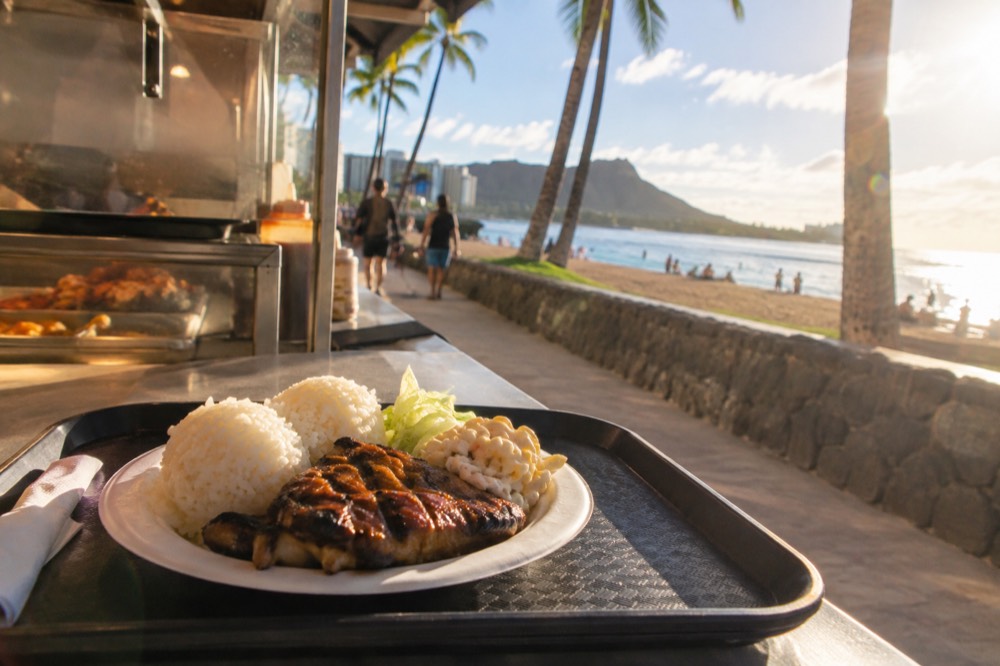
Food on Oahu runs from the cost of a plate lunch at a food truck, through a mid-priced casual sit-down dinner, up to resort and fine-dining venues that can cost several times the local tier, so a couple eating mostly local food can hold their daily food budget near what one resort breakfast for two would cost. Shave ice, malasadas and snacks add a few dollars each and add up faster than people expect.
The saving grace of eating on Oahu is that the cheap end is not a compromise, it is the actual local cuisine. Plate lunches, poke bowls, garlic shrimp on the North Shore and farmers market fruit are what residents eat, and our guide to the best food on Oahu covers where the money goes furthest. The expensive end is largely a visitor economy product, and it is fine to skip entirely.
Two structural notes. First, groceries on Oahu cost more than on the mainland because almost everything ships in; a rental with a kitchenette saves less than people assume. Second, tipping in Hawaii follows mainland US norms, 15 to 20 percent at table service, and that belongs in the daily food math.
A third note that budget guides rarely make: the drink line matters as much as the food line. Alcohol at resort venues carries resort pricing, while the same beer at a neighbourhood store or a plate lunch spot costs a fraction as much, and a family that shifts even one drink occasion a day off resort property saves more over a week than any coupon strategy will ever return.
| Meal type | Relative cost | Notes |
|---|---|---|
| Plate lunch / food truck | The baseline | The standard local lunch; portions are large |
| Casual sit-down dinner | A few times the baseline | Waikīkī averages higher than neighbourhood spots |
| Resort or fine dining | Several times the baseline | Tasting menus and resort venues climb steeply |
| Shave ice / snacks | Small, but daily | A habit, not a treat, if you let it become one |
How Much Do Activities And Tours Cost On Oahu?
Activity spend is the most controllable part of an Oahu budget: the island's headline natural sights are free or nearly free, while the paid layer runs from a roughly $25 distillery tasting up to helicopter tours in the hundreds of dollars, so a traveller who mixes free beaches and hikes with two or three marquee paid experiences can hold the week's activity total near a few hundred dollars per person. The mistake is treating every day as a tour day.
The free tier is genuinely strong. Waikīkī Beach, the North Shore beaches, most hiking trails and the lookouts cost nothing. The paid tier at state sites is modest and posted: Hanauma Bay charges non-residents $25 plus a 2.35% online service fee, with children 12 and under free and Hawaii residents free with ID, while Diamond Head State Monument charges non-residents $5 per person plus $10 per vehicle, credit card only, with a mandatory reservation for non-residents in force since 12 May 2022. Waimea Valley lists adult admission at $26. More of these guides are collected on Oahu Travel Guide.
| Site or activity | Non-resident cost | Notes |
|---|---|---|
| Hanauma Bay Nature Preserve | $25 + 2.35% online fee | Children 12 and under free; residents free with ID; closed Mondays and Tuesdays |
| Diamond Head State Monument | $5 per person + $10 per vehicle | Reservation required for non-residents; card only |
| Waimea Valley | $26 adult | Kamaʻāina and military rates lower; closed Mondays |
| Pearl Harbor National Memorial | Free | USS Arizona program is free; a $1 per-ticket management fee applies on recreation.gov; parking is $7 per day |
The USS Arizona Memorial deserves a plain note here: it is a war grave and the park is fee-free, so no budget line is needed beyond the $1 reservation management fee and parking. The commercial tours that bundle transport and guides are priced on the operator's live listing, and this site deliberately does not type those figures into copy because they change.
For repeat paid activity, two products change the arithmetic. A hop-on hop-off trolley day pass turns Waikīkī transport and sightseeing into one fixed price, and a multi-attraction pass can cover a stack of paid venues for one cost. Check availability on the pass below and compare it against the à la carte total for your own shortlist before committing.
What Does Getting Around Oahu Cost?
Public transport on Oahu is among the best value in American travel: TheBus costs $3.25 for a single cash ride, but a HOLO card caps fares at $7.50 per day no matter how many trips you take, and the same card works on the Skyline rail line, so a car-free traveller's transport budget for a full week can stay remarkably low.
A rental car adds the daily rate plus hotel parking, and Oahu parking charges are high enough to rival the rental itself.
The fare table is published by the City and County of Honolulu, which states that TheBus and Skyline use the same fare structure. The numbers that matter for a visitor: $3.00 for a two-hour pass with unlimited transfers, $7.50 for a 24-hour pass and the same $7.50 as the daily cap, $20 for three days, $45 for seven days, and a $2 fee for the HOLO card itself. A child five and under rides free with a paying adult.
| Fare product | Price | Notes |
|---|---|---|
| Adult cash single ride | $3.25 | TheBus only, no transfers, exact fare |
| HOLO 2-hour pass | $3.00 | Unlimited transfers, bus and rail |
| 24-hour pass / daily cap | $7.50 | The cap is the number to remember |
| 7-day pass | $45.00 | Best fit for a week-long car-free trip |
| HOLO card fee | $2.00 | One-time, initial and replacement |
The rail line, Skyline, now reaches a station serving the airport, but there is no Waikīkī station, so a rail arrival still needs a bus transfer to reach most visitor lodging. Our Honolulu Skyline rail guide and TheBus on Oahu guide cover the details, and if you are weighing a car at all, read do you need a car on Oahu and the Oahu parking guide before deciding, because parking, not the rental rate, is often the real cost.
What Taxes And Fees Will You Pay On Oahu?
The taxes to plan for are the 11.00% state Transient Accommodations Tax on lodging, in force since 1 January 2026, and a 4.5% general excise tax on purchases on Oahu that is usually already built into shelf prices, plus any county accommodation surcharge your property passes through. There is no arrival fee and nothing is collected at the airport, whatever competing content may claim. Treat the nightly rate as meaningfully higher once tax applies.
The single most repeated error in current Hawaii budget content is calling Act 96 a "green fee" tourists pay on entry. It is not. It is a 0.75-point increase to the existing TAT, from 10.25% to 11.00%, plus an extension of the tax to cruise fares, and it is collected through normal lodging billing.
The other quiet cost is reservation friction rather than money: Hanauma Bay's two-day-ahead booking window and Diamond Head's non-resident reservation requirement mean some of Oahu's cheapest sights demand the most planning. Budget your attention as well as your dollars, and see our best time to visit Oahu guide for how seasonality shifts both prices and availability.
How Can You Keep An Oahu Trip Affordable?
The reliable savings on Oahu are structural, not coupon-based: stay outside Waikīkī or in a neighbourhood hotel, eat plate lunches and food-truck food by default, use a HOLO card instead of a rental car if your plans stay in the Honolulu and windward corridor, and fill most days with the free tier of beaches, hikes and lookouts before adding paid tours. Travelling in the shoulder months also softens lodging rates and thin crowds at the same time.
Start with the free layer. Our things to do in Oahu roundup and the free things to do on Oahu guide show how many headline experiences, beaches, trails and lookouts, cost nothing. Then add paid experiences deliberately rather than daily. A single well-chosen splurge, a luau, a snorkel tour, a zipline, often satisfies the "we did something special" requirement for the whole trip, and the rest of the week can be beach days.
Two specific products reward comparison shopping rather than default buying. The hop-on trolley pass below suits a Waikīkī-based traveller who wants sightseeing and transport in one purchase, and the guided Diamond Head option bundles the reservation, which is the actual scarce resource at that park, not the hike itself.
For a Waikiki-based traveller wanting transport and sightseeing in one purchase, book a hop-on hop-off trolley pass here.
Between those two, the trolley is the transport-and-sightseeing play and the guided hike is the logistics play, so they solve different problems rather than competing. A traveller staying in Waikīkī without a car gets more from the trolley pass; a traveller who keeps missing the Diamond Head reservation window gets more from the guided option.
For the full budget-first treatment, our Oahu on a budget guide goes deeper than this page can. The last honest note: Oahu is not cheap, but almost every expensive thing on the island has a genuinely good inexpensive alternative, and the people who overspend are usually the ones who bought the expensive version of everything without checking.
Common Questions About The Cost Of A Trip To Oahu
Most cost questions about Oahu come down to three things: what the taxes actually add to a hotel bill, whether a rental car is worth it against a $7.50 daily transit cap, and how many paid activities a week really needs, since the island's best beaches, hikes and lookouts are free and the paid layer is optional rather than essential. Get those three decisions right and the rest of the budget mostly takes care of itself.
How much does a trip to Oahu cost?
A mid-range trip typically runs a few hundred dollars per person per day for lodging, food, transport and a paid activity, and a leaner budget trip is entirely possible by leaning on plate lunches, the transit daily cap and the island's free sights. Flights are excluded from those ranges because they vary too much by origin city to generalise.
Is Oahu expensive to visit?
It can be, but the expensive version is optional. Lodging and resort dining carry Hawaii prices, while plate lunches, TheBus at a $7.50 daily cap, and the island's free beaches and trails keep a lean trip entirely possible.
What is the hotel tax on Oahu?
The state Transient Accommodations Tax is 11.00% since 1 January 2026, and it stacks with the general excise tax and any county surcharge. There is no separate arrival fee and nothing is collected at the airport, whatever you may have read.
What is the cheapest way to get around Oahu?
A HOLO card on TheBus and Skyline, with a $7.50 daily cap and a $45 seven-day pass, is the cheapest practical option. Note there is no Skyline station in Waikīkī, so rail trips there end with a bus transfer.
Do you need to book Hanauma Bay or Diamond Head in advance?
Yes. Hanauma Bay reservations open two days ahead at 7:00 a.m. HST and the bay closes Mondays and Tuesdays, while Diamond Head requires a reservation for all non-residents, for entry and parking, a rule in force since May 2022.
Is a multi-attraction pass worth it on Oahu?
It depends entirely on your shortlist. If your plans include several of the covered paid venues, one fixed pass price can beat buying individually, but a trip built around free beaches and one luau will not get its money back. Compare the pass against your own list before buying.