Oahu Surfing: Where, When And How To Surf The Island
Oahu's four shores take turns holding the island's best surf: the north shore peaks in winter, the south shore in summer, and Waikiki stays rideable almost all year for beginners.
Short answer
Oahu is one of the world's easiest places to learn to surf and one of the most serious places to watch it done at the highest level. The north shore peaks in winter, the south shore in summer, and Waikiki's sheltered rolls suit beginners year-round.
Oahu is the island where surfing grew up. The stand-up wave riding the world now knows was practised here and across Hawaiʻi long before it became a global sport, and the island still carries both ends of the spectrum at once: Waikiki, where a first-timer can stand up on a soft-top in waist-deep water, and the north shore, where the world's best surfers spend every northern-hemisphere winter. This guide, from Oahu Travel Guide, covers which shore to surf in which season, where beginners belong, what lessons cost, and how to stay out of trouble.
Where Are The Best Places To Surf On Oahu?
The honest answer is that it depends on the season, because Oahu's four shores take turns. The north shore, meaning Waimea Bay, Sunset Beach and the breaks around Pūpūkea, holds the island's biggest winter surf. The south shore around Waikiki and Ala Moana works best in summer. Kailua and Waimānalo on the windward side pick up east swell, and the leeward coast is the quietest of the four.
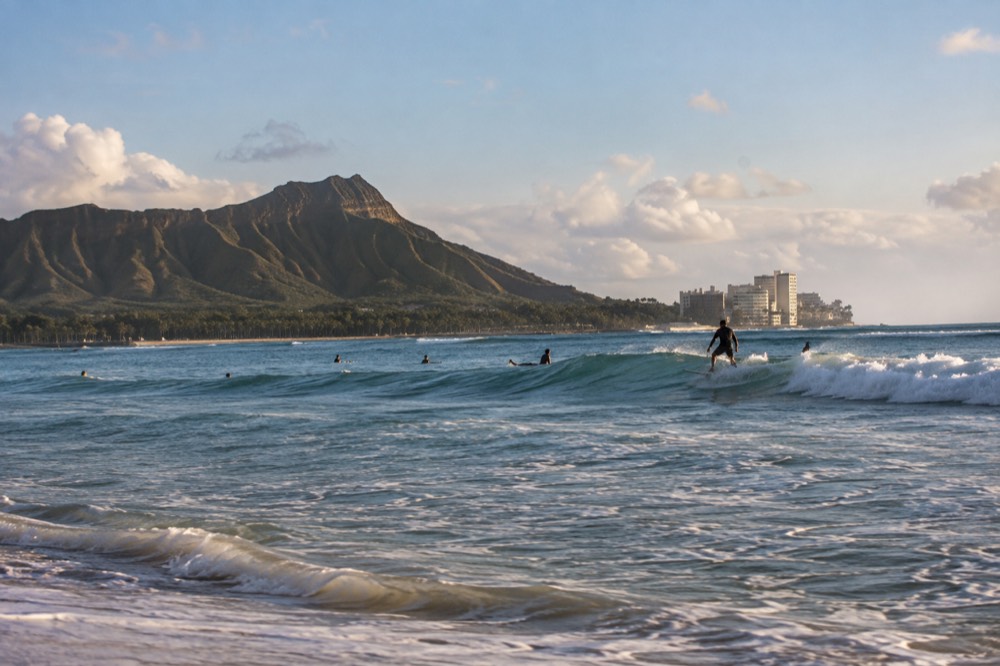
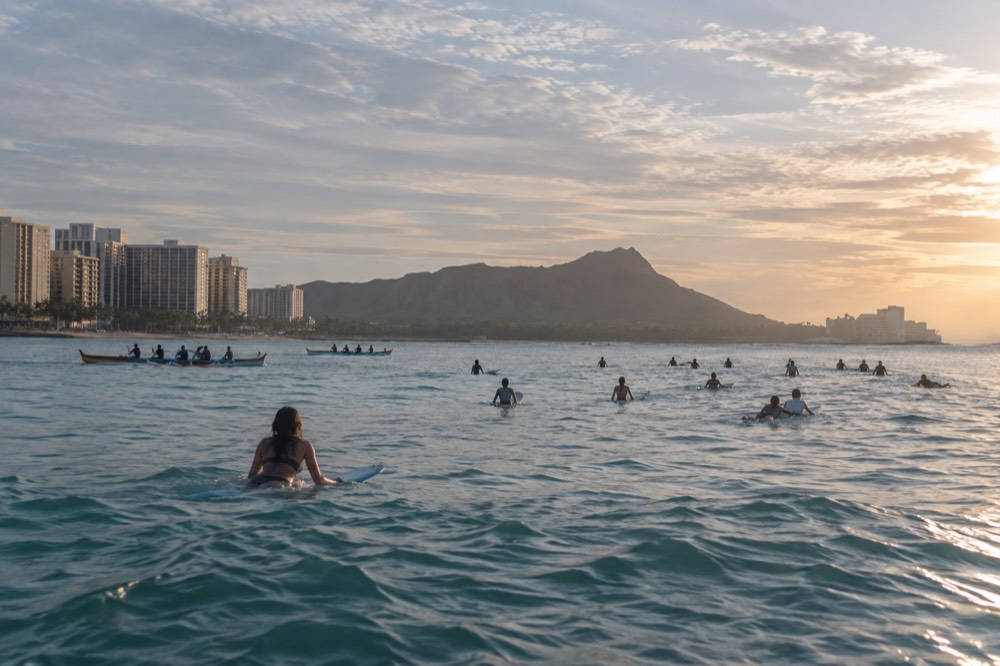
Waikiki is where almost everyone should start. The waves there are long, slow and forgiving, the reef bottom sits deep enough to keep things gentle, and the whole stretch from Kapiʻolani Park toward the Moana is lined with beach boys who have been teaching visitors to stand up for over a century. The view from the lineup, back toward Lēʻahi, the Hawaiian name for the crater signposted as Diamond Head, is one of the most photographed lines of sight on the island.
Ready to catch your first wave where the sport began? Book a group surfing lesson here.
The north shore is a different sport. In summer it can be flat and bathtub-calm, which is exactly why snorkellers love Sharks Cove and Waimea Bay then. In winter the same bays hold surf that only experienced surfers should go near, and even watching it deserves caution: the sand at Sunset Beach and Waimea narrows in big-surf season and the sets will move a careless bystander off the rocks. Haleʻiwa, a few minutes inland, is the town that services all of it, and it is a working country community, not a beach-club backdrop. Park legally, spend money there, and move on.
The windward side, Kailua and Waimānalo, faces east and picks up whatever the trade winds and any east-northeast swells push in. It is a good option when the south is flat and the north is closed out, though onshore trade wind texture can make the surface bumpy by mid-morning.
 outrigger canoes nearby" width="1000" height="667" loading="lazy">
When Is The Best Time To Surf On Oahu?
North-facing shores peak in winter, roughly November through March, and south-facing shores peak in summer, roughly May through September. The two seasons run out of phase, which means one side of the island is almost always working. East-facing shores sit between the two, filling in from trade wind swells, and the west side is the least consistent of the four.
This is not surf folklore. The National Weather Service's Honolulu surf zone forecast publishes Oahu's expected surf by shore aspect every day, and a reading of that bulletin in September 2026 showed the inversion plainly: the south shore was running four to six feet while the north shore sat at one to three. In January the same table flips. That single fact is the most useful thing a visiting surfer can learn, because it means the question is never "is there surf on Oahu" but "which shore is holding it today."
Check the forecast each morning rather than trusting the calendar. The same NWS product also flags any box jellyfish influx advisories, which matter more to surfers than to anyone, since you are in the water for hours at a time.
For beginners, the season barely matters. Waikiki's rolls are small and consistent enough year-round that a lesson booked in February works about as well as one booked in August. What changes is the crowd: winter brings bigger surf crowds to the north shore and slightly thinner lineups in town.
| Shore | Main season | Character | Best for |
|---|---|---|---|
| North (Waimea, Sunset, Pūpūkea) | Winter, Nov–Mar | Powerful, world-class, hazardous in season | Experts; spectators in winter |
| South (Waikiki, Ala Moana, Kewalos) | Summer, May–Sep | Long, slow, forgiving | Beginners and longboarders |
| East (Kailua, Waimānalo) | Trade wind swells, most consistent in summer | Fun-sized, sometimes choppy | Intermediates |
| West (Mākaha, leeward coast) | Winter, less frequent | Powerful when it works, quiet otherwise | Experienced surfers |
If your trip is short and you want to see big surf without surfing it, plan a north shore day in winter and read our north shore day trip from Waikiki guide for the logistics. If you want to actually surf, stay in town and book a lesson.
Do You Need Surf Lessons On Oahu?
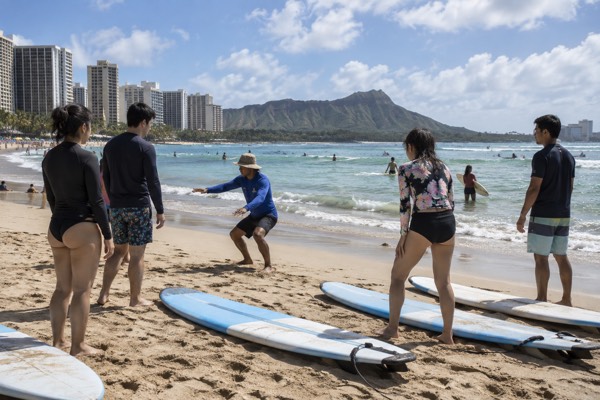
Most first-timers should take at least one lesson, and Waikiki is the single best place in Hawaiʻi to do it. A group lesson puts you with an instructor in water shallow enough to stand in, on waves slow enough to read, with a soft-top board that forgives every mistake. On Oahu the lesson is cheap relative to the value, and lineup etiquette is easier to learn from an instructor than by trial and error.
The standard format in Waikiki is a group lesson with a low student-to-instructor ratio, about two hours on the water including beach instruction, board and reef-safe sunscreen considerations handled on the sand first. The beginner lesson we feature runs about two hours and covers exactly this ground. If you are nervous in the ocean, book a private or semi-private session instead; the price step up buys you a dedicated instructor and no waiting for your turn on a wave.
One lesson will not make you a surfer. It will make you someone who has stood up on a wave, which is a different and more achievable goal, and it teaches you the safety basics: how to fall, how to cover your head coming up, how to hold the board, and how not to drop in on someone who is already riding. Those habits are what you are actually paying for.
Siblings on this site go deeper: our surf lessons on Oahu guide compares lesson formats, operators and what to ask before booking. If you already surf, skip the lesson and rent a board from any of the beach-side stands along Kalia Road or Uluniu Avenue; ask the rental desk which break suits the morning's swell, they will tell you honestly because they want the board back in one piece.
Is The Ocean Warm Enough To Surf Year-Round On Oahu?
Yes, and this is one of Oahu's genuine advantages: you never need a wetsuit. Monthly mean water temperature at Honolulu runs from about 78°F in the coolest months to about 82.7°F in August, the warmest, and the annual range across a full year of hourly readings spanned only 75.7°F to 84.0°F. Most surfers wear boardshorts and a rash guard all year, with the rash guard for sun and chest abrasion rather than warmth.
Those numbers come from NOAA's tide and current station in Honolulu Harbor, which sits in sheltered water and runs a little warm against the open ocean off Waikīkī, so treat them as a good approximation rather than a precise open-water figure. The direction of the answer does not change: the water never gets cold by mainland standards, and surfers from California or the Atlantic coast routinely find they overpacked.
| Month | Mean water temp (Honolulu Harbor) | Month | Mean water temp |
|---|---|---|---|
| Jan | 78.2°F | Jul | 81.3°F |
| Feb | 78.0°F | Aug | 82.7°F |
| Mar | 78.2°F | Sep | 82.4°F |
| Apr | 79.3°F | Oct | 82.5°F |
| May | 79.7°F | Nov | 81.2°F |
| Jun | 80.6°F | Dec | 80.4°F |
One planning note that surprises visitors: Oahu's day length only varies by about two hours and thirty-five minutes across the whole year, and the latest sunset ever observed is about 7:17 p.m. in early July. There are no long summer evenings here. If you want an uncrowded session, the dawn patrol around sunrise is the local answer, and in midwinter that means being in the water before 7 a.m.
What Does Surfing On Oahu Cost?
A group lesson in Waikiki typically runs roughly $100 to $150 per person for about two hours including board and instruction, private lessons run meaningfully higher, and a straight board rental without instruction usually costs somewhere in the $20 to $40 range for a few hours. Check the live listing for the current price of any specific lesson, because rates move with season and demand. Treat those ranges as planning figures, not promises.
What you get for the lesson price is more than board rental. The instructor reads the waves for you, pushes you into the right ones at first, positions you in the lineup so you are not in anyone's way, and gets you standing on your first or second try more often than not. The board rental alone is cheaper but leaves every one of those decisions to you, which in a busy Waikiki lineup is a real cost.
| Item | Typical planning range | Notes |
|---|---|---|
| Group surf lesson | ~$100–150 pp | ~2 hours, board and instructor included |
| Private lesson | Meaningfully above the group rate | Dedicated instructor, best for nervous swimmers |
| Board rental (no lesson) | ~$20–40 per session | Soft-tops widely available in Waikiki |
| Rash guard | ~$30–50 to buy, sometimes included | Sun protection matters more than warmth |
If surfing turns out not to be your thing, the money still buys a morning on the water, and Waikiki has plenty of alternatives: a Waikiki Turtle Canyon guided snorkel runs about two hours with a turtle guarantee, and a parasail flight off the same beach gets you above the water instead of under it. The lesson, the snorkel and the parasail are all booked through the operator's live listing, where the current price and cancellation terms are shown before you pay.
How Do You Stay Safe Surfing On Oahu?
Respect the shore you are on, never surf a north shore break in winter without the ability to handle it, and learn the three local water hazards before you paddle out: reef, current and jellyfish. Check the NWS surf forecast every morning, swim near a lifeguard whenever one is posted, and treat any box jellyfish advisory as a reason to skip the water that day. Ocean safety here is about picking the right beach, not about being brave.
The reef is the first thing. Most Oahu breaks, including Waikiki, sit over coral or rock, and the standard injuries are cuts from falling badly near the bottom. Falling flat and covering your head with your arms as you surface is the habit an instructor drills into you, and it is worth the lesson fee on its own. If you do cut yourself, clean it thoroughly; reef cuts infect easily.
Currents are the second. A channel current or longshore drift can move you a few hundred metres down the beach without you noticing, so pick two fixed landmarks on shore and check them between waves. If you find yourself drifting, paddle in, walk back and go out again. Nobody in the lineup thinks less of you for it.
Jellyfish are the third and the most predictable. Oahu has a well-known box jellyfish influx pattern roughly eight to ten days after each full moon, concentrated on the south shore, and the NWS forecast flags it. Our ocean safety guide covers the pattern, the sting response and the lifeguard flags in detail, and it is worth ten minutes of reading before your first session.
A note on wildlife law, because surfers share the water with honu and monk seals. Keeping about 10 feet from a green sea turtle is a recommended guideline, and the same goes for about 50 feet from a monk seal; what is actually illegal, under federal and state law, is taking or harassing them at all. Do not chase a turtle for a photo, and give any seal the whole beach if it hauls out near your break.
Where Should Beginners Surf On Oahu?
Waikiki, and almost nowhere else for a first session. Its waves break slowly over a deep reef, the surf school infrastructure is the most developed in the state, and the walk from any Waikiki hotel to the lineup is minutes. Second-session surfers can graduate to Queens or Canoes on the same stretch, or try the Ala Moana area when the south shore is small. The north shore is a spectator destination for beginners in winter, full stop.
The progression most instructors recommend is simple. Session one: Waikiki group lesson. Session two or three: rent a board and surf the same break without the instructor, consolidating the basics. After that, your ability, fitness and honesty about both decide the next step, and the east shore's fun-sized wind swell is a reasonable intermediate proving ground.
What beginners should not do is let a good summer day on the north shore fool them. Sharks Cove and Waimea Bay in July are calm, family-friendly water. The same bays in a winter swell are not, and the difference between the two is not visible to an untrained eye from the sand. When in doubt, ask a lifeguard. They answer that question several times a day and they answer it straight.
If you want to see the island's surf culture without paddling into it, a circle island tour covers the north shore towns, the lookouts and the beaches in one day with someone else driving. Our Things to Do in Oahu page places surfing in the context of everything else on the island, and the best beaches on Oahu guide covers the swimming-first beaches that suit a family where only one person wants to surf.
Whichever way the surf trip ends, the water itself is only half of what Waikiki offers from its sand. If the waves are flat or the jellyfish advisory is up, a parasail flight off the same beach gets you above the water instead of under it, and it needs no skill at all.
Common Questions About Surfing On Oahu
Most questions about surfing on Oahu come down to three things: which shore is working this season, whether you need a lesson, and what the water hazards are. The north shore peaks in winter and the south shore in summer, so one side is always rideable. Almost all first-timers should take a lesson, in Waikiki specifically. And the safety picture is reef, current and jellyfish, all manageable with a forecast check and a lifeguard nearby.
Can beginners surf on Oahu's north shore?
Not in winter. In summer the north shore can be calm enough for swimming, but the breaks that make it famous are for expert surfers only in season, and conditions change faster than an untrained eye can judge from the sand. Beginners should learn in Waikiki and treat the north shore as a place to watch, not to paddle out.
Do I need a wetsuit to surf on Oahu?
No. Mean water temperature at Honolulu ranges from about 78°F in the coolest months to about 82.7°F in August, and those harbor readings, if anything, run warm. Boardshorts and a rash guard are the standard kit all year; the rash guard is for sun and chest protection, not warmth.
How many surf lessons do I need?
One lesson gets most people standing on a wave. Two or three lessons get you paddling into waves yourself, reading the lineup and turning, which is the point at which surfing becomes something you do rather than something you tried once. After a first lesson, renting a board and practising in Waikiki is a reasonable next step.
When is surf biggest on Oahu?
The north shore peaks in the northern-hemisphere winter, roughly November through March, and the south shore peaks in summer, roughly May through September. The National Weather Service Honolulu forecast publishes expected surf heights by shore aspect daily, and checking it each morning is the reliable way to know which side is holding surf on your particular day.
Is surfing on Oahu safe for kids?
Waikiki is one of the gentler places in the world for a child's first surf lesson: shallow water, slow waves and instructors who do this every day. Age minimums vary by operator, so check the listing before booking. For everything else about bringing children, our Oahu with kids guide covers the family side of the island.
Where do I check the surf forecast for Oahu?
The National Weather Service Honolulu office publishes a surf zone forecast that breaks expected surf down by shore aspect: north, west, south and east facing. It is the same product lifeguards and local surfers use, it is free, and it also flags box jellyfish advisories, which matter to anyone spending hours in south shore water.
Surfing on Oahu rewards matching your ambition to the right shore on the right day: a lesson in Waikiki to start, the forecast every morning after that, and the north shore left to the people it belongs to until your surfing says otherwise.