Car Rental On Oahu: When You Need One, When You Don't, And How To Do It Right
Oahu is the one Hawaiian island where a rental car is genuinely optional, and whether you need one depends almost entirely on where you are staying and how much of the island you intend to see.
Short answer
You do not need a rental car on Oahu if you are staying in Waikiki and plan a couple of tours; you probably do want one if you are basing outside Honolulu or want to reach North Shore, windward and leeward spots on your own schedule. Waikiki hotel parking is expensive and scarce, TheBus and Skyline cover Honolulu cheaply, and paid parking rules are enforced aggressively at the popular beaches.
Oahu is the only island in Hawaiʻi where the car question has a real answer in both directions. Roughly 5.68 million visitors arrived by air in 2025, preliminary DBEDT figures show, and a large share of them never once sat behind a steering wheel, because Waikiki, Pearl Harbor, Diamond Head and downtown Honolulu are all reachable by bus, rail or shuttle. At the same time, the island's best-known experiences, the North Shore, the windward coast, the leeward side, run along a two-lane highway network that public transit serves slowly if at all.
This guide lays out the honest case for each side: what a rental actually buys you, what it costs you in parking and hassle, and the alternatives that sometimes do the job better. The short version is that the decision hinges on your base, not your ambition. If you want a deeper comparison before committing either way, our guide to whether you need a car on Oahu works through the same question for specific itinerary styles, and the broader Oahu Travel Guide covers everything else on the island.
Do You Actually Need A Rental Car On Oahu?
No, if you are staying in Waikiki and your plan is beaches, Pearl Harbor, Diamond Head, a luau and one or two island tours, because TheBus, Skyline and shuttles cover all of that. Yes, if you are staying outside Honolulu or want the North Shore, Kailua, Waimānalo or the leeward coast on your own clock more than once. Avoid renting for a whole week when you would only drive it two or three days.
The reason the question is even debatable is density. Honolulu's resort strip, the state's main historic sites and the island's two most-visited natural attractions sit within a compact corridor, and the transit system there is genuinely usable. TheBus and Skyline share a single fare structure: $3.25 for an adult cash single ride on the bus, a $7.50 daily cap on a HOLO card, $90 for a monthly pass. Skyline now reaches Daniel K. Inouye International Airport, though there is no Waikiki station, so rail alone never finishes the trip from the airport to your hotel.
Where the calculus flips is the country. The North Shore, Haleʻiwa, the windward beaches and the leeward coast are strung along Kamehameha and Farrington highways, two-lane for long stretches, and the bus serves them on schedules designed for commuters rather than visitors. A day out there by car is straightforward. Three days out there by bus is a commitment.
A useful test: count the days on your itinerary that genuinely need a car. If it is one or two, rent for those days only, from an agency that lets you pick up downtown or in Waikiki rather than paying airport concession fees and parking a dormant car at your hotel for the rest of the week. If it is four or more, a week-long rental starts to make sense despite the parking.
What Does Car Rental On Oahu Actually Cost?
The rental rate itself varies enormously by season and by how early you book, so treat any number quoted in an article, including this one, with suspicion and check the live listing. The predictable costs are the ones around the rental: Waikiki hotel parking is expensive and scarce, resort fees frequently exclude parking, and the Transient Accommodations Tax rose to 11 percent on 1 January 2026, which affects your room bill rather than your car.
No reliable public source pins a daily rental rate for Oahu, and the rates that circulate online are usually stale. What is verifiable is the shape of the cost. Demand spikes hard around holidays and summer, and the cheapest inventory goes first. Booking well ahead, and checking whether your hotel bundle already includes a car, matters more than any loyalty programme.
The hidden line items are where budgets break:
| Cost item | What to expect | Notes |
|---|---|---|
| Daily rental rate | Varies by season; check the live listing | Book early for summer and holiday weeks |
| Airport concession fees | Added at airport counters | Often avoidable by renting downtown or in Waikiki |
| Waikiki hotel parking | Expensive and capacity-limited | Confirm whether your rate includes a stall before booking |
| Resort fees | Frequently exclude parking | Read the fee breakdown, not the headline |
| Fuel | Self-serve, prices vary by side of the island | Fill up before returning; airport-area stations are busiest |
| TAT on accommodation | 11.00% since 1 Jan 2026 | Affects the hotel, not the car, but the same wallet |
One structural point worth knowing: because Oahu's transit is good enough to make partial-week rentals viable, several agencies operate neighborhood branches in and around Waikiki. Renting from one of those mid-trip, for just the days you need, sidesteps both the airport concession fee and the hotel parking problem for the days you are not driving. It also frees you from the most common visitor mistake, which is a car sitting in a paid stall from Monday to Friday while you ride the bus anyway.
If your plan is mostly sightseeing within reach of Waikiki, compare the alternatives with your own rental quote and parking estimate. A tour is not automatically cheaper for every party size.
Where Should You Pick Up Your Rental Car On Oahu?
The airport is the default and the best choice if you are driving the day you land, but it carries concession fees and the longest counter queues. Waikiki and downtown branches suit a partial-week rental better: take the bus, rail or a shuttle from the airport, settle in, and collect the car only for the days you will use it. Returning at the airport on departure morning is usually easier than returning in Waikiki.
The airport's advantage is operational. The rental counters sit a short shuttle ride from the terminals, the inventory is largest, and the hours are longest. If your itinerary starts with a drive, a Kailua base or a North Shore plan on day one, collecting at the airport saves a second trip.
The counterargument is cost and idle time. Collecting a rental car at the airport on day one means the car sits in paid hotel parking every night you do not drive it, and Waikiki stalls are both pricey and finite. The partial-week pattern, bus or shuttle in, car later, only works if you plan it deliberately, because mid-trip pickups need a reservation and the neighborhood branches keep shorter hours than the airport.
Practical notes that visitors regularly miss:
- Check the branch hours before booking a neighborhood pickup; some close early and none match the airport's schedule.
- Confirm your hotel's guest parking rate and whether it is per night per vehicle, before you commit to any rental at all.
- If you are dropping the car at the airport on departure day, leave more time than feels necessary; the shuttle cycle adds a leg between the lot and your terminal.
- Skyline now serves the airport directly via the Lelepaua station, with bus transfers onward, which makes a car-free arrival genuinely practical even with luggage.
What Are The Alternatives To Renting A Car On Oahu?
TheBus covers the whole island on a single $3.25 cash fare with a $7.50 daily cap on a HOLO card, and it serves many destinations including Pearl Harbor, Diamond Head, Kailua and the North Shore. Do not assume a public bus reaches the Hanauma Bay entrance; check the current access arrangements. Skyline rail serves the airport and the Pearl Harbor area but has no Waikiki station, so it always pairs with a bus transfer.
For sightseeing rather than transport, the trolley and guided circle island tours replace a rental on the days you only wanted the car to reach the sights.
The bus deserves more credit than visitors give it. It is frequent on the trunk routes, air-conditioned, and the fare structure is simple enough to memorise in a minute: cash single rides are $3.25 with no transfers, while a HOLO card gives you two hours of unlimited transfers for $3.00 and caps at $7.50 a day no matter how much you ride. A family of four can spend a full day on transit for less than one night of hotel parking.
| Fare | Price | What it covers |
|---|---|---|
| Adult cash single ride (TheBus only) | $3.25 | No transfers, exact fare |
| HOLO 2-Hour Pass | $3.00 | Unlimited transfers, bus and Skyline |
| 24-Hour Pass / daily cap | $7.50 | Max charged per day, then free |
| 3-Day Pass | $20.00 | 72 hours from first tap |
| 7-Day Pass | $45.00 | 168 hours from first tap |
| Monthly cap | $90.00 | Month pass on HOLO |
| Child 5 and under | Free | With a paying rider, not occupying a seat |
The trolley occupies a different niche: it is a sightseeing product, not a commuter one. The Waikiki hop-on hop-off trolley loops Honolulu's main stops on a day pass, which covers the days when your real goal was seeing the city rather than getting anywhere in particular. For the days you want the whole island, a guided circle island tour does the driving entirely: the Grand Circle listing distinguishes a 6.5-hour Dole and Haleʻiwa itinerary from its 9-hour circle-island option. The separate Hidden Gems tour also includes Byodo-In Temple. Both remove parking from your day completely, which at the popular North Shore and windward stops is a genuine benefit, since legal parking there is limited and enforcement is real.
Our TheBus on Oahu guide has route-by-route detail, and the best Oahu day trips page covers the destinations worth the drive or the tour.
How Does Parking Work On Oahu?
Parking is the part of car rental that actually defeats people, not the driving. Waikiki hotel stalls are expensive and scarce, beach lots at popular parks fill early on good days, street parking in residential neighborhoods near beaches like Lanikai is restricted or prohibited outright, and the city tows. Budget parking time into every beach day, read every posted sign, and never treat a residential street near a beach as overflow.
The pattern repeats across the island. The famous spots have deliberately constrained parking because the neighborhoods around them cannot absorb visitor traffic, and the city has responded with time limits, permit zones and towing. Lanikai is the clearest case: there is no public lot, the main residential streets carry no-parking restrictions, and the nearest legal option is the Kailua Beach Park lot. At Laniakea, the highway project has been changing the parking configuration, so check current conditions rather than relying on anything you read from before the work started.
| Parking situation | What actually happens | Practical move |
|---|---|---|
| Waikiki hotels | Paid, capacity-limited, often excluded from resort fees | Confirm rate and availability before booking the hotel |
| Popular beach lots | Fill early on weekends and good-swell days | Arrive before mid-morning or go late afternoon |
| Residential streets near beaches | Restrictions, permits, towing enforced | Use the designated lot, never the street |
| Street meters, Honolulu | Time-limited, actively enforced | Feed the meter honestly; tickets are not cheap |
| Pearl Harbor visitor center | Paid daily parking, mobile app or QR code | Budget it into the visit |
The rule of thumb that saves the most grief: if a beach or lookout is famous, assume its parking was designed to hold fewer cars than want to be there, and plan arrival times around that assumption rather than around optimism. Our full Oahu parking guide goes lot by lot.
What Should You Know About Driving On Oahu?
Oahu drives on the right, on US-standard roads, with no toll roads anywhere on the island, so there is nothing to rent a transponder for. The genuine differences are cultural and geographic: locals use the shaka to say thanks, the highway between towns is two lanes and slow behind anyone turning left, and the places to slow down are the working communities, Haleʻiwa, Waiʻanae, Kailua, where the road is also someone's commute and driveway.
Start with the good news: no tolls. Unlike a lot of mainland destinations, there is no toll road, bridge or express lane on Oahu that a visitor can accidentally enter, so ignore any rental-counter pitch about toll passes.
The rest is temperament. Traffic in and around Honolulu is real, worst at commuter hours, and the visitor who plans a North Shore run at the same time the Kamehameha Highway is carrying the morning commute will feel it. On the two-lane stretches, locals pull over to let faster traffic pass, and the same courtesy is expected in reverse. If a line forms behind you on a country road, find a safe shoulder and let it by.
Two rules with teeth:
- Never stop in a travel lane to look at turtles, whales or a view. Laniakea in particular has a history of exactly this, and it is both dangerous and the reason the parking configuration keeps changing.
- Never treat a resident's driveway or a residential curb as overflow beach parking. The communities most visited are the ones with the least parking, and the city's answer has been restrictions and towing, not expansion.
Which Roads And Routes Matter Most For An Oahu Road Trip?
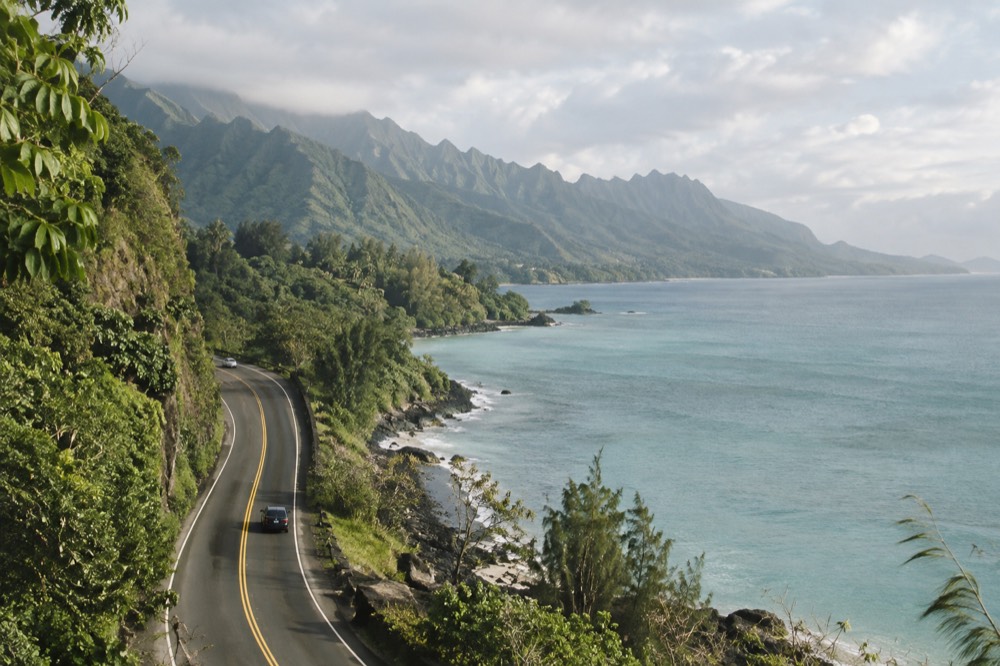
An Oahu sightseeing loop can connect the southeast coast, windward coast and North Shore, then return through central Oahu. It is not a continuous coastal drive around the island: Kaʻena Point does not provide a through-road for ordinary rental cars between the North Shore and the Waiʻanae coast.
The two decisions that matter are where to cross the Koʻolau range, the Pali Highway or Likelike, and whether to add a separate out-and-back visit to the leeward coast.
The classic day is the counter-clockwise loop: windward first, North Shore second, so the sun and the beach stops land in the right order. The H-1, H-2 and H-3 freeways are all Honolulu-side; beyond Kāneʻohe and ʻAiea you are on two-lane highway for the rest of the day.
One live caution: the Nuʻuanu Pali Lookout, the traditional first stop on a loop over the Pali, is closed until further notice as of the September 2026 DLNR storm-repair notice following Hurricane Lowell, along with Kaʻena Point State Park's Mokuleʻia and Keawaʻula sections. Check the state parks notices the week you travel, because a route plan that assumes the lookout is open will need a substitute, and the leeward loop's signature endpoint is also currently shut. Kaʻena Point is additionally a place of cultural significance, a leina where souls depart, and a protected seabird area, so it deserves restraint even when open.
For stops along the way, the destination guides carry the detail: Haleʻiwa town, Kailua and the North Shore.
When Is Renting A Car On Oahu A Mistake?
Renting is a mistake when your hotel is in Waikiki, your itinerary is tours and beaches within the Honolulu corridor, and you would be paying for parking on the days the car sits idle, which is the single most common pattern among first-time visitors. It is also a mistake for anyone unwilling to plan parking at every stop, and for cruise passengers in port for a single day, where a tour bus beats a rental counter queue.
The waste is usually invisible at booking time. A week-long rental feels like freedom, but if four of the seven days are a luau, a Pearl Harbor morning, a Waikiki beach day and a snorkel tour, the car spent those days in a paid stall. The honest arithmetic is to price the rental plus seven nights of parking against a couple of partial-week rentals or a couple of tours, and the tours frequently win once parking is counted.
The cruise case is even clearer. Port days are short, and the time cost of a rental counter, both directions, eats the day. A circle island tour with confirmed pickup can cover a sightseeing route with someone else handling the driving. Check the return time against your ship’s all-aboard deadline; the products compared here do not establish cruise-terminal pickup or a return guarantee, while the Byodo-In tour is another full-day option with a temple stop. Neither should be booked for a cruise call without checking pickup and return times.
The decision tool after the FAQ compares a rental, Honolulu trolley sightseeing, guided island days and a separate airport ride against the type of day you want.
There is also a respect argument that is also a practical one. The neighborhoods that visitors most want to drive into, Lanikai, Mānoa, the North Shore towns, are the ones carrying the heaviest visitor pressure on infrastructure built for residents. Choosing the bus, a tour or a shuttle on some days is not a compromise, it is the difference between visiting a place and wearing it out.
Common Questions About Car Rental On Oahu
Most questions about renting a car on Oahu come down to three things: whether your base makes a car necessary, what parking will actually cost you, and whether a tour or the bus does the same job for less. The answers follow your itinerary rather than the island itself, Waikiki-based visitors can skip the car entirely on transit and tours, while anyone basing outside Honolulu or chasing the country side several times will want wheels for those days at minimum.
Is it worth renting a car on Oahu?
Only if you will drive it most days. Waikiki-based visitors doing tours, beaches and Pearl Harbor can manage entirely on TheBus, Skyline and shuttles, at $7.50 a day capped on a HOLO card. If you plan three or more days on the North Shore, windward or leeward coasts, a rental earns its cost, and a partial-week rental from a Waikiki or downtown branch is often the best value of all.
Do I need a car to get from Honolulu Airport to Waikiki?
No. Skyline rail now serves the airport via the Lelepaua station, with bus transfers onward to Waikiki, and airport shuttles and taxis cover the run directly. Collecting a rental car at the airport only makes sense if you are driving somewhere the day you land.
Is parking difficult on Oahu?
At the popular places, yes. Waikiki hotel stalls are expensive and limited, beach lots fill early on weekends, and residential streets near beaches like Lanikai carry no-parking restrictions with towing enforced. Plan arrival times around parking, not around optimism.
Are there toll roads on Oahu?
No. There are no toll roads, bridges or express lanes a visitor can enter, so there is no reason to accept a toll pass at the rental counter.
Can I drive around the whole island in one day?
You can drive a sightseeing loop through the southeast, windward coast, North Shore and central Oahu in a day if your stops allow enough time. You cannot continue around Kaʻena Point on an ordinary rental-car road, so the leeward coast requires a separate route. Note that the Nuʻuanu Pali Lookout and sections of Kaʻena Point State Park were closed for storm repairs as of September 2026, so check state parks notices before you plan stops.
What is the cheapest way to get around Oahu without a car?
TheBus, on a HOLO card. A two-hour pass with transfers costs $3.00, the day caps at $7.50, and a 7-day pass is $45.00, which is less than a single night of hotel parking in Waikiki. For sightseeing days, the hop-on hop-off trolley and circle island tours replace the car entirely.
The final word is that Oahu rewards matching the tool to the day rather than committing to one tool for the week. Drive the loop on the day the loop makes sense, ride the bus on the days it does, and let the parking stall at your hotel stay empty more often than not.
Choose Transport For Your Oahu Plans
Start with the option below, or choose the kind of day you want. These are planning choices; final eligibility, schedules and prices are checked with the provider.
Compare Honolulu Airport Rentals
A rental gives you control of departure times and stops. Compare quotes for the days you will actually drive, then add parking and fuel to your budget. Check branch hours and your full quote before fixing the driving days.
Check the supplier’s age, licence, payment-card, deposit and pickup conditions. Quote totals and branch hours depend on your dates.
Compare Your Transport Estimates
Enter totals for the same travel days and your whole party in USD. These are your estimates, not live quotes. Include rental taxes and fees in the first total; add only parking and fuel that are not already included. Include any transfers or admission you would buy separately in the car-free total, once only.
Choose your dates, pickup and driver details on EconomyBookings. This link opens a rental search, not live results on this page.