Box Jellyfish Calendar On Oahu: When They Arrive And How To Plan Around Them
Box jellyfish arrive on Oahu's south shore beaches on a schedule tied to the lunar cycle, roughly eight to ten days after each full moon, and the influx usually lasts two to three days.
Short answer
Box jellyfish reach Oahu's south shore beaches roughly 7 to 11 days after each full moon, with the arrival usually concentrated into a two to three day window. Waikīkī, Ala Moana and other south facing beaches post warning signs during influxes. The stings are painful but rarely life threatening, and vinegar plus hot water is the standard first aid.
Oahu's box jellyfish do not arrive randomly. They show up on the south shore on a schedule that tracks the full moon, which means you can plan around them, and most visitors never think to. The influx typically lands seven to eleven days after each full moon, hits the busiest swimming beaches on the island, and clears within a few days. This guide lays out the calendar logic, the beaches that bear the brunt, what a sting actually feels like, and what to do if you or someone near you gets stung.
What Is The Box Jellyfish Calendar On Oahu?
The box jellyfish calendar is the recurring pattern in which these animals arrive on Oahu's south facing beaches roughly seven to eleven days after each full moon, with the peak usually falling eight to ten days after. Because the moon runs on a fixed cycle, the influxes repeat every month of the year, in summer and winter alike. Lifeguards post warning signs when an influx is detected, and the animals typically clear out within two to three days.
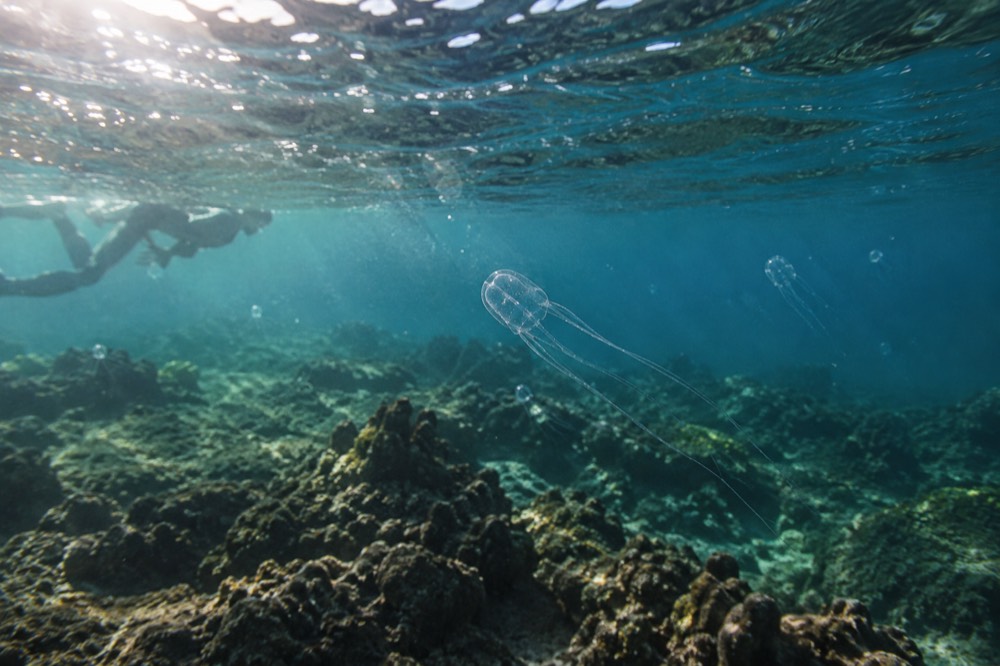
The species involved is a small box jellyfish, Alatina alata, and it is not the basketball-sized Australian box jellyfish that headlines nature documentaries. Oahu's version is modest in size but packs a genuinely painful sting, and it arrives in numbers large enough to close stretches of Waikīkī some months.
The mechanism is still being studied, but the pattern itself is well established and consistent enough that the state's ocean safety community treats it as a planning fact rather than a curiosity. Researchers at the University of Hawaiʻi have tracked the arrivals for years, and the lunar link holds across decades of records.
One point worth repeating: the calendar does not take a season off. Visitors often assume jellyfish are a summer problem, but the arrival after the January full moon is just as real as the one after the July full moon. What changes is how many people are in the water when it happens.
When Do Box Jellyfish Arrive On Oahu Beaches?
Count forward from the full moon. The first animals usually appear on the south shore about seven days after the full moon, numbers peak around eight to ten days after, and the influx is generally over by day eleven. That gives you a two to three day window each month when the risk is elevated. If you are picking swim days, the simplest rule is to check the full moon date and avoid the south shore in that trailing week.
The arrival also has a daily rhythm. Box jellyfish come toward the beach in the early morning hours, so the counts on a given influx day are usually highest before mid-morning and taper through the afternoon as the animals drift back out or wash in and die on the sand.
Here is the planning table in its most useful form:
| Days after full moon | What usually happens on the south shore |
|---|---|
| Days 1 to 6 | Normal conditions, no influx expected |
| Day 7 | First arrivals possible, scattered animals |
| Days 8 to 10 | Peak influx, warning signs posted if counts are high |
| Day 11 and later | Influx tapering off, conditions returning to normal |
Because the lunar cycle runs a little shorter than a calendar month, the influx drifts a few days earlier each month relative to the date of the previous one. If you are on the island for a week, there is a real chance your week either contains an influx window or misses it entirely. Checking the full moon date for your travel month is the single highest-value minute of trip planning you can spend on this.
If your dates land on an influx window, the fix is usually simple: swim on the north or east shore that day instead. The influx is a south shore phenomenon, driven by the animals' approach across the open channel south of the island. The same logic applies in reverse for planning a full island day, which is why a circle island tour is a natural hedge on a jellyfish day.
A circle island day moves you around the whole coastline, so a closed beach in Waikīkī costs you nothing. For more on dividing the island by shore and season, our Oahu ocean safety guide covers the hazards that actually matter here, and the best beaches on Oahu overview breaks the island down by coast.
Which Oahu Beaches Are Affected By Box Jellyfish?
The south shore takes the influx: Waikīkī Beach, Ala Moana Beach Park, Queen's Beach, Kapiʻolani Regional Park beaches, and the stretch from Diamond Head to Hanauma Bay are the classic arrival zones. Waikīkī and Ala Moana see the highest numbers and the most posted warnings because they face directly south and carry the heaviest swimmer traffic. North, east and west facing beaches are largely unaffected by the monthly arrival, though individual animals can drift anywhere.
The south shore concentration matters for two reasons. First, it is where most visitors swim, since the resort corridor sits on that coast. Second, the south shore is also Oahu's calmest water in winter, so the beaches people retreat to when the north shore is too rough are the same ones the jellyfish calendar hits.
| Beach | Exposure to influx | Notes for influx days |
|---|---|---|
| Waikīkī Beach | High | Warning signs posted most influxes, heaviest swimmer traffic |
| Ala Moana Beach Park | High | Calm, family-heavy water, check signs before entering |
| Queen's Beach / Kapiʻolani parks | High | Close to Waikīkī, same arrival pattern |
| Hanauma Bay | Possible | Influxes have been recorded; check with staff on arrival |
| North and east shore beaches | Low | Not part of the monthly arrival pattern |
| West shore beaches | Low | Occasional stray animals, no recurring influx |
Lifeguards handle the practical warning system. When an influx is detected, ocean safety crews post box jellyfish signs at affected beaches and update the counts daily until the animals clear. A posted sign is the authoritative signal, and it outranks any forecast or app: if the sign is up, stay out or swim with real caution. If you want the broader picture of how conditions vary around the island, the Oahu weather by month guide pairs well with this calendar, and for a full island orientation the Oahu Travel Guide homepage ties the pieces together.
How Dangerous Are Box Jellyfish Stings Really?
For most people, an Oahu box jellyfish sting is intensely painful but not dangerous: immediate sharp burning pain, welts in a whip-like pattern where the tentacles touched, and symptoms that ease over one to three hours. A minority of people have a stronger systemic reaction, with nausea, muscle cramps, difficulty breathing or fainting, and those cases need emergency care immediately. Children, elderly swimmers and anyone with heart or respiratory conditions should treat any sting seriously.
This is a real hazard with a low worst-case frequency. Oahu sees thousands of stings in heavy influx months, and emergency departments treat the vast majority with basic care and release. Severe reactions are uncommon but well documented, which is why the standard advice is not "tough it out" but "treat it properly and watch for systemic symptoms."
The pain is the part people underestimate. Descriptions from stung swimmers consistently rank it well above a bee sting, closer to a burning electric shock, and the welts can leave marks that last days. It will ruin a beach day. It is very unlikely to ruin a trip, provided the first aid is done right and red-flag symptoms are acted on fast.
What Should You Do For A Box Jellyfish Sting?
Get out of the water, then rinse the area with vinegar to neutralize any unfired stinging cells still on the skin, remove any tentacle fragments with tweezers or a gloved hand, and immerse the stung area in hot water, as hot as the person can comfortably stand, for twenty to forty minutes. Do not rub the area, do not rinse with fresh water, do not apply urine, ice or meat tenderizer. Call emergency services for any difficulty breathing or fainting.
The sequence matters because box jellyfish tentacles carry stinging cells that continue firing after the animal is no longer attached. Fresh water and rubbing both trigger more firing. Vinegar, which lifeguards and emergency crews in Hawaii carry for exactly this purpose, inhibits the remaining cells, and the hot water breaks down the toxin already delivered.
| Step | Do | Why |
|---|---|---|
| 1 | Exit the water and call or signal for help | Prevents repeat stings and gets eyes on symptoms |
| 2 | Rinse with vinegar for about 30 seconds | Stops unfired stinging cells from firing |
| 3 | Remove tentacle bits with tweezers or a gloved hand | Physical removal without triggering more stings |
| 4 | Hot water immersion, 20 to 40 minutes | Heat degrades the toxin and relieves pain |
| 5 | Watch for systemic symptoms for the next few hours | Delayed reactions are possible |
| Never do this | Why it fails |
|---|---|
| Rub the sting site | Triggers more stinging cells to fire |
| Rinse with fresh water | Osmotic shock fires remaining cells |
| Apply urine, ice or alcohol | No benefit, may worsen the sting and the firing |
| Scrape with a card before vinegar | Spreads and triggers cells |
Lifeguard towers on the south shore keep vinegar on hand during influx periods, and they are the fastest source of competent help on the beach. If you are swimming at an unguarded stretch, carry a small bottle of vinegar in your beach bag during the influx window. It costs a couple of dollars and it is the single most useful item in an Oahu beach kit for those weeks.
One more practical note: if you are traveling with children, brief them before the swim, not after. A kid who knows to come straight out of the water and tell an adult, rather than thrashing or rubbing the sting, avoids the two responses that make a sting measurably worse. The same briefing is worth giving to anyone in your group who has a history of strong allergic reactions to stings or bites, since they are the most likely to need the emergency response rather than the home version of it.
Can You Still Swim On Oahu During A Box Jellyfish Arrival?
Yes, but not on the affected south shore beaches during the peak days. The practical move is to shift your swimming to the north, east or west shore for the two to three days of the influx, or to swim on the south shore only in the late afternoon, when counts are usually lower, and only if no warning signs are posted. Many visitors structure an influx day around a circle island drive and swim on a different coast entirely.
The influx window is short and the island is small. A morning at Waimea Bay or Kailua Beach Park, neither of which is part of the south shore arrival pattern, costs you nothing but the drive. If you have already booked a south shore activity such as a catamaran sail or a surf lesson, check with the operator: boats can usually reroute or reschedule, and lessons are commonly pushed to the following morning.
The most-booked circle island day on Oahu is a natural fit for a jellyfish window, because it converts a lost beach morning into a full island tour with stops on coasts the influx does not touch. Operators run this as a guided day with the major lookouts and a Haleʻiwa town stop, and it is the tour most visitors use as their fallback when Waikīkī conditions turn.
For a slower-paced alternative that reaches the windward coast and Byodo-In Temple, the hidden gems circle island tour covers similar ground with more time at fewer stops:
One planning nuance worth knowing: the influx and the box jellyfish calendar are not the same thing as jellyfish presence in general. Smaller numbers of box jellyfish and other stinging species appear sporadically year round on any coast. The calendar is about the predictable monthly pulse, and it is the part you can actually schedule around.
How Do You Check The Box Jellyfish Forecast Before You Swim?
Start with the full moon date for your travel month and count forward seven to eleven days to get the risk window. Then confirm against current conditions: look for posted warning signs at the beach, ask the lifeguard tower directly, and check the ocean safety and University of Hawaiʻi jellyfish reporting channels, which publish influx counts during active arrivals. A posted sign is the final word, and no forecast overrides it.
The lunar calculation is something you can do from a calendar app in thirty seconds, and it is genuinely reliable for identifying the risk window. What it cannot tell you is the size of a given month's influx, which varies a lot. Some months produce a light scattering, some produce enough animals to post warnings across the whole south shore, and the difference only shows up in the actual counts as the arrival begins.
If you are staying on the south shore, make it a habit during the risk week to glance at the beach in the early morning. Jellyfish that washed in overnight are visible on the sand, and a beach with a dozen animals on it at 7 a.m. is telling you exactly what the water holds.
For visitors who want the flexibility to move around the island without renting a car or rebooking day by day, an attractions pass covers the cost question in one purchase:
The pass route works well here because the strongest jellyfish hedge is simply having a plan B for the water, and the island's paid attractions, from the Polynesian Cultural Center to Kualoa Ranch, sit on coasts the influx does not touch.
Common Questions About Box Jellyfish On Oahu
Most questions about box jellyfish on Oahu come down to three things: the timing, the location, and the response. The timing is lunar, seven to eleven days after each full moon. The location is the south shore, chiefly Waikīkī and Ala Moana. The response is vinegar, tentacle removal, hot water, and emergency care for any systemic symptoms. Everything else, from whether to cancel a swim to whether a sting needs a hospital, follows from those three facts.
How many days after the full moon do box jellyfish arrive on Oahu?
Usually seven to eleven days after the full moon, with the peak around eight to ten days after. The influx typically clears within two to three days.
Which Oahu beaches get box jellyfish?
The south shore: Waikīkī, Ala Moana Beach Park, Queen's Beach and the Kapiʻolani park beaches are the classic arrival zones, with Hanauma Bay occasionally affected. North, east and west shore beaches are not part of the monthly arrival.
Are box jellyfish on Oahu dangerous?
The sting is very painful but rarely life threatening. Most cases resolve with basic first aid within hours. A small number of people have systemic reactions with breathing difficulty, cramps or fainting, and those need emergency care immediately.
What is the first aid for a box jellyfish sting?
Rinse with vinegar, remove tentacle fragments with tweezers or a gloved hand, then immerse the area in hot water for twenty to forty minutes. Do not rub the sting or rinse it with fresh water. Call emergency services for difficulty breathing, chest pain or fainting.
Do box jellyfish come every month on Oahu?
Yes, the lunar pattern repeats year round, including winter. The size of each month's influx varies, but the timing window is consistent enough to plan around.
Can I swim during a box jellyfish influx?
Not on the affected south shore beaches during peak days. Shift to a north, east or west shore beach for the two to three day window, or swim south only in the late afternoon if no warning signs are posted and lifeguards confirm conditions are clear.
The box jellyfish calendar is one of the most predictable hazards on the island, and planning around it takes minutes. Check the full moon date, count forward a week and a half, keep your swimming flexible across coasts for those days, and put a bottle of vinegar in the beach bag just in case.