Best Hikes On Oahu: Every Trail Worth Your Time
Oahu packs ridgelines, rainforest valleys and crater climbs into a circle you can drive in a day. Here is what each of the island's best hikes actually involves, what reservations they need, and which ones are closed right now.
Short answer
The best hikes on Oahu are Diamond Head (Lēʻahi), the Mānoa Falls trail, the Koko Crater Railway Trail, the Makapuʻu Point Lighthouse Trail and the Lanikai Pillbox hike. Diamond Head requires a reservation and a $5 per person entry fee for non-residents; the others are free to walk. Kaʻena Point and the Nuʻuanu Pali Lookout are closed for storm repairs as of September 2026.
Oahu is a small island with an outsized range of walking. One morning you can climb a dried lava crater above Waikīkī, and by afternoon be under a rainforest canopy five miles away where the weather behaves like a different country. The island took 5,679,047 visitors by air in 2025, and a large share of them attempt the same handful of trails, so the real planning problem on Oahu is not finding a hike. It is knowing which ones need reservations, which ones are closed this month, and which ones your knees will forgive you for.
This overview covers the trails that earn their reputation, from the paved and pushchair-friendly to the ones that leave your calves shaking. Reservation rules and closures below are checked against the official state and city sources.
What Are The Best Hikes On Oahu?
The best hikes on Oahu are Diamond Head (Lēʻahi) for the classic crater panorama, Mānoa Falls for rainforest and a 150-foot waterfall, the Koko Crater Railway Trail for a brutal staircase climb, the Makapuʻu Point Lighthouse Trail for a paved coastal walk, and the Lanikai Pillbox hike for sunrise views over the Mokulua islands. All five sit within reach of Waikīkī, and together they cover crater, valley, coast and ridge in one week of walking.
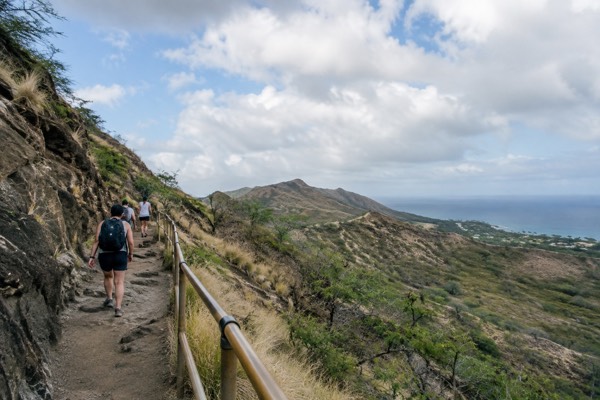
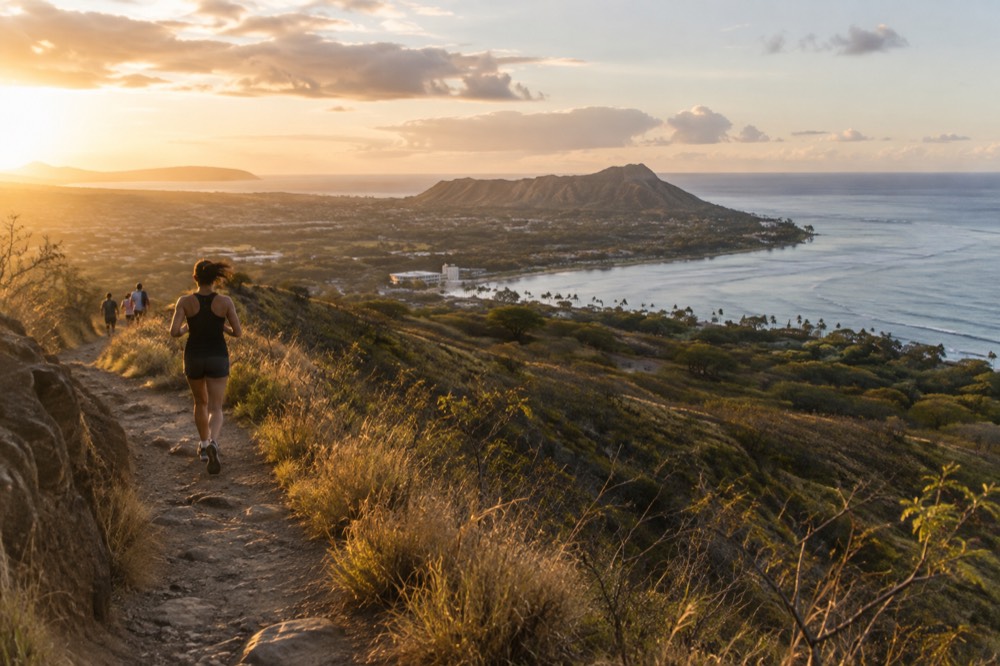
Each of those five earns its place for a different reason, and the differences matter more than any ranking. Diamond Head is the island's signature walk: a 1.6-kilometre round trip through a crater built by a single explosive eruption, ending at a bunkered lookout over Waikīkī and the leeward coast. It is short, it is busy, and it is the one trail on this list that non-residents cannot walk without a reservation.
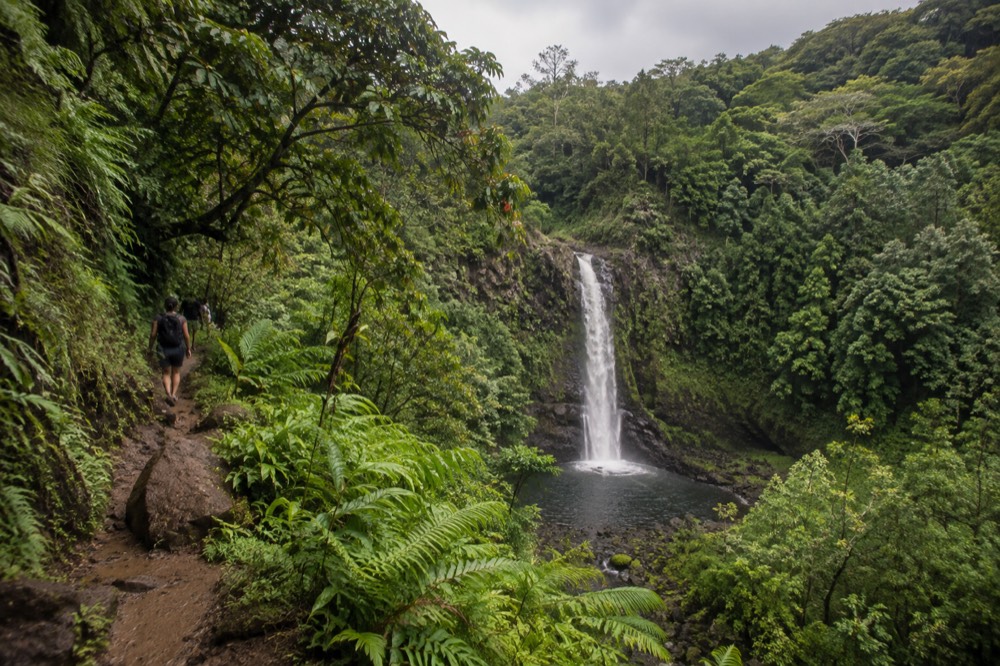
Mānoa Falls trades ocean for canopy. The trail runs through rainforest to a 150-foot waterfall that runs hardest after rain, which on the windward side of the Koʻolau range is often. The Koko Crater Railway Trail is the opposite experience: over a thousand old railway ties climbed like stairs, straight up the crater's spine, with the reward being a view over Hanauma Bay and the east coast. It is hard and it is exposed, and people who hate stairs should skip it.
To walk the rainforest trail to the falls yourself, book a self-guided Manoa Falls hike here.
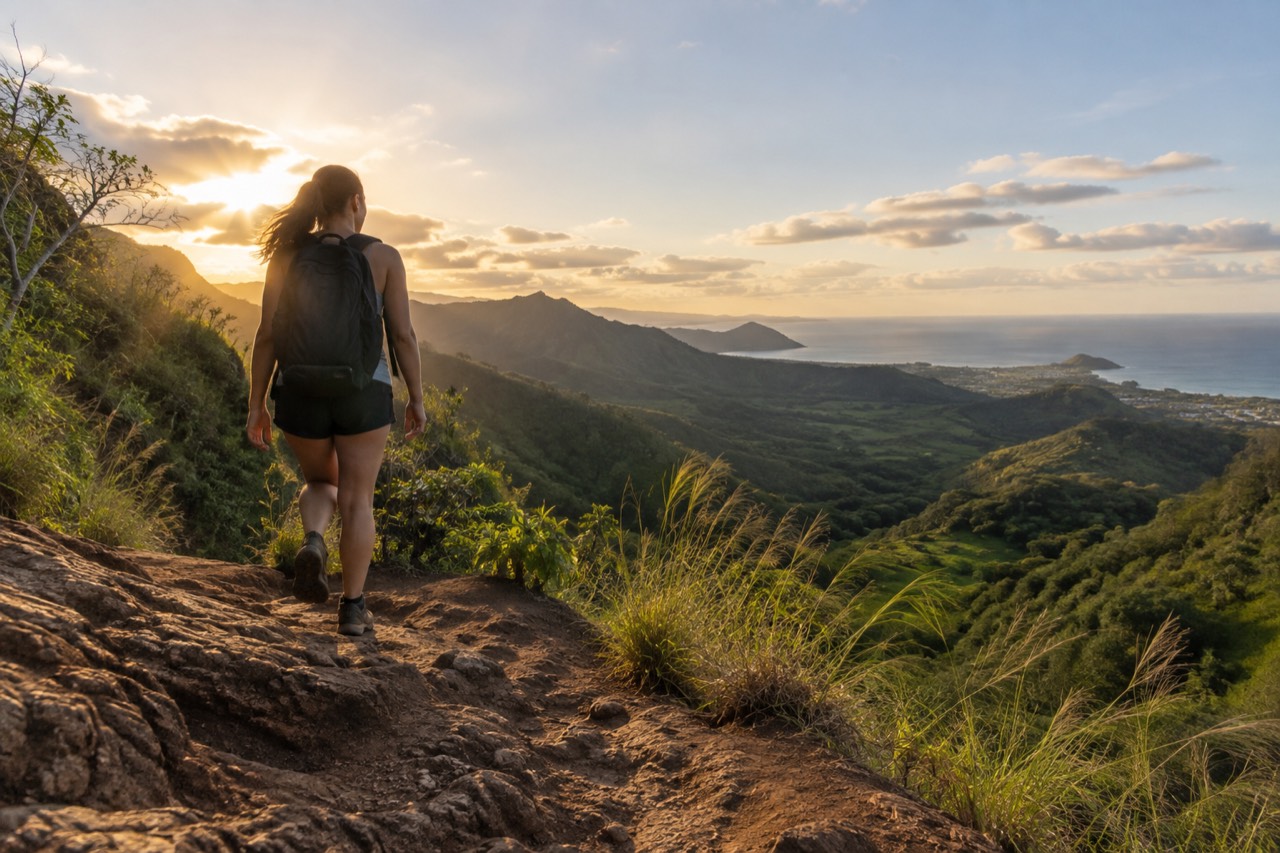
The Makapuʻu Point Lighthouse Trail is the easy one: fully paved, gently climbing, suitable for wheels in dry weather, with whale-watching potential from November through April when humpbacks are in Hawaiian waters. The Lanikai Pillbox hike, properly the Kaʻōhao ridge trail, is short but steep, and it is the island's most popular sunrise walk because it faces the Mokulua islands directly.
Beyond those five, the island's serious walking is in the Koʻolau range and on the North Shore. The full details for the crater, the valley and the stairs live on their own pages: the Diamond Head State Monument guide, the Mānoa Falls trail guide and the Koko Head crater trail guide.
Which Oahu Hikes Need Reservations Or Tickets?
Diamond Head is the only major Oahu hike requiring a reservation for non-residents, and it has since 12 May 2022: entry costs $5 per person plus $10 per non-resident vehicle, credit card only, with no on-site sales. Hawaii residents walk in free with state ID. Hanauma Bay, often grouped with hikes, costs $25 for non-residents and also needs a timed reservation, opening two days ahead at 7 a.m. HST.
Every other trail on this page is free to walk.
The Diamond Head reservation rule is the one that wrecks itineraries, because a large share of travel content online still predates it. You cannot arrive at the gate and pay; the monument takes reservations for both entry and parking, bookable up to 30 days ahead. The park runs 6 a.m. to 6 p.m. daily except Christmas and New Year's Day, with last entry at 4:30 p.m. If walking in from outside, only the per-person fee applies.
Hanauma Bay is a snorkelling spot rather than a hike, but the walk down from the rim is real exercise and the reservation system is stricter than Diamond Head's. The bay closes Mondays and Tuesdays plus Christmas and New Year's Day, entry is allowed 6:45 a.m. to 1:30 p.m., and everyone must be out by 4 p.m. Children 12 and under enter free, and Hawaii residents enter free without a reservation at all.
| Trail or site | Reservation needed? | Cost for non-residents | Residents |
|---|---|---|---|
| Diamond Head (Lēʻahi) | Yes, entry and parking, since May 2022 | $5 per person, $10 per vehicle, card only | Free with Hawaii ID |
| Hanauma Bay | Yes, timed slot, opens 2 days ahead at 7 a.m. HST | $25 plus online service fee | Free, no reservation, with ID |
| Mānoa Falls | No | Trail free; parking charged by a private lot | Same trail access |
| Koko Crater Railway Trail | No | No fee charged | Same |
| Makapuʻu Point Lighthouse Trail | No | Free | Free |
| Lanikai Pillbox hike | No | Free; street parking is restricted | Free |
The Mānoa Falls row carries a caveat worth spelling out. The trail itself is free, but parking is handled by a private operator beside the trailhead, and the fee is charged by that lot rather than by the city or state. The widely repeated parking figure has not been confirmed from an official source, so check the current rate at the lot rather than budgeting from a number read online.
If reservation logistics sound like more admin than a holiday needs, guided options exist that bundle the Diamond Head ticket and transport, which is exactly the problem they solve.
Can You Hike Diamond Head Without Sorting The Ticket Yourself?
Yes, but the reservation still has to exist. A guided Diamond Head tour does not exempt you from the entry system; what it does is make the booking for you and add a shuttle from Waikiki, so you arrive with the ticket and the transport already handled. That matters most in high season, when the timed slots for the monument and its parking lot go days ahead, and for travellers staying in Waikiki without a rental car.
The most-booked version of this runs about three hours door to door, with the entry reservation and the shuttle both included, and it is rated 4.8 from just under a thousand traveller reviews on the operator's live listing. For a family or anyone travelling car-free, the arithmetic often works: the tour price sits against the entry fee, the parking fee and the time cost of getting the reservation right yourself.
The trade-off is simple. A guided ticket costs more than walking in on your own reservation, and the fixed departure time removes the early-morning option that beats both the crowds and the heat. Independent walkers who book their own slot at opening time get the crater nearly to themselves for the first hour. Guided walkers get certainty and a ride. Neither is wrong; it depends on whether your trip has slack in it.
Which Oahu Hikes Are Best For Beginners?
The Makapuʻu Point Lighthouse Trail is the best beginner hike on Oahu: fully paved, about two miles round trip, climbing gently to a lookout over a historic lighthouse, with whale viewing from November through April. The Diamond Head trail is the next step up, wide and well-graded but with two sets of stairs and an unlit tunnel near the summit. Both are manageable for anyone who can walk a couple of miles in the sun.
Makapuʻu is the one to give a reluctant hiker. There is no shade, so go early or late and carry more water than feels reasonable, but the surface never turns technical and there are benches along the way. The full write-up, including the tide pools below the trail, is in the Makapuʻu Point lighthouse trail guide.
Diamond Head is only moderately harder. The path is paved and then compacted, the switchbacks are forgiving, and the famous summit section involves a narrow tunnel, a spiral staircase and a short scramble over rocks that is the only place nervous walkers slow down. Allow ninety unhurried minutes. The crater has almost no shade after the first section, and the Hawaii sun is the real difficulty, not the gradient.
The Mānoa Falls trail is the beginner pick on the windward side, with one honest warning: it is rainforest, so the path is often muddy and occasionally slick even on days when Waikīkī is dry. Footwear with grip matters more here than fitness does. A self-guided version with transport from Waikīkī exists for walkers who want the logistics handled while keeping the walk itself private.
What Are The Hardest Hikes On Oahu?
The Koko Crater Railway Trail is the hardest widely accessible hike on Oahu: more than a thousand former tramway ties climbed as stairs, gaining serious elevation on a route with no shade and no water. Above it sit the Koʻolau summit ridge trails, which are steeper, muddier and far less forgiving, and which should only be attempted by experienced hikers with proper footwear and a weather check.
The stairs are the hardest thing most visitors will ever voluntarily do before lunch.
Koko Crater, often called the Koko Head stairs, was a cable tramway track built to haul supplies to a military installation at the summit. The railway is gone; the ties remain, and they now function as the stairmaster to end all stairmasters. The reward is a sweeping view over the east coast, Hanauma Bay and, on clear days, Molokaʻi in the distance. Start early. The route is fully exposed, and the midday sun on those ties is the reason local walkers treat it as a dawn ritual.
The Koʻolau ridge trails above Honolulu are a different category of difficulty. They climb the pali, the steep windward face of the range, on root ladders and mud chutes where the weather can flip in minutes. Flash floods are a real hazard in the valleys, and the island's rain pattern explains why: the Mānoa valley, five miles from Waikīkī, records an annual rainfall normal of 150.96 inches against 16.41 inches at Honolulu airport. A valley five miles inland lives under nine times the rain. Check the forecast for the valley, not the beach, before committing to a ridge.
| Trail | Difficulty | Exposure | Shade | Best for |
|---|---|---|---|---|
| Makapuʻu Point Lighthouse Trail | Easy | Full sun | None | Beginners, whale season |
| Diamond Head (Lēʻahi) | Easy-moderate | Mostly full sun | Little | First-timers, the classic view |
| Mānoa Falls | Moderate | Forest | Full | Rainforest, families |
| Lanikai Pillbox hike | Moderate | Ridge, full sun | None | Sunrise, short and steep |
| Koko Crater Railway Trail | Hard | Full sun | None | Fitness, the big view |
| Koʻolau summit ridge trails | Very hard | Ridge and mud | Mixed | Experienced hikers only |
Which Oahu Trails Are Closed Right Now?
Two of Oahu's headline walking destinations are closed as of September 2026: the Nuʻuanu Pali Lookout and Kaʻena Point State Park, both shut until further notice for repairs after Hurricane Lowell, per a DLNR notice dated 9 September 2026. Wahiawā Freshwater State Recreation Area is also closed. Every other state park on the island had reopened at that date. Any itinerary naming the Pali Lookout or Kaʻena Point needs a re-check the week you travel.
The Pali closure matters more than it looks on a map, because the lookout is the natural stop on any route over the Koʻolaus between Honolulu and the windward side, and several popular ridge walks start near it. Kaʻena Point matters for a different reason: it is the island's far northwest tip, a leina a ka ʻuhane where souls depart the living world in Hawaiian tradition, and also a protected seabird and monk seal area behind a predator-proof fence. It deserves restraint in any case, and right now it is simply not available.
The closures are a moving situation, and the state posts updates on the DLNR State Parks notices page. Storm-related reservation refunds are being processed automatically, minus non-refundable service charges, over four to six weeks, which is worth knowing if you hold a booking for an affected site.
When Is The Best Time Of Year To Hike On Oahu?
There is no bad month to hike on Oahu, but there are better months for specific trails. Winter, roughly November through March, brings the island's rainiest weather and its biggest surf on north-facing shores, which suits valley and crater walks but argues against exposed ridge climbs after heavy rain. Summer is drier and hotter, better for ridgelines and worse for anything at midday. Whale season, November through April, adds a reason to walk the Makapuʻu coast.
Oahu's seasons are wet versus slightly less wet, not the four-season calendar most visitors bring with them. Honolulu's driest month, June, still averages half an inch of rain, and the windward side of the island never dries out at all. The planning consequence is simple: on any given morning, one side of the island is often walkable while the other is not, and the flexibility to swap a Mānoa valley morning for a leeward crater walk is worth more than any date choice.
Heat is the underrated variable. The island's day length swings only about two hours and thirty-five minutes across the entire year, and sunset never gets later than about 7:17 p.m., so there are no long summer evenings to rescue a late start. What there is, reliably, is a 6 a.m. sunrise. Local hikers use it. The Koko Crater stairs at dawn, Diamond Head at opening, the Lanikai Pillbox before the sun clears the ridge: these are not secrets, they are just the hours that make the walks pleasant instead of punishing.
What Should You Bring On An Oahu Hike?
Bring more water than feels necessary, sun protection for a trail with no shade, and footwear with real grip for anything on the windward side: those three cover most Oahu hiking mistakes. Add reef-safe sunscreen, a fully charged phone, and cash only where a lot demands it, such as the private parking beside the Mānoa Falls trailhead. For the Koʻolau ridge trails, add a weather check, because flash floods in the valleys are a genuine hazard.
Footwear deserves a paragraph of its own because it is where visitors most often get it wrong. The Mānoa Falls trail is muddy most of the year, the Koko Crater ties are uneven and polished, and the ridge trails are root ladders. Running shoes with worn tread are the wrong tool for all three. Trail shoes or anything with a lugged sole change the experience completely, and they are rentable on the island if packing them is not an option.
Water follows the sun. Most of the island's best walks, including Diamond Head, Makapuʻu, Koko Crater and the Pillbox trail, have essentially no shade for their entire length, and the heat on an exposed slope is a different animal from the beach at the same hour. Carry a litre minimum per person on anything short, two on Koko Crater, and drink before feeling thirsty. There is no water sold at any of these trailheads.
| Trail | Water | Footwear | Sun protection | Key hazard |
|---|---|---|---|---|
| Diamond Head | 1 litre | Any closed shoe | Essential, little shade | Heat, summit stairs |
| Mānoa Falls | 1 litre | Grip essential | Useful | Mud, flash flood risk in heavy rain |
| Koko Crater Railway | 2 litres | Grip essential | Essential, no shade | Heat, uneven ties |
| Makapuʻu Point | 1 litre | Any closed shoe | Essential | Heat, shore access rocks |
| Lanikai Pillbox | 1 litre | Grip useful | Essential | Heat, parking restrictions |
One more thing that belongs on the list: restraint around wildlife and places. Honu, the green sea turtles seen near several coastal trails, carry a recommended viewing distance of about 10 feet, and monk seals about 50 feet, both guidelines rather than statutory distances, though harassing either is illegal under state and federal law. Humpback whales, if you spot them from the Makapuʻu lookout between November and April, are protected by a 100-yard approach rule that is law. And leave the rocks and sand where they lie: removing them from the shoreline is prohibited under Hawaii law, which is the actual reason, ahead of any invented curse stories.
For travellers whose ideal day involves a viewpoint without the climb, a half-day van tour of the island's lookouts covers the same panoramas with none of the stairs, and pairs well with a week that already includes one or two big walks.
Common Questions About Oahu Hikes
Most questions about Oahu hikes come down to four things: whether a reservation is needed, what the walk costs, how hard it is, and whether it is open this month. Diamond Head is the only headline trail requiring a non-resident reservation, at $5 per person plus $10 to park; the rest are free.
Difficulty runs from a paved two-mile stroll at Makapuʻu to the thousand-step Koko Crater climb, and the Pali Lookout and Kaʻena Point are closed for storm repairs as of September 2026.
What is the best hike on Oahu for first-timers?
The Makapuʻu Point Lighthouse Trail: fully paved, gently graded, about two miles round trip, with a lighthouse and open-ocean views. Diamond Head is the alternative if the crater itself is the draw, and it is manageable for anyone comfortable with stairs.
Do you need a reservation to hike Diamond Head?
Non-residents do, for both entry and parking, a rule in force since 12 May 2022 with no on-site sales. Entry is $5 per person and parking $10 per vehicle, credit card only. Hawaii residents enter free with state ID.
Is the Mānoa Falls hike free?
The trail itself is free. Parking beside the trailhead is run by a private lot that charges a fee, and the current rate should be checked at the lot, as the widely repeated figure has not been confirmed from an official source.
How hard is the Koko Crater Railway Trail?
Hard. The route climbs steeply up more than a thousand old tramway ties, with no shade and no water. It is short in distance but relentless, and it is best started at dawn.
Which Oahu hikes are closed right now?
As of the DLNR notice dated 9 September 2026, Nuʻuanu Pali Lookout and Kaʻena Point State Park are closed until further notice after Hurricane Lowell, along with Wahiawā Freshwater State Recreation Area. Re-check the DLNR notices the week you travel, as this changes.
Can you hike to a waterfall on Oahu?
Yes. The Mānoa Falls trail reaches a 150-foot waterfall through rainforest, and Waimea Valley on the North Shore has a paved walk to its falls, though the valley is closed Mondays and charges admission, $26 for an adult. Whether you can swim at either is decided on the day by conditions and staff, so treat swimming as a possibility, not a promise.
The through-line of all of this: Oahu's trails reward planning more than fitness. Book the crater slot, check the DLNR notices, look at the valley forecast rather than the beach one, and start early. Do those four things and the island's best walks, from the paved coast to the crater stairmaster, are all comfortably within reach on a single trip, as the Oahu Travel Guide lays out across its individual trail pages.