Lanikai Pillbox Hike: What The Kaiwa Ridge Trail Involves, Access, Timing And Whether It Is Worth It
The Lanikai Pillbox Hike, properly the Kaiwa Ridge Trail, is a short, steep climb above the Kaʻōhao neighbourhood of Kailua that ends at old military observation bunkers with a panorama over the Mokulua islands. There is no reservation system, no entry gate and no tour required, but the access questions, parking, timing and heat, are where most visits go wrong.
Short answer
The Lanikai Pillbox Hike is a short, steep ridge climb above Kaʻōhao (Lanikai) in Kailua on Oahu's windward coast, ending at two concrete observation bunkers with views over Lanikai Beach and the Mokulua islands. There is no reservation system and no entry gate. The real planning problems are limited residential parking, morning heat and the fact that the trailhead sits inside a quiet neighbourhood that carries heavy visitor pressure.
The Lanikai Pillbox Hike is one of the most photographed short hikes on Oʻahu, and almost nothing about planning it is about the trail itself. The walk up Kaiwa Ridge is not long. The hard parts are the parking, the timing and the respect the neighbourhood deserves, because the trailhead sits in the middle of Kaʻōhao, the quiet Kailua community marketed to visitors as Lanikai, on residential streets with no visitor infrastructure to speak of.
This guide covers what the hike actually involves: where the trail starts, how to reach it without a car if you would rather not fight for a curb, when the light and the heat are on your side, what it costs, and an honest verdict on whether it earns its reputation. If you are still sketching the wider trip, our things to do in Oahu page puts the hike in context against everything else competing for your days.
What Is The Lanikai Pillbox Hike?
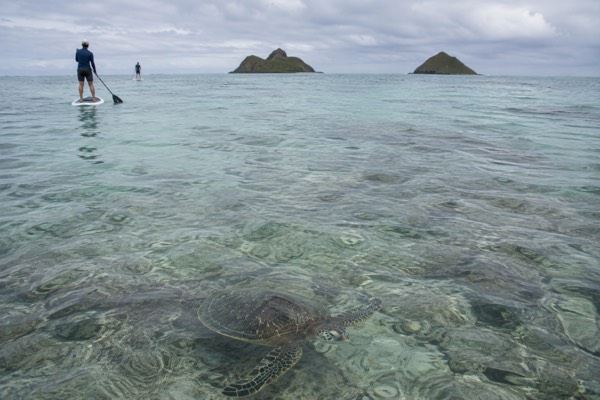
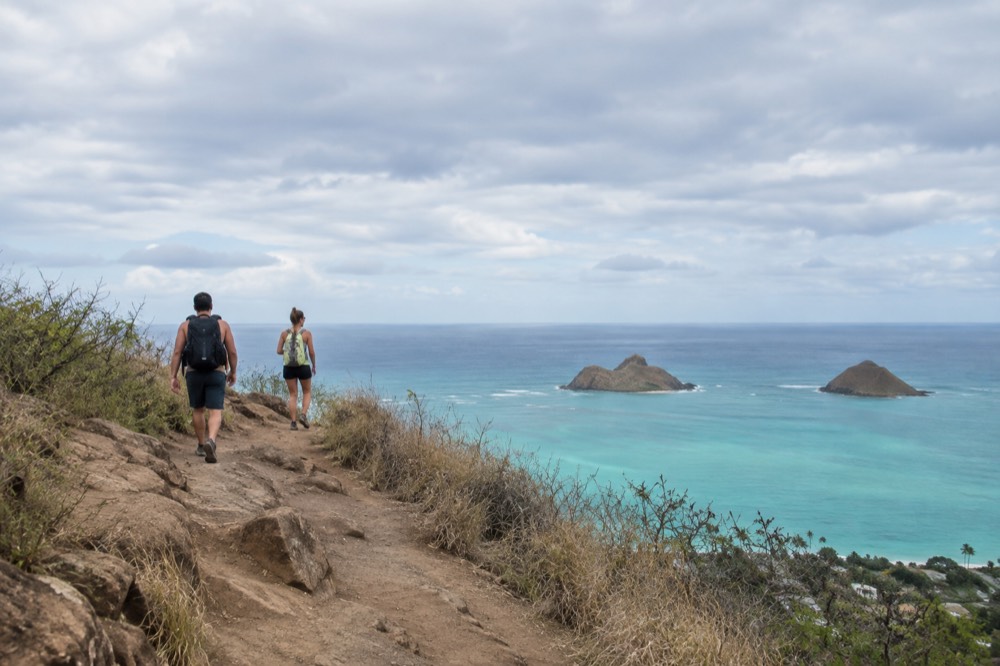
The Lanikai Pillbox Hike is the popular name for the Kaiwa Ridge Trail, a steep ridge climb that starts on a residential street in Kaʻōhao, the Kailua neighbourhood marketed as Lanikai, and rises to two old concrete military observation bunkers. From the top you look down on Lanikai Beach, Kailua Bay and the Mokulua islands.
There is no fee, no gate and no reservation system, unlike Diamond Head, and the whole thing is short enough that it is done before breakfast more often than after lunch.
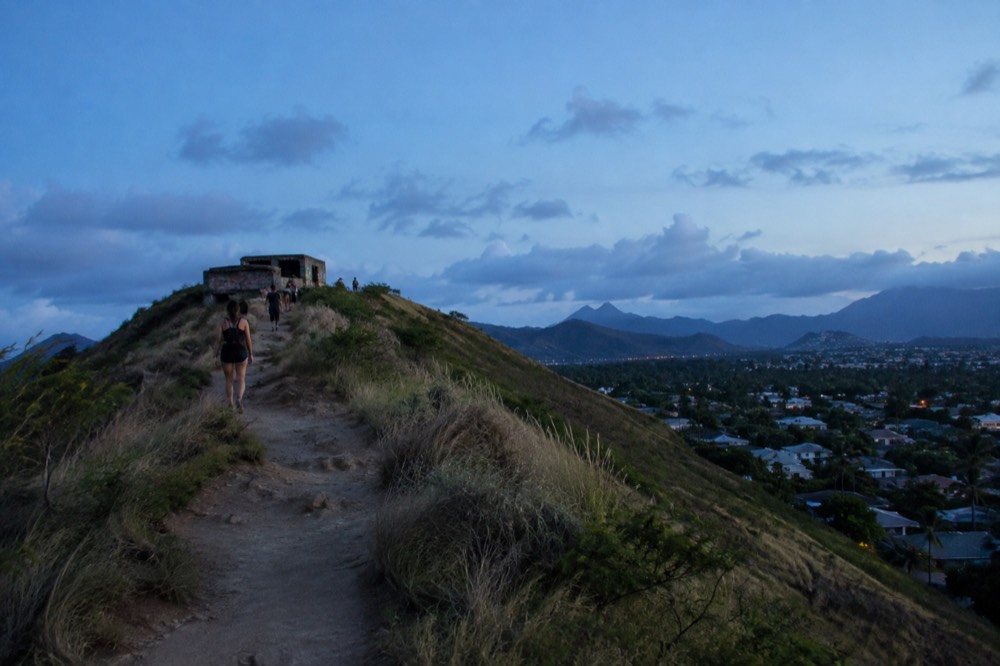
The trail's official name is worth knowing because signage and official maps use Kaiwa Ridge, while everyone from hotel concierges to social media says pillbox. They are the same walk. The two bunkers near the top are the origin of the nickname: squat concrete structures built as observation posts, now stripped of anything military and used mainly as a frame for photographs of the Mokulua islands offshore.
What surprises many first-time visitors is how domestic the start is. You begin the climb from a street of houses, between driveways and mailboxes, and for the first stretch the trail is a dirt path with the ridge on one side and someone's roofline on the other. That is normal here, and it sets the tone for the whole visit: this is a hike through a neighbourhood that happens to end somewhere spectacular, not a park with a car park and a visitor centre.
The payoff view runs east over Lanikai Beach, one of the island's most photographed stretches of sand, and out across the reef to Mokoliʻi's larger neighbours, the two Mokulua islands. On a clear morning, with the sun coming up behind the islands, it is the single most photographed vantage point on this coast, and the photographs are not lying. The crowds reflect that.
Where Is The Trailhead And How Do You Get There?
The trailhead sits at the mauka, mountain, end of Kaelepulu Drive in Kaʻōhao, roughly a ten-minute walk from the beach end of the Lanikai loop. There is no parking lot and no visitor facility; you park on residential streets or arrive without a car. TheBus reaches Kailua town from Waikīkī and Honolulu, and many people combine the hike with a morning at Kailua Beach Park, which does have a public lot.
Getting there without a car is more realistic than the guidebooks suggest. TheBus and Skyline share one fare structure: an adult cash single ride on TheBus is $3.25 with no transfers, while a HOLO card two-hour pass is $3.00 and includes unlimited transfers, and a 24-hour pass is $7.50, which is also the daily cap, so a day of hopping on and off costs no more than that. Routes serve Kailua from town, and from the Kailua side the walk or a short local bus ride to Kaʻōhao is manageable.
| Option | What it involves | The honest catch |
|---|---|---|
| TheBus from Waikīkī or Honolulu | $3.00 on a HOLO card with two hours of transfers, or $7.50 for a 24-hour pass | No bus runs the Lanikai loop itself; expect a walk from central Kailua |
| Driving | Street parking in a residential neighbourhood | No public lot; restrictions and towing enforcement on the main loop streets |
| Bicycle from Kailua town | Flat ride along Kailua Road into Kaʻōhao | You are climbing a ridge on foot afterwards; bring more water than feels reasonable |
| Ride-hail or taxi | Door to trailhead | Surge pricing on popular sunrise mornings, and the return pickup can be slow |
The parking situation deserves plain language. Kaʻōhao is a small residential community with no public parking lot, and the streets around the trailhead carry both resident pressure and heavy visitor pressure. Restrictions on the main loop streets are enforced, including towing, and the configuration of nearby beach access arrangements has been changing as the city works through its transportation management plan for the area. Treat every curb as something to read before you leave the car, and if you arrive and nothing looks legal, the honest answer is to go to Kailua Beach Park, park there, and walk in.
That walk is not a hardship. Kailua Beach Park is the nearest legal parking option with facilities, and from there Kaʻōhao is a pleasant flat stroll along the beach road. It adds time, and it removes the single worst part of the visit, which is circling a stranger's neighbourhood at 5:30 a.m. hoping a curb opens up. Our Kailua Beach Park guide covers that lot and the facilities around it, and our Lanikai Beach guide goes deeper on the neighbourhood's access rules.
One more thing that matters here: this is a working residential community, not a resort zone. Do not block driveways, do not treat hedges and walls as overflow parking, and do not assume a resident pointing at a sign is being unwelcoming. The sign is the message. Oʻahu's windward side has absorbed enormous visitor growth, and Kaʻōhao's streets are the front line of it.
If hiking is the centrepiece of your Oʻahu trip rather than one stop among many, these three are the walks and lookouts we would put on the same shortlist as Kaiwa Ridge:
What Does The Climb Actually Involve?
The Kaiwa Ridge Trail is steep almost from the first step, climbing a bare dirt and rock spine with loose sections, short scrambles and little shade to the first bunker, then a second one further along the ridge. There is no water, no toilet and no shade anywhere on the trail, and the surface is slick when wet.
Most of the difficulty is grade and exposure, not distance, and the descent is harder on the knees than the climb was on the lungs.
The first section is the steepest and the most eroded. The trail leaves the street and goes straight up the nose of the ridge, on dirt that decades of feet have polished smooth, with a few rocky steps where you will use your hands. Footwear matters more than fitness here: running shoes survive it, sandals do not, and after rain the whole upper stretch turns into a slide. The windward side of the Koʻolaus gets real rain, and the ridge dries slower than the beach below it looks like it would.
The first pillbox arrives early enough that many people turn around there, and honestly, it is a defensible choice. The view over Lanikai Beach and the Mokulua islands from the first bunker is the postcard. The second bunker adds a different angle and usually a fraction of the crowd, along a narrower stretch of ridge with steeper drops to the sides. Neither structure is anything more than a concrete shell at this point, and neither should be climbed on: the edges are unforgiving, the concrete is weathered, and the photographs from inside the frame are the safe ones.
A few practical notes that first-time visitors consistently get wrong:
| Reality on the trail | What it means for you |
|---|---|
| No shade from trailhead to summit | Sunscreen before you start, a hat, and more water than you think you need |
| Loose dirt and rock on the steep lower section | Real shoes, and slow steps on the descent |
| No facilities of any kind | Toilet and water at Kailua Beach Park, not at the trail |
| Residential trailhead | Keep voices down at dawn; the neighbours hear every word |
| Slick surface after rain | Check the windward forecast, not the Waikīkī one |
That last row is not a throwaway. Rainfall on this island varies absurdly by location: the official climate normals put Honolulu International Airport at 16.41 inches of rain a year, while the Lyon Arboretum station in Mānoa, five miles from Waikīkī, records 150.96 inches, and every single month there is wetter than the airport's wettest month. The windward coast sits between those extremes but leans wet, and a morning that looks clear over your hotel can have been raining on the ridge since dawn. Check the windward forecast, and if the dirt is dark, give it time.
For hikers who want the view without handling the logistics themselves, the guided alternative most comparable to this kind of morning is the Diamond Head hike with tickets and shuttle sorted, which handles the reservation and the transport so the only decision left is what time to wake up.
When Is The Best Time To Do The Lanikai Pillbox Hike?
Sunrise is the answer most people are looking for, and it is the right one: the trail faces east over the Mokulua islands, early hours are cooler, and parking pressure is at its worst by mid-morning. In midsummer the sun comes up at about 5:50 a.m., while in mid-January it rises as late as 7:11 a.m., so the alarm time swings by more than an hour across the year.
Sunset works too, but Oʻahu's latest sunset of the year is only about 7:17 p.m.
The sunrise numbers are worth internalising because they shape the whole morning. The sun reaches its earliest rise around the June solstice and its latest around mid-January, and the day length across the whole year varies by only about two hours and thirty-five minutes. Oʻahu does not have long summer evenings the way mainland destinations do; the light is generous at dawn and stingy at dinner time, which is exactly why local hiking culture is a dawn culture. The full index of guides sits on Oahu Travel Guide.
| Time of day | The case for it | The case against |
|---|---|---|
| Pre-dawn, on the trail by first light | Coolest hour, empty ridge, the classic sunrise shot | You are walking a residential street in the dark; headlamp and quiet voice required |
| Mid-morning | Easy logistics, no alarm | Heat on a shadeless ridge, peak parking pressure, the biggest crowds |
| Late afternoon | Softer light, thinner crowds | Sunset is early all year; you are descending in fading light sooner than you think |
| After rain | None | The ridge is slick and the views are gone; wait for drying time |
Weekday versus weekend matters as much as hour. Saturday and Sunday bring local families as well as visitors, and the loop streets fill correspondingly earlier. If your trip allows any flexibility, a Tuesday sunrise beats a Saturday sunrise in every measurable way: cooler assumptions about crowds, easier parking, and a neighbourhood that gets one fewer day of pressure.
The other timing question is season, and here the windward coast is forgiving. Rainfall on this side is spread across the year rather than dumped in one wet season, and temperatures vary little month to month. The ocean is a different story: surf runs out of phase by shore, with north-facing shores peaking in winter and south-facing shores in summer, and the east-facing coast Kaiwa Ridge looks down on takes its share of swell. That matters for your post-hike swim at Lanikai or Kailua more than for the hike itself. Our Oahu ocean safety guide covers reading conditions before you get in.
How Much Does The Lanikai Pillbox Hike Cost?
Nothing, in entry fees: there is no charge to walk Kaiwa Ridge, no reservation system and nothing to book, which sets it apart from Diamond Head, where out-of-state visitors pay $5 per person plus $10 per vehicle and must reserve in advance. Your real costs are transport to Kailua, water and sunscreen, and time.
If you drive, the cost is parking discipline, because a towing ticket in Kaʻōhao costs vastly more than any trail fee on this island.
The comparison table is the clearest way to see what a free trail really means:
| Hike or site | Entry cost (non-resident) | Reservation needed? |
|---|---|---|
| Kaiwa Ridge (Lanikai Pillbox) | Free | No |
| Diamond Head State Monument | $5 per person, plus $10 per vehicle, card only | Yes, for entry and parking, up to 30 days ahead |
| Hanauma Bay Nature Preserve | $25 plus online service fee, children 12 and under free | Yes, opens two days ahead at 7:00 a.m. HST; closed Mondays and Tuesdays |
| Mānoa Falls Trail | Trail free; parking charged by a private lot | No |
Free does not mean effortless. Diamond Head's reservation system has been mandatory for non-residents since May 2022, and a large share of the advice still circulating online predates that rule, so people arrive expecting to pay at a gate that no longer sells anything. Kaiwa Ridge has no such machinery at all: no gate, no ranger, no kiosk. The flip side of that freedom is that nobody is managing the crowd, the erosion or you.
If the zero-cost hike appeals but the self-managed logistics do not, the same trio of guided options covers the spectrum from a fully ticketed Diamond Head morning to a rainforest waterfall walk and a half-day of lookouts:
And for a completely different kind of Oʻahu morning, one that swaps ridge views for rainforest, the Mānoa Falls self-guided hike puts you in the valley that gets more than nine times the airport's annual rainfall, with a shuttle and drop-off arranged so the trailhead logistics are not yours to solve.
Is The Lanikai Pillbox Hike Worth It?
Yes, with conditions. The view from the ridge, Lanikai Beach below, the Mokulua islands offshore, the Koʻolau range behind you, is one of the defining images of windward Oʻahu and the short climb genuinely earns it. The conditions are behavioural: go at dawn, park legally or arrive without a car, keep quiet in the neighbourhood, and do not treat the trail as a theme park ride.
Done that way it is one of the best free hours on the island.
The honest case against is mostly about the neighbourhood. Kaʻōhao's streets have no capacity for the demand the trail generates, and every year the city tightens the parking rules in response. The residents are not hostile to visitors; they are exhausted by them, and the difference shows up in enforcement. A hiker who arrives at dawn, parks where it is clearly legal and leaves no trace is welcome. A caravan of cars at 9 a.m. is not, and the rules are written for the second kind.
The case for is simpler. Few short walks anywhere deliver this ratio of effort to payoff. You get ocean, islands, a ridge walk and a sunrise, all within sight of a flat white-sand beach you can swim off an hour later. Kailua as a base makes a full morning of it easily: hike at dawn, swim at Kailua Beach Park, breakfast in town. Our Kailua guide lays out that whole day.
For visitors who want the island's big views with someone else driving, the half-day scenic tour of seven lookouts covers a spread of vantage points across Honolulu and the coast in three to four hours, which pairs well with a week that already includes one self-guided hike.
What Should You Bring, And What Should You Leave Behind?
Bring more water than feels reasonable, real shoes with grip, sunscreen applied before the climb, a hat, and a headlamp if you are going at dawn. Leave the drone at home, it is prohibited in state parks and restricted in city parks, leave the speaker, the ridge does not need a soundtrack, and leave every rock, shell and pinch of sand exactly where it is, because removing them from the shoreline is prohibited by state law, not superstition.
That last point deserves the plain version. You will see claims online that taking lava rock brings bad luck through an old Hawaiian belief; that story is a modern invention, not tradition. The actual reason not to take rock or sand is that it is illegal under Hawaii's shoreline statutes, and the reason that matters is that thousands of visitors taking a pocketful each adds up to real damage. The law is the reason. Folklore dressed up as tradition is not.
The drone point is equally practical. Drones are prohibited in Hawaii state parks without a written permit, restricted in Honolulu city parks, and banned around Pearl Harbor National Memorial, and the sunrise crowd on Kaiwa Ridge is exactly the audience that most wants aerial footage and least needs a citation. The view from your own two feet is the one on every postcard anyway.
A short list, in order of importance:
- Water, roughly a litre per person even for a short hike, because the ridge has no shade and no refill point
- Shoes with tread; the descent is where slips happen
- Sunscreen and a hat; you are facing the rising sun for the best view
- A headlamp for pre-dawn starts, used with consideration on residential streets
- Nothing that comes off the island: no rock, no sand, no coral, and pack out every wrapper
Common Questions About The Lanikai Pillbox Hike
Most questions about the Lanikai Pillbox Hike come down to three things: parking in a neighbourhood with no lot, timing a sunrise climb when the sun's rising time swings by more than an hour across the year, and the trail's shadeless, sometimes slick surface.
The short answers are to park at Kailua Beach Park and walk in if in doubt, check the sunrise time for your date rather than guessing, and wear real shoes while carrying more water than feels necessary.
Is the Lanikai Pillbox Hike hard?
It is short but steep, and the difficulty is grade and exposure rather than distance. The lower section climbs relentlessly on dirt and rock, there is no shade, and the descent is slick after rain. Reasonably fit adults and steady older children manage it comfortably at their own pace; anyone with knee trouble or a serious fear of loose footing should treat the first bunker as the summit.
Do you need a reservation for the Lanikai Pillbox Hike?
No. There is no reservation system, no entry fee and no gate, unlike Diamond Head, where non-residents must reserve entry and parking in advance, or Hanauma Bay, where tickets open two days ahead at 7:00 a.m. HST. The only thing you need to arrange is legal parking, and the safest assumption is that you will not find any in Kaʻōhao on a popular morning.
How long does the Lanikai Pillbox Hike take?
Plan on a slow, photo-heavy outing rather than a workout. Most people are up, across to the second bunker, and back down within a couple of hours, and sunrise visitors linger longer. Budget extra time for the walk in from wherever you legally parked, which on busy days means Kailua Beach Park.
What is the best time of day for the Lanikai Pillbox Hike?
Sunrise, for the light over the Mokulua islands, the cooler air and the thinner crowd. Check the actual sunrise time for your date: it swings from about 5:50 a.m. in midsummer to about 7:11 a.m. in mid-January. If dawn is not happening for you, late afternoon is the second choice, remembering that the latest sunset of the whole year is only about 7:17 p.m.
Can you swim at Lanikai Beach after the hike?
Yes, and it is the natural pairing: the descent puts you minutes from one of the island's most photographed beaches. Read the ocean first, because the east-facing coast takes swell, and conditions change by shore and season. Facilities, including parking and restrooms, are at Kailua Beach Park rather than in Kaʻōhao itself.
Is the Lanikai Pillbox Hike suitable for kids?
Steady, school-age children who are used to real trails handle it, with close supervision on the steep lower section and on the ridge near the second bunker, where the sides drop away. It is not a stroller walk and not a good first hike for a toddler. Go early, go slow, and turn around at the first pillbox if small legs are voting no.
Kaiwa Ridge rewards the visitor who treats it as a guest in a neighbourhood rather than a customer at an attraction, and that single frame, more than any gear choice or timing trick, is what separates the people who love this hike from the people who leave frustrated. Go early, park honestly, carry your water and your rubbish, and the windward coast hands you one of the best free mornings on Oʻahu in return.