Is $2,000 Enough For A Week In Hawaii? An Honest Oahu Budget Answer
A direct, sourced answer to whether $2000 covers a week in Hawaii, using real Oahu entry fees, transit fares and tax rates, plus a day-by-day budget that actually closes.
Yes, $2000 is enough for a week in Hawaii, with three conditions attached: the week happens on Oahu rather than a resort-heavy neighbour island, your flights are paid for separately, and you treat lodging as the one line item that decides everything else. Oahu is the only island in the state where a car is optional, where the flagship historical site is free to enter, and where a full day of guided sightseeing costs less than a single dinner at a resort restaurant on Maui. The week is tight but genuinely doable, and this page breaks down exactly where the money goes.
The question people are really asking is whether Hawaii on a normal budget feels like a real trip or like a punishment of instant noodles and guilt. The answer is that Oahu rewards planning more than spending. The numbers below come from official sources: state park fee schedules, the City and County transit fare page, the National Park Service, and the Hawaii Department of Taxation. Nothing here is a guess dressed up as a statistic.
Is $2000 Enough For A Week In Hawaii?
Yes, $2000 covers seven days on Oahu if flights are excluded and lodging stays at the budget end of the market. That leaves roughly half the total for food, local transport and activities, which is workable because Oahu's headline sites are free or cheap: the Pearl Harbor program is free, Diamond Head is $5 per person, and a week of unlimited bus riding costs $45. It is not a resort holiday, but it is a full Hawaii week.
The honest version of this answer starts with what $2000 does not buy. It does not buy a week at a beachfront resort in Waikīkī, and it does not buy interisland hops. Oʻahu took 5,679,047 visitors by air in 2025, preliminary DBEDT figures, and a large share of them were not staying in luxury hotels. The island has an entire economy pitched at normal travelers: food trucks, plate lunch counters, city buses, free beaches and a state park system whose entry fees are modest by mainland standards.
The comparison that matters is Oahu against the neighbour islands. On Maui or the Big Island, a rental car is close to mandatory, and that alone can consume a quarter of a $2000 budget before a single activity. On Oahu the transit system, TheBus and the Skyline rail line, shares one fare structure: $3.25 for a single adult cash ride on the bus, or a HOLO card that caps at $7.50 per day no matter how many rides you take. A 7-day pass costs $45, less than one day of rental car parking at many Waikīkī hotels.
There is also a tax detail most budget guides miss. Act 96, effective 1 January 2026, raised the state Transient Accommodations Tax from 10.25% to 11.00% on lodging gross rents, and it now also applies to cruise fares. That increase lands directly on your hotel bill, so when you compare room rates, remember the listed price is not the paid price. Budget the tax, do not be surprised by it.
Where Does The Money Actually Go On An Oahu Week?
Lodging is the swing variable, typically close to half of a $2000 Oahu budget, and everything else is negotiable around it. Food is the second biggest line and the most controllable, transport can be pinned down to a $45 weekly bus pass, and activities are the flexible layer you expand or cut. The single biggest mistake is booking a room first without pricing the whole week.
Lodging is the line to compare first. Book an Oahu hotel here.
Here is a workable allocation for one person, seven nights, flights excluded. Treat the ranges as planning shapes and check live rates before committing, because Waikīkī pricing moves with demand.
| Line item | Planning approach for 7 days | Notes |
|---|---|---|
| Lodging | The swing line, close to half the budget | Basic Waikīkī hotel, a budget hotel outside Waikīkī, or a private room in a shared rental; the 11% state TAT and county charges stack on top of listed rates |
| Food | The most controllable line | Plate lunches, food trucks and grocery breakfasts cost a fraction of beachfront dining; one sit-down dinner a day is the ceiling |
| Local transport | Pinnable to a fixed number | A 7-day HOLO pass is $45, or ride on the $7.50 daily cap; add a couple of rideshares for late nights |
| Activities | The flexible layer | Free entries, state park fees of $5 to $25, and one or two paid tours |
| Buffer | Never zero | Shave ice adds up, and something always costs more than planned |
The buffer line is not decoration. A week in Hawaii always produces an unplanned expense: a bag-storage fee at Pearl Harbor, a second snorkel rental, an umbrella when the trade winds quit. If your allocation has no slack, the slack comes out of your last day.
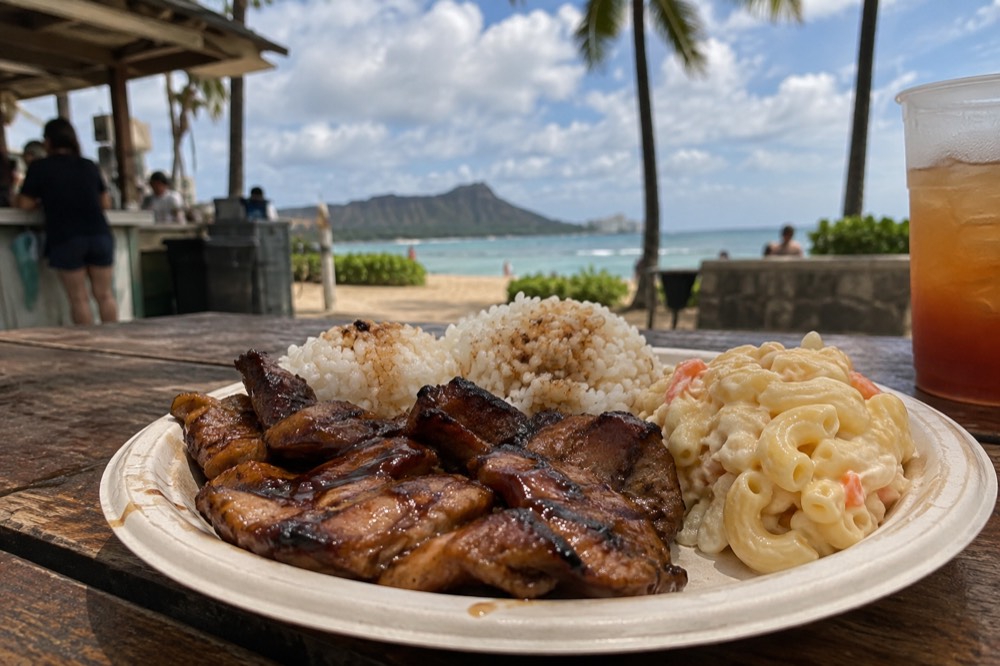
Food deserves a specific word because it is where budgets quietly die. The tourist strip in Waikīkī prices meals for people who are not counting. Two miles in almost any direction, the same money buys twice the food. Plate lunch spots, noodle houses and the shrimp trucks of the North Shore exist in a different price universe from the beachfront strip, and they are better eating anyway. Our best food on Oahu guide lists the categories worth spending on and the ones worth skipping.
One structural saving: the biggest marquee sites on Oahu are free or nearly free. Pearl Harbor National Memorial's visitor center and the USS Arizona Memorial program are free, with a $1 per-ticket management fee when you reserve on the official reservation system, and $7 per day if you drive and park. Diamond Head State Monument charges $5 per non-resident person plus $10 per vehicle, card only, reservation required. Hanauma Bay is $25 plus a service fee, closed Mondays and Tuesdays. These are the island's headline experiences, and none of them breaks a budget.
Can You Do Oahu On $2000 Without A Rental Car?
Yes, and skipping the car is the single strongest move a $2000 Oahu budget can make. TheBus and the Skyline rail line share one fare structure, a HOLO card caps at $7.50 per day, and a 7-day pass costs $45. Waikīkī, Pearl Harbor via the Hālawa Aloha Stadium station, Ala Moana and downtown are all reachable without driving. The trade-off is the North Shore, which is slow by bus.
The fare table comes straight from the City and County of Honolulu's transit page. A single adult cash bus ride is $3.25 with no transfers. Load a HOLO card instead and a two-hour pass with unlimited transfers is $3.00, the day cap is $7.50, and the monthly cap is $90. The card itself costs $2. A visitor riding the bus every day for a week spends less on transit than a single day of rental car plus hotel parking in most of Waikīkī. Everything else covered here is indexed on Oahu Travel Guide.
The rail line, Skyline, now reaches the airport, with a station named Lelepaua Daniel K. Inouye International Airport, and it serves Hālawa Aloha Stadium Station, the stop for the Pearl Harbor memorial and visitor center. There is no Waikīkī station, so you transfer to a bus, but the airport-to-Waikīkī trip is cheap and doable. Our Honolulu Skyline rail guide walks the line station by station, and do you need a car on Oahu covers the decision in full.
The honest limit of car-free Oahu is the North Shore and the windward coast. Buses reach them, but a day trip becomes a long day. This is exactly where a tour becomes the budget move rather than the splurge: a booked circle-island day puts you on a coach with a driver who handles the two-lane highway, and the price of one ticket is usually less than a rental car day plus fuel plus parking. The full rundown of options is in our best Oahu day trips guide.
What Does A Realistic $2000 Oahu Week Look Like Day By Day?
A realistic week pairs one anchor activity per day with free beach and walking time, keeping daily spend even rather than spiking. Two days carry most of the activity cost, a lūʻau or a big tour, and the other five lean on free beaches, free memorials and cheap state park entries. The pattern works because Oahu's best experiences are unevenly priced, not uniformly expensive.
Here is a sample shape of the week, with the paid items called out. Prices for the tours below are on the operator's live listings, and the entry fees are the official published figures.
| Day | Anchor | Cost picture |
|---|---|---|
| 1 | Waikīkī Beach, walk to Kapiʻolani Park | Free; food only |
| 2 | Pearl Harbor: visitor center and USS Arizona Memorial program | Free entry, $1 per-ticket reservation fee, $7 parking if driving, no bags allowed |
| 3 | Diamond Head hike, morning | $5 per person entry, $10 per vehicle, reservation required for non-residents |
| 4 | Circle-island tour day, North Shore and Haleʻiwa | One booked ticket replaces a rental car day |
| 5 | Hanauma Bay snorkel | $25 plus service fee, closed Mondays and Tuesdays, reserve two days ahead at 7 a.m. HST |
| 6 | Free beach day, Ala Moana or Kailua | Bus fare only |
| 7 | Lūʻau evening, slow morning | The week's biggest single ticket |
Two reservation rules make or break this itinerary, and both are widely misreported. Hanauma Bay's reservation system opens two days ahead at 7:00 a.m. HST, verbatim from the official page: Monday at 7 a.m. you can begin reserving a time slot for Wednesday. If you show up hoping to walk in, you will be standing at a closed gate. Diamond Head requires non-residents to reserve both entry and parking in advance, with no on-site sales, a rule in force since May 2022 that a large amount of older content still gets wrong.
The lūʻau line is where a $2000 budget flexes. A lūʻau is not a dinner, it is the one evening where food, performance and history arrive together, and it is the item most worth protecting in the plan. If the week is running hot, cut it to a half-day tour and a food-truck evening instead. Our best lūʻau on Oahu comparison breaks down which experiences earn their ticket price and which are dinner with a show bolted on.
Which Oahu Experiences Are Worth The Spend?
Spend on the experiences that buy you access you cannot arrange yourself: a guided circle-island route, a boat on the water, and a lūʻau with a real show. Skip spending on things that are free or nearly free on your own: beaches, the Pearl Harbor visitor center, hiking, and snorkeling from shore in the right spots. The budget traveler's rule on Oahu is to pay for guides and boats, never for sand.
The paid layer earns its money in specific ways. Kualoa Ranch's valleys and movie sites sit on private land and cannot be visited without a paid guided tour, so if the Jurassic scenery matters to you, that is a legitimate spend with no free workaround. A shark cage dive off the North Shore, a catamaran off Waikīkī, a snorkel boat to Turtle Canyon: these buy water access and safety staffing that a solo traveler cannot replicate.
The free layer is deeper than most visitors expect. The USS Arizona Memorial program is free. The National Memorial Cemetery of the Pacific at Puʻuowaina, the crater known as Punchbowl, is free. The Byodo-In Temple, ʻIolani Palace grounds, Ala Moana Beach Park, Kailua, Waimānalo, Lanikai's shore: all free to stand on, with the honest caveat that Lanikai has no public lot and residential streets are ticketed and towed, so you walk in from the Kailua Beach Park area. The full list lives in our free things to do on Oahu guide.
One timing fact that saves real money: Oahu's surf runs out of phase by shore, and so do its crowds. The National Weather Service's surf zone forecast publishes the island's four shore aspects separately, north, west, south and east, and on a September day in 2026 the south shore was running larger surf than the north shore, the exact inverse of winter. What that means for a budget is that you do not need to chase the famous North Shore in winter traffic to see impressive water, and the free beaches near your room are usually good enough on any given day.
If the week has room for exactly one big ticket beyond the essentials, the circle-island tours are the strongest value in the roster, and the two below are the ones worth comparing side by side. Both bundle transport, guide and a full day of the island's signature scenery into a single price, which is precisely the arithmetic a $2000 week needs.
Common Questions About A $2000 Oahu Week
Most questions about whether $2000 covers a Hawaii week come down to three things: whether flights are inside the number, whether the island is Oahu, and whether the traveler will eat and sleep like a local or like a tourist. The answers below cover the specific numbers people ask for, including the per-day figure, the room question, and what happens if you try to stretch the same budget across two islands.
Is $2000 enough for a week in Hawaii?
Yes, on Oahu, with flights paid separately. Keep lodging at the budget end of the market, ride the bus with a HOLO card capped at $7.50 a day or buy the $45 weekly pass, eat plate lunches and food-truck meals, and pick one or two paid anchors like a circle-island tour or a lūʻau. The same money does not stretch to a resort week or to island-hopping.
Does the $2000 include flights?
No, and it should not. Interisland and mainland airfare is too volatile to fold into a destination budget. Treat $2000 as the on-island number: lodging, food, transport and activities. If flights must come out of it, the week gets very tight and lodging drops to hostel or shared-room territory.
How much per day is $2000 for a week?
It works out near $285 a day all-in, but the honest split is uneven: lodging eats roughly half the total whether you like it or not, leaving the rest for everything else. On Oahu that daily figure works because transit is capped at $7.50 and the headline sites are free or under $30.
Can two people do Oahu on $2000 together?
It is possible but the squeeze is real, mainly because you share a room but not a bus fare or an entry fee. The shared costs, the room and any car, split in half; the per-person costs, food, entries and tours, do not. Two people on $2000 means both halves of the couple eat cheap every single meal and the activity budget buys one shared anchor experience.
Is it cheaper to skip the rental car on Oahu?
Usually yes. A 7-day HOLO bus pass costs $45 per person against a rental car's daily rate plus Waikīkī hotel parking, which is a notoriously volatile number. The trade-off is time on the North Shore and windward side, which is exactly what a booked circle-island tour solves for less than the cost of a car day.
What is the biggest hidden cost in a Hawaii budget?
Lodging taxes. The state Transient Accommodations Tax rose to 11.00% on 1 January 2026 under Act 96, and county charges stack on top. A room's listed nightly rate is not what you pay. Price the tax-inclusive total before you decide the budget closes.
The final word is this: $2000 is a real Hawaii week on Oahu if you let the island's pricing structure work for you, free memorials, cheap transit, modest state park fees, food served in generous portions away from the beachfront strip. It stops being a real week the moment the plan includes resort rooms, a car sitting in paid parking, or two islands in seven days. Choose the version you can actually pay for, and the week closes with money left for one last shave ice on the way to the airport, which is exactly how it should end.