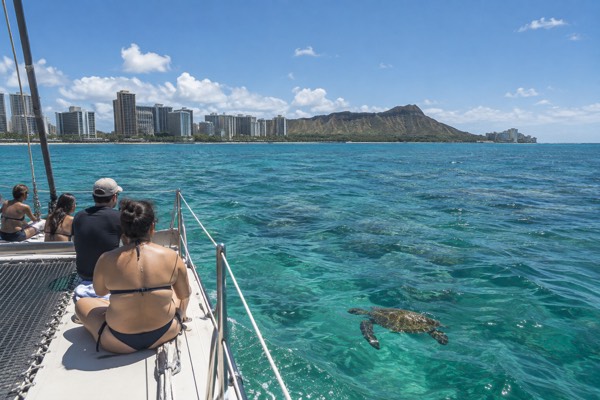
Laniakea Beach (Turtle Beach) On Oahu's North Shore: What A Visit Actually Involves
Laniakea Beach is where Oahu's green sea turtles come ashore to rest, and the honest pitch is simple: the turtles are close to guaranteed at the right hour, the beach itself is narrow, and the parking situation is the part that decides whether your visit is pleasant or frustrating.
Short answer
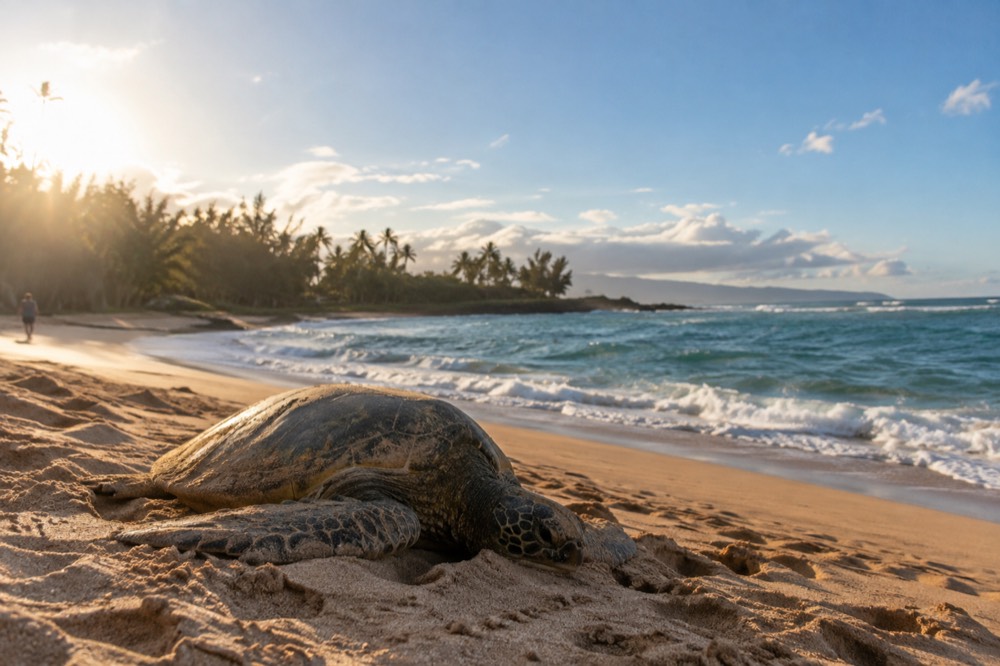
Laniakea Beach, on Oahu's North Shore between Haleʻiwa and Pūpūkea, is a small roadside beach where Hawaiian green sea turtles (honu) haul out onto the sand most afternoons. Viewing is free, volunteers rope off resting turtles, and the main planning problems are parking and the Kamehameha Highway safety project that keeps changing the roadside arrangements.
Laniakea Beach is the stretch of sand on Oahu's North Shore where Hawaiian green sea turtles, honu, come out of the water and rest in plain view, close enough that the main job of the volunteers on site is keeping people back rather than finding the animals. The beach sits directly on Kamehameha Highway between Haleʻiwa and Pūpūkea, there is no entry fee of any kind, and the turtles are wild, unprotected by fences or tanks. What decides whether a visit works is not luck with turtles, it is timing and the roadside, which a state highway drainage and safety project has been reconfiguring. This page covers what a visit actually involves: how turtle viewing works here, when to come, what it costs, how to behave around the animals, and a straight answer on whether the drive up from town is worth it. It sits inside our broader Things to Do in Oahu coverage of the North Shore, alongside the North Shore Oahu guide if you are building a full day around the drive.
Where Is Laniakea Beach And How Do You Get There?
Laniakea Beach sits directly on Kamehameha Highway on Oahu's North Shore, between Haleʻiwa town to the west and the Pūpūkea and Sharks Cove area to the east. There is no village, no signposted entrance and no parking structure; the beach is simply the shoreline beside the road. You reach it by car or as part of a circle-island tour, since no transit route serves the sand directly.
The beach is unmarked in the sense that there is no official gate or kiosk. Travellers recognise it by the turtle-viewing presence: volunteers with the local conservation group set up near the sand most days, and there is often a small canopy and signage about honu behaviour. If you are driving yourself, the honest advice is to know the stretch of coast you are looking for before you set out, because the roadside here is thin and stopping in the travel lane to gawk at a turtle through the window is both dangerous and exactly the behaviour the highway project is trying to eliminate.
Getting there without a car is awkward. TheBus does not stop at the sand, so independent visitors without a vehicle generally arrive on an organised North Shore day trip from Waikiki or a circle-island tour, both of which build in a Laniakea stop. That is not a marketing line, it is the practical reality of a beach with no trailhead, no transit and a highway shoulder that has been under active reconfiguration. If you are weighing car versus no car for your whole trip, our do-you-need-a-car-on-Oahu guide walks through the trade-offs, and the North Shore is one of the places where a car or a tour genuinely earns its cost.
Want to drive the North Shore loop yourself? Book a rental car here.
What Is The Parking Situation At Laniakea Beach?
Parking at Laniakea is limited roadside space along Kamehameha Highway, and the configuration keeps changing under an ongoing state drainage and safety project, so no description of exact stalls or barriers should be trusted for long. The reliable rules are simple: park only where parking is legally permitted, never in the travel lane, never blocking a resident's driveway, and expect the arrangement you find on arrival to differ from older blog descriptions.
This is the part of the Laniakea story where most published guides go stale fastest, and we will not pretend otherwise. The Hawaii Department of Transportation has been running a Kamehameha Highway drainage and safety project through this stretch, and the roadside has been reshaped more than once during the work. Shoulder parking has been restricted with barriers in earlier phases. What is permitted today may not be permitted next month, and we are deliberately not publishing a stall count or a map of the current arrangement, because a confident-sounding wrong answer here sends people into a travel lane.
What we can say with confidence is the etiquette that holds regardless of the configuration. The North Shore is a working community on a two-lane highway, and Laniakea's popularity has put real pressure on the residents who live along it. Park legally or move on. Do not treat a driveway as an overflow lot. Do not stop the car in the live lane, hazard lights on, because a turtle is visible from the window: this is the single most dangerous behaviour the site sees, and it is why the state has spent money re-engineering the roadside at all. If the legal spots are full, the practical move is to come back later in the afternoon or build the stop into a tour that handles its own logistics.
The alternative that removes parking from your problem entirely is a guided day that includes the stop. Two of the most-booked options on the island route through the North Shore with a Laniakea pause built in:
Both take the parking hunt, the highway stress and the "where exactly do I pull over" question off your plate, which for many travellers is worth the ticket price on its own.
When Is The Best Time Of Day To See Turtles At Laniakea?
Turtles haul out at Laniakea most reliably in the afternoon, with the strongest window running roughly from midday into the late afternoon, and the animals rest on the sand for hours once they arrive. Mornings are the weaker bet for turtles on the beach, though they are often visible swimming just offshore. Honu use this beach year-round; the variables that matter are hour of day and crowd.
The afternoon pattern is the single most useful planning fact on this page. Honu at Laniakea feed in the morning, often in the nearshore water where you can watch them surface, then come up onto the sand to bask, which is a genuine resting behaviour rather than a trick for tourists. Once a turtle is ashore and asleep, it tends to stay for a long time, so arriving late in the day does not mean you missed the show. Arriving at 4 p.m. on a bright afternoon is often better than arriving at 10 a.m., and it also dodges some of the midday crowd.
There is a trade-off worth naming. The North Shore's famous surf season runs through the winter months, and on big-swell days the sand at Laniakea narrows under high wash, which changes both the turtle behaviour and the whole feel of the beach. The flip side of the island's surf calendar is that it runs out of phase by shore: north-facing shores peak in winter, south-facing shores in summer. A summer visit gives you calmer North Shore water and easier swimming conditions nearby; a winter visit gives you the spectacle of the surf but a less predictable beach.
Our Oahu weather by month guide has the fuller picture if you are choosing a travel window.
A quick timing table for planning the stop:
| Time of day | Turtles on the sand | Crowd level | Notes |
|---|---|---|---|
| Early morning | Less likely; often swimming offshore | Low | Best light for photos, weakest bet for haul-outs |
| Late morning | Possible | Building | Volunteers usually on site |
| Midday to mid-afternoon | Most likely | Highest | Peak haul-out window, peak parking pressure |
| Late afternoon | Likely, often still resting | Easing | Good second window if midday was full |
| Sunset | Possible but variable | Low | Check daylight; the North Shore has no late summer evenings, sunset never runs much past about 7:17 p.m. anywhere on Oahu |
How Much Does It Cost To Visit Laniakea Beach?
Visiting Laniakea costs nothing. There is no entry fee, no beach fee, no parking charge and no ticket of any kind, because it is an open roadside shoreline rather than a staffed park. The volunteer turtle program on site accepts donations but charges nothing. The only money a self-driving visitor spends is fuel and food nearby; a guided tour that includes the stop is the only paid version.
That free admission is worth stating plainly, because the North Shore has a mix of free and paid stops and travellers often assume a site this well known must charge something. It does not. Compare it with its neighbours: Waimea Valley, a short drive east, charges admission, while Sharks Cove and Sunset Beach, both also on this stretch of highway, are free like Laniakea. If you are building a budget day, Laniakea is one of the least expensive meaningful stops on the island.
The honest cost is time and logistics. For a visitor staying in Waikiki, the beach is a long round trip for a stop that may take thirty minutes, so almost nobody visits it alone; it gets folded into a North Shore day that also covers Haleʻiwa, the Pūpūkea beaches and maybe a food truck stop. That bundling is the right instinct. Our Oahu on a budget guide collects the island's other free and cheap stops, and the free things to do on Oahu page includes this stretch of coast among them.
What Are The Rules For Watching Turtles At Laniakea?
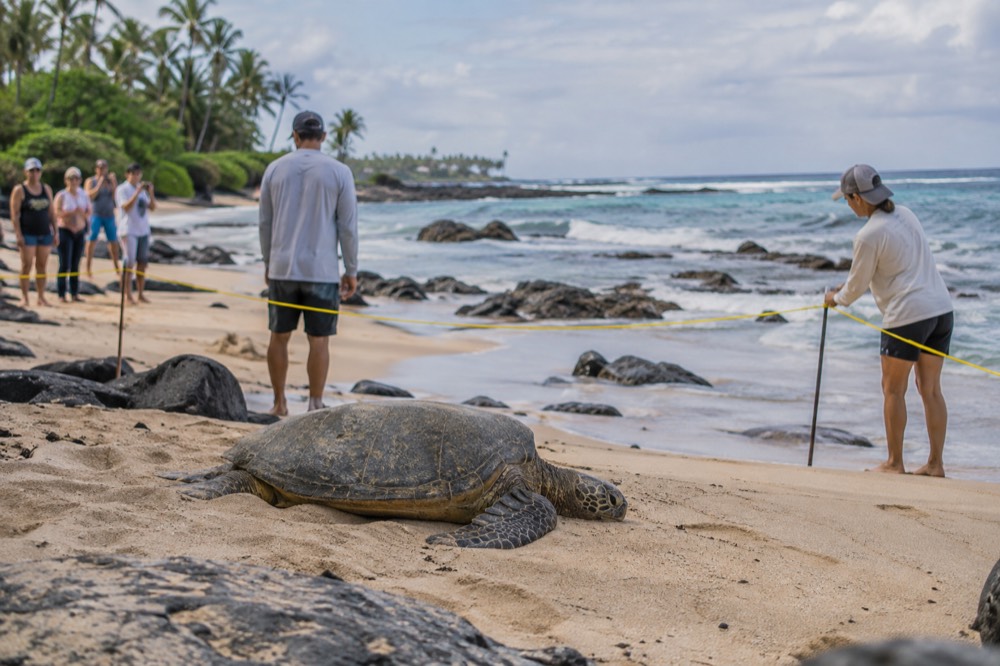
Green sea turtles are protected under the US Endangered Species Act and Hawaii state law, and the recommended viewing distance is about 10 feet, which volunteers mark with rope when a turtle hauls out. Touching, feeding, chasing or riding a turtle is illegal harassment, not a gray area. The 10-foot figure is a guideline rather than a statute, but harassment itself is the crime, so stay outside the rope.
The distinction at the end of that answer matters and most guides flatten it. For whales, 100 yards is law. For spinner dolphins, 50 yards is law. For monk seals and green sea turtles, the published distances are guidelines, but the underlying prohibition on take and harassment is absolutely law, under the federal Endangered Species Act and Hawaii Revised Statutes chapter 195D. What that means at Laniakea in practice: nobody is going to cite you for standing 8 feet from a turtle, but anybody who touches one, blocks its path back to the water, or puts a child on one for a photo is committing a federal offence, and the volunteers on the beach will say so.
The rope is not decoration. When a turtle hauls out, volunteers place a low barrier around it, partly to protect the animal and partly to protect visitors from themselves, because a basking honu that feels cornered will return to the water abruptly and a flippers-first exit through a crowd of ankles is not gentle. Do not step over the rope for a photo. Do not use flash. Do not chase a swimming turtle for a closer look, in the water or from the sand. Drone photography is prohibited in Hawaii state parks and a bad idea over a crowded roadside beach generally; leave it home.
One more rule that is about the place rather than the animal: never take sand, coral or rock from any Hawaii shoreline. It is prohibited under Hawaii law, and the folk explanation you may have heard involving a volcano deity's curse is a twentieth-century invention, not a Hawaiian tradition. The statute is the real reason, and the Oahu Travel Guide covers the wider set of wildlife and shoreline rules in our ocean safety and snorkeling pages.
The distances, in one place:
| Animal | Distance | Status | Where it applies |
|---|---|---|---|
| Green sea turtle (honu) | 10 ft | Guideline; harassment is illegal under ESA and HRS ch. 195D | Laniakea, any beach or in the water |
| Hawaiian monk seal | 50 ft (150 ft for mother and pup) | Guideline; take is illegal | Any beach |
| Humpback whale | 100 yards | Law | On the water and from the air |
| Hawaiian spinner dolphin | 50 yards | Law | On the water |
Can You Swim And Snorkel At Laniakea Beach?
Laniakea is a viewing beach more than a swimming beach: the sand is narrow, the entry is rocky in places, and there is no lifeguard, so it is not the place to plan a swim around. Snorkeling nearshore is possible on calm days and turtles feed there, but the North Shore's better snorkeling sits a short drive east around Pūpūkea. Treat Laniakea as the free wildlife stop, and swim elsewhere.
That is not a knock on the beach, it is a description of it. The shoreline here is a mix of coarse sand and rocky reef, the nearshore bottom is uneven, and in the winter months the surf that makes the North Shore famous arrives on this coast with real force. Even in summer, the honest comparison is unfavourable: Sharks Cove and the Pūpūkea Marine Life Conservation District a few minutes up the road are the North Shore's proper snorkeling ground, and our best snorkeling spots on Oahu page ranks the island's options with Laniakea's role made clear.
If your actual goal is to be in the water with turtles rather than standing above them on the sand, the reliable product on the island is the Waikiki Turtle Canyon snorkel, which runs a turtle guarantee and includes gear:
Turtle Canyon sits off Waikiki, so it is the opposite trade from Laniakea: you travel nowhere, the operator handles everything, and the guarantee means the question of whether today is a turtle day is the company's problem rather than yours. Some travellers do both, the sand-side viewing at Laniakea for the free, up-close resting behaviour, and a Turtle Canyon trip for the in-water experience.
Is Laniakea Beach Worth The Trip?
For most first-time visitors building a North Shore day, yes: Laniakea offers something genuinely uncommon, wild turtles resting within a few metres of you at no cost, and no other Oahu stop replicates it. It earns its place only as part of a North Shore itinerary, not as a destination in itself, because the stop is short and the parking friction is real. Do not drive up from Waikiki solely for it.
The reason it earns the stop is the quality of the encounter. At an aquarium or a resort lagoon you are looking at captive animals; at most beaches a turtle sighting means a head above water at thirty metres. At Laniakea, on a good afternoon, a honu sleeps on the sand while a volunteer explains what you are watching, and that is an experience children in particular remember. The reason it does not earn a dedicated drive is arithmetic: a stop of thirty to sixty minutes against a substantial round trip, with a parking situation that can add stress to the one hour you came for.
The compromise that works for most people is one of two shapes. Shape one: a self-drive North Shore loop, Haleʻiwa for food, Laniakea for turtles, Pūpūkea for water, timed so the turtle stop lands in the afternoon window. Shape two: a guided circle-island day that includes the stop and removes the driving. Our 1 day Oahu itinerary sketches the first, and the best Oahu day trips page collects the second.
A comparison of the island's main turtle experiences, since this is the decision most travellers are actually making:
| Turtle experience | Where | Cost | Best for | Guarantee |
|---|---|---|---|---|
| Laniakea Beach viewing | North Shore roadside | Free | Close-up resting turtles, no water time | No, but afternoon odds are strong |
| Sharks Cove snorkeling | Pūpūkea, North Shore | Free | Snorkelers already on the North Shore | No |
| Waikiki Turtle Canyon snorkel | Off Waikiki | Paid tour | In-water turtle time with gear and guide | Yes, stated on the listing |
| Hanauma Bay snorkeling | East Honolulu | Entry fee plus reservation | Reef snorkeling generally, turtles possible | No |
What Should You Bring And What Should You Skip?
Bring reef-safe sunscreen applied before you reach the sand, water, a hat and shoes that handle rocks, because the entry and the roadside are rougher than the postcard suggests. Skip the drone, skip any plan to touch or feed a turtle, and skip the expectation of facilities: there are no showers, restrooms or food vendors at the beach itself, so plan food and facilities around Haleʻiwa or Pūpūkea instead.
Hawaii law requires reef-safe sunscreen, and at a beach whose entire appeal is a resident reef and its turtles, that is not a technicality. Apply it before you park, since a chunk of the visit happens on the roadside before you even reach the sand. Footwear matters more than people expect: the sand strip is short and the terrain around it is rock and highway shoulder, not a manicured park.
The packing shortlist:
| Bring | Why | Skip | Why |
|---|---|---|---|
| Reef-safe sunscreen | Required by Hawaii law; the reef is the point | Regular sunscreen | Illegal to sell in Hawaii, harmful to the reef |
| Water and a hat | No shade, no vendors | Drone | Prohibited in state parks, reckless over a crowd |
| Shoes for rocks | Rocky entry and roadside | Food for the turtles | Feeding wildlife is harassment |
| A modest zoom lens | Turtles are close; the rope is the limit | Selfie sticks over the rope | Touching-distance photography is the offence volunteers watch for |
One note on the photos themselves. A resting honu with the Koʻolau backdrop behind it is a genuinely beautiful image, and taking it from outside the rope costs you nothing in quality. The images that cause harm are the close ones, the ones taken from inside the barrier or with a hand reaching into frame, and those are the ones that end visits for everybody. Shoot wide, keep your distance, and the photo is both better and legal.
If a full North Shore day is the plan and you want the water-sport side of the coast covered by someone else's logistics, the beginner surf lesson at Waikiki and the flat-water paddleboard yoga class are the two products we most often see booked alongside a turtle stop, and both suit absolute beginners:
For travellers who prefer their water time calm and meditative rather than surf-shaped, the paddleboard yoga class runs on flat water in Honolulu and needs no experience either:
And for the wider set of options that pair well with a North Shore turtle day, these are the three we would compare first:
Common Questions About Laniakea Beach (Turtle Beach)
Most questions about Laniakea come down to three things: timing, distance and parking. Turtles appear most reliably in the afternoon, the rope and the 10-foot guideline define how close you may get, and the roadside parking arrangement is under active state reconfiguration, so arrive expecting to adapt. Everything else, the free entry, the lack of facilities, the year-round season, is stable and easy to plan around. The specifics follow below.
Is Laniakea Beach free?
Yes. There is no entry fee, no parking charge and no ticket. The beach is an open roadside shoreline, and the volunteer turtle program on site charges nothing, though it accepts donations. The only paid version of a Laniakea visit is a guided tour that includes the stop.
What time of day are turtles at Laniakea Beach?
Afternoon is the strongest window. Honu feed in the morning, often visible swimming just offshore, then haul out onto the sand to rest, frequently from midday into the late afternoon. Arriving in the late afternoon is often better than the morning, and a turtle that is already ashore tends to stay for hours.
Can you touch the turtles at Laniakea?
No. Touching, feeding, chasing or blocking a turtle's path is illegal harassment under the Endangered Species Act and Hawaii state law. The 10-foot viewing distance is a guideline rather than a statute, but harassment itself is the offence, and volunteers rope off resting turtles to keep everyone on the right side of it.
Is Laniakea Beach good for swimming?
Not especially. The sand is narrow, the entry is rocky in places, and there is no lifeguard. On calm summer days a careful swim is possible, but the North Shore's proper snorkeling and swimming sites sit a short drive east around Pūpūkea and Sharks Cove, and winter surf makes this coast genuinely hazardous.
Where do you park at Laniakea Beach?
In legally permitted roadside space along Kamehameha Highway, and only there. The arrangement has been changing under a state highway drainage and safety project, so check current conditions on the day rather than trusting an older description, never stop in the travel lane, and never block a resident's driveway. If legal space is full, come back later in the afternoon or visit as part of a tour.
Is Laniakea worth visiting from Waikiki?
As part of a North Shore day, yes: free, up-close turtle viewing is something no other Oahu stop offers. As a standalone trip, no: the stop itself is short and the drive is long. Fold it into an itinerary that also covers Haleʻiwa and the Pūpūkea beaches, or take a circle-island tour that includes it.
Laniakea rewards the traveller who plans around its one awkward feature instead of pretending it away: come in the afternoon, park legally or let a tour handle it, stay outside the rope, and a wild honu asleep on the sand a few metres away is one of the most memorable free hours Oahu will give you.