What's The Hardest Hike On Oahu?
A direct, sourced answer to which hike is the hardest on Oahu, plus how Koko Head, Olomana, Diamond Head and Mānoa Falls compare, what is closed right now, and how to prepare.
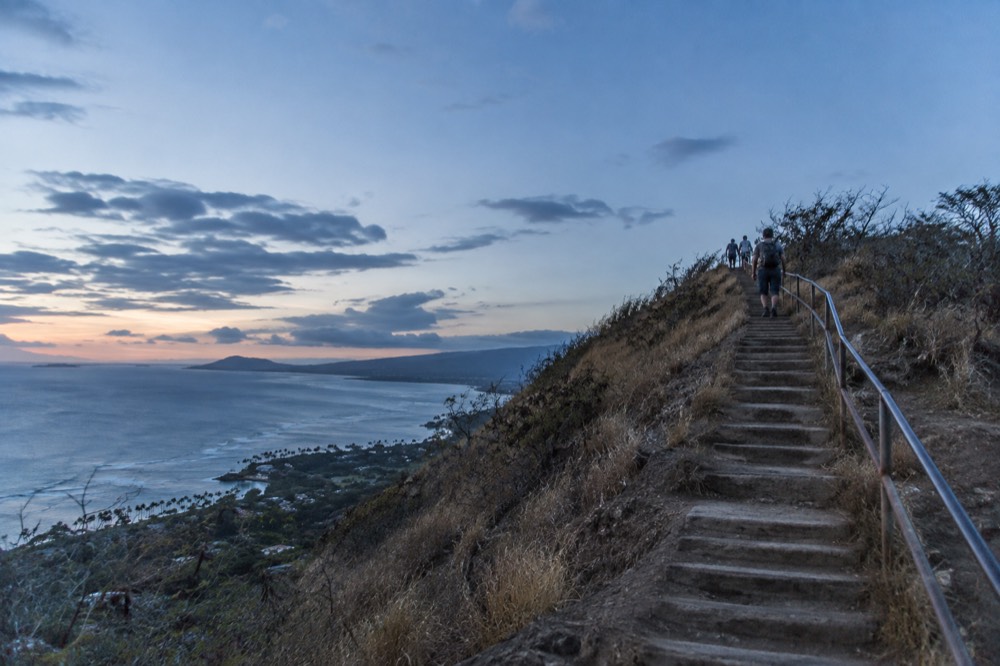
Koko Head Crater Trail is the hardest hike on Oahu for pure, unrelenting effort: a staircase of old tramway-style steps that goes up and keeps going up, with no shade and no flat stretch to recover on. If you define "hard" as the hike most likely to hurt, that is the answer. If you define it as the hike where a fall has real consequences, the Three Peaks of Olomana on the windward side takes it, because its second and third peaks involve exposed scrambling that turns back plenty of people who survived the stairs.
That distinction matters, because "hard" means two different things on this island. Oahu does not have much genuinely remote alpine terrain. What it has instead is heat, humidity, steep volcanic ridgelines, mud that never fully dries in the valleys, and trails that go from city street to serious exposure in well under an hour. The hardest hike for you depends on whether your weakness is lungs or nerves.
This article walks through the candidates honestly: what makes each one hard, what it costs to get on the trail, which of them need reservations, and which ones you cannot hike at all right now. Two of the island's best-known spots, Nuʻuanu Pali Lookout and Kaʻena Point, are closed for storm repairs as of the DLNR notice dated 9 September 2026, and a hard-hike list that does not say so is out of date.
What's The Hardest Hike On Oahu?
Koko Head Crater Trail, above Hawaiʻi Kai on the island's eastern tip, is the hardest hike on Oahu by the most common measure: a continuous, shadeless stair climb with no water and no bail-out points until the top. Olomana is a close second and arguably harder for inexperienced scramblers, because its ridge peaks demand hands-on climbing above steep drop-offs. Most fit hikers will finish Koko Head exhausted and Olomana turned back early.
The honest answer is that it depends on the failure mode you are testing. Koko Head is a cardio test. The stairs are uneven, the sun off the dry crater slope is punishing by mid-morning, and the incline never really relents. People who fail on Koko Head fail slowly: they stop, they sit on a step, and they go back down. Olomana is a nerve test. The first peak is a straightforward, steep climb that most reasonably fit people finish. The second and third peaks are where the trail stops being a hike and becomes a scramble, with ropes anchored to the rock on the steeper sections and significant exposure on either side of the ridge. People who fail on Olomana fail by choosing not to continue, which is the correct decision and one you should be comfortable making before you start.
There is a third answer that shows up in local conversations, and it is the Waiʻanae side. The leeward mountains are steep, eroded and far less used than the Koʻolau trails closer to town, and trails out there can be overgrown, badly signed and genuinely committing. But much of that terrain is unofficial, unmarked or crosses access questions, so it stays out of the ranking. The comparison that actually matters for a visitor planning a week in Oʻahu is the one below.
| Hike | What makes it hard | Fee or reservation | Current status |
|---|---|---|---|
| Koko Head Crater Trail | Relentless steep stairs, no shade, no water | No reservation system | Open, check before you go |
| Olomana (Three Peaks) | Exposed scrambling on peaks two and three | No reservation system | Open, check before you go |
| Diamond Head (Lēʻahi) | Moderate climb, heat and crowding | $5 per non-resident plus $10 parking, reservation required | Open daily, reservations up to 30 days ahead |
| Mānoa Falls | Mud, tree roots, rainforest humidity | Trail free, no reservation | Open, very wet after rain |
| Kaʻena Point | Long, hot, exposed coastal walk | Was free | Closed for storm repairs per DLNR |
If you are choosing a single "conquer" hike for your trip and you only have one hard morning in you, Koko Head is the one to pick, and our full Koko Head Crater Trail guide covers it in detail. If you have scrambling experience and want the harder psychological test, Olomana is the pick, with the standing warning that the third peak is not a place to discover you have a fear of heights.
For visitors who want a rewarding climb without the hardest-hike commitment, there are easier ways to earn a view.
Why Is Koko Head Crater Trail So Hard?
Koko Head is hard because of the combination, not any single feature. The stairs climb the crater's dry southeastern slope in one long, unbroken line, there is no tree cover anywhere on the route, there is no drinking water, and the old tramway steps vary in height and spacing so your legs never settle into a rhythm. The climb is fully exposed to the sun, which is what breaks more people than the incline itself.
The trail is a staircase, and that is the whole point. It follows the line of an old tramway that once hauled equipment and personnel up the ridge, and the steps are the surviving footprint of that alignment. Because they were built for a fixed rail, they go straight up the fall line rather than switchbacking, which is precisely why the climb feels so relentless. A switchback trail spreads the same elevation across more distance. Koko Head does not spread it anywhere. Every step is a step up.
The conditions compound it. The crater's eastern slope sits in Honolulu's drier, sunnier corner, and the surface reflects heat back at you from below. Humidity on Oahu runs high year-round, so sweat does not evaporate efficiently, and the trail offers nowhere to sit in shade even if you wanted to. Hikers who start after about 9 a.m. in summer regularly report dizziness and cramping, and the Honolulu Emergency Services Department has issued repeated public appeals over the years asking people to hike Koko Head early, hydrate and not go alone. That appeal is not marketing. It is the routine response to a trail that keeps generating rescue calls.
What Koko Head does not have is technical difficulty. There are no ropes, no scrambles and no navigation decisions. You can see the top from the bottom, which is both motivating and demoralising, and the descent, while hard on the knees, is straightforward. That combination, brute-force effort with zero technical risk, is exactly what makes it the island's best answer to "the hardest hike": it is hard in the way a stadium stair workout is hard, scaled up and set in tropical sun.
The practical prep is simple and non-negotiable. Start at or before sunrise, both for heat and for parking pressure at the adjoining district park. Carry more water than feels reasonable, drink before you are thirsty, and turn around without ego if you feel unwell. The trail will still be there on your next trip, and the view from the top, over Koko Crater's botanical garden floor and out to the windward coast, is worth doing properly rather than dangerously.
Is Olomana Harder Than Koko Head?
For many hikers, yes. Olomana near Kailua is harder in the ways that actually stop people, because the second and third peaks require hands-on scrambling with ropes on steep rock and sustained exposure on a narrow ridge. Koko Head will make you tired; Olomana will make you decide. The first peak alone is a popular, manageable hike, but continuing past it commits you to terrain where a slip has real consequences and retreat is awkward.
Olomana is the ridgeline that stands alone above the windward plain, visible from Kailua and Waimānalo as three green humps. The trail climbs from a residential neighbourhood at the base straight up the ridge to the first peak, which is steep and rooted but well within the range of a fit beginner. That first peak is where a large share of hikers correctly stop. The view is already excellent: Kailua, the Mokulua islands, the Koʻolau wall behind you.
The second peak is where the character changes. The descent from the first peak and the climb to the second involve near-vertical sections where ropes are anchored to the rock, and the ridge narrows to the point where you are moving with air on both sides. The third peak is harder again, with a down-climb section that many people do facing the rock, and it is the least forgiving of the three to retreat from. This is not a place to test your limits for the first time. It is a place to bring experience, dry rock and a willingness to abandon the summit.
Weather is the multiplier. The windward side is the wet side of the island, and Olomana's rock gets slick fast. Our Kailua guide covers the area; the relevant point here is that the same valley rain that makes Mānoa lush makes Olomana dangerous, and a dry-looking morning in Waikīkī tells you nothing about conditions on a windward ridge. Check the sky over Kailua, not over your hotel.
If Olomana sounds like more than you want, that is useful information, not a failure. The windward side has plenty of beautiful, non-exposed walking, and a guided option can put a hard-earned view within reach without the ridge risk.
Prefer an easier way to see the rainforest? Book a rainforest eBike tour here.
Is Diamond Head Actually A Hard Hike?
Diamond Head, the crater the state signs as Lēʻahi, is not one of Oahu's hardest hikes, but it is harder than its postcard reputation suggests. The trail climbs a moderate grade, passes through dark tunnels and a spiral staircase inside the fire-control station, and the sun routinely overwhelms visitors in flip-flops carrying one small bottle of water. Non-residents pay $5 per person plus $10 per vehicle, and a reservation is mandatory.
The reservation rule is the part that trips people up, because a large amount of older guide content predates it. Since 12 May 2022, non-residents must reserve both entry and parking in advance, with no on-site sales at the gate, and entry is credit card only. Reservations can be made up to 30 days ahead. Hawaii residents enter free with state ID and do not need a reservation. Children 3 and under enter free regardless. The monument is open 6 a.m. to 6 p.m. daily except Christmas and New Year's, with last entry at 4:30 p.m. Other pages covering the same trip are gathered on Oahu Travel Guide.
| Diamond Head fee item | Non-resident | Hawaii resident |
|---|---|---|
| Entry per person | $5, card only | Free with Hawaii ID |
| Parking per vehicle | $10 | Free with Hawaii ID |
| Reservation | Required for entry and parking | Not required |
| Children | 3 and under free | 3 and under free |
| Advance window | Up to 30 days ahead | n/a |
The trail itself is a paved and stepped climb through the crater's interior, finishing with the tunnel, the staircase and the panoramic view from the fire-control platform over Waikīkī and the south shore. It is a genuine hike, not a walk, and in midday heat it humbles people. But it is not in the same class as Koko Head for effort or Olomana for exposure, and that is precisely why it works as a first hard-ish hike: it delivers a big payoff for moderate suffering, with a state park's worth of infrastructure underneath you.
Many visitors skip the reservation logistics entirely by taking a guided tour that bundles the ticket and the shuttle, which is the easiest way to do Diamond Head if you are staying in Waikīkī without a car. Our full Diamond Head State Monument guide covers the trail, the history and the reservation system in depth.
Is Mānoa Falls A Hard Hike?
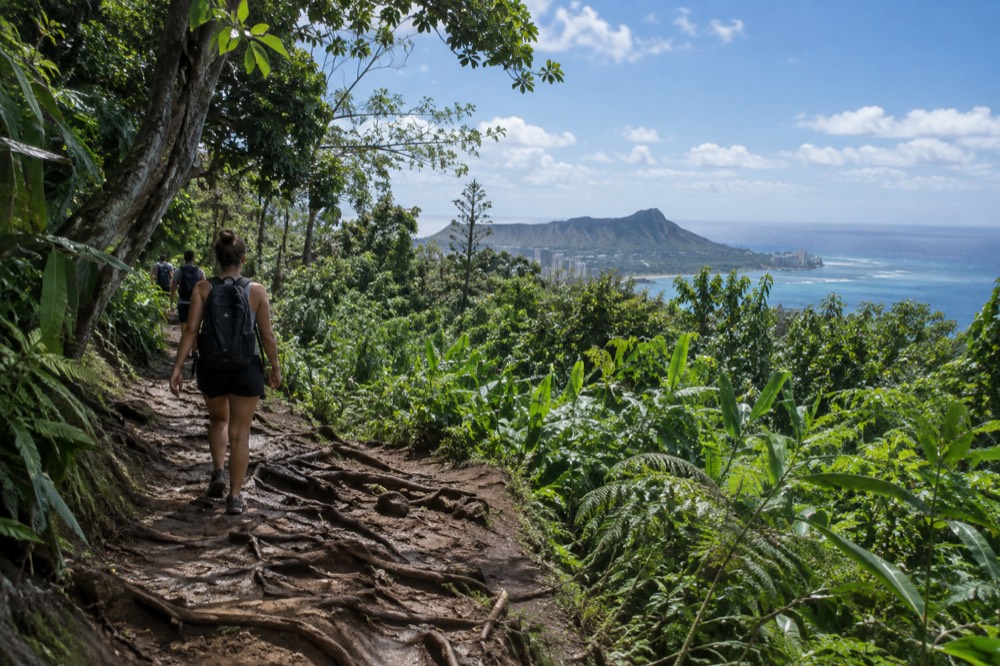
Mānoa Falls is not technically hard, but it is harder than it looks in photos, because the trail through the rainforest is a churn of mud, exposed roots and slick stone crossings that stay wet even in dry spells.
The walk to the waterfall is short and gentle in gradient, yet the footing demands attention the entire way, and the valley's climate is the real obstacle: Mānoa receives roughly nine times the annual rainfall of the airport area, five miles away.
That rainfall figure is the single most useful piece of planning data on this page, and it comes from the NOAA 1991–2020 climate normals. The Lyon Arboretum station in Mānoa records 150.96 inches of rain a year. Honolulu International Airport, on the leeward coast, records 16.41 inches. Every single month in Mānoa, including its driest, is wetter than the airport's wettest month. So the trail you see in someone's sunny Instagram photo is not the trail you are likely to meet. You are likely to meet mud, and mud on a rooted slope is a legitimate difficulty.
The trail is free, and it ends at a waterfall pool area where the state asks visitors not to enter the water, both for safety and because rockfall at the base is a documented hazard. What Mānoa offers, in exchange for dirty shoes, is the deepest rainforest experience reachable from Waikīkī without a long drive: banyans, bamboo, the constant drip of the canopy, and a valley wall that explains why the Koʻolau range looks the way it does.
Two safety notes specific to this valley. First, flash floods are a real hazard on Oahu's mountain streams and waterfall trails, and the water can rise faster than you can walk out; our Oahu flash flood safety guide explains how to read the conditions before you commit. Second, the trail's popularity means the parking situation is its own challenge, and the private lot at the trailhead is not free, so plan the practical side before you arrive rather than after.
A self-guided package with transport from Waikīkī is a good middle path if you want the rainforest without the logistics.
Which Hard Hike Areas Are Closed Right Now?
As of the DLNR State Parks notice dated 9 September 2026, three Oahu sites remain closed following Hurricane Lowell: Nuʻuanu Pali State Wayside, Kaʻena Point State Park in its Mokuleʻia and Keawaʻula sections, and Wahiawā Freshwater State Recreation Area. All are closed until further notice for storm repairs. Do not plan a hike to the Pali Lookout or out to Kaʻena Point until the DLNR notices banner says otherwise.
Kaʻena Point deserves special mention, because it appears on hard-hike lists for good reason: the walk out to the point is long, hot and exposed, and the point itself is both a protected seabird and monk seal area behind a predator-proof fence and a place of deep cultural significance, a leina a ka ʻuhane where souls depart in Hawaiian tradition. It is not a casual beach stroll, and it is not a photo backdrop either. When it reopens, treat it with restraint: stay on the trail, keep clear of wildlife, and carry far more water than the flat profile suggests.
The Pali Lookout closure is less about hiking and more about the island's most famous viewpoint, but it ripples into hiking plans because several popular Koʻolau trails are accessed from that side of the mountains. If your itinerary assumed a Pali stop between a windward hike and a leeward one, cut it and re-check the DLNR page the week you travel. Storm-related reservation refunds for state park bookings are being processed automatically, minus non-refundable service charges, and taking four to six weeks.
The wider lesson is that Oahu's trail status changes more than most destinations. A hurricane season can close a trail in an afternoon. Check the DLNR State Parks notices page and the relevant city pages the week of your trip, not the month before.
How Should You Prepare For A Hard Hike On Oahu?
Prepare for heat, humidity and footing, in that order. Start at or before sunrise, carry more water than you think you need, wear real shoes with grip, and check the weather on the side of the island you are hiking rather than the side you are sleeping on. Tell someone your route, keep your phone charged, and decide your turn-around conditions before you start rather than at the moment you are tired, thirsty and emotionally invested in the summit.
The heat rule is the one that matters most. Oahu sits in the tropics, and the sun is intense year-round, but the humidity is what actually defeats people, because sweat cannot cool you efficiently in saturated air. Hard trails like Koko Head have no water and no shade, so you carry everything. A common mistake is hydrating at the trailhead and then rationing on the climb; do the opposite, drink steadily from the start, and bring electrolytes for anything over an hour.
The footing rule matters most in the valleys. Mānoa-style rainforest mud, root lattices and wet stone are slicker than they photograph, and most injuries on Oahu's easier trails are ankle and knee injuries from slips, not falls from cliffs. Shoes with real tread beat sandals on every trail in this article without exception. Trekking poles are a genuine help on the muddy ones and on Koko Head's descent.
The weather rule requires knowing the island's geography. The windward and valley trails sit in a different rainfall regime from Waikīkī, as the Mānoa figures above show, and the surf and swell conditions run out of phase by shore, which matters for any trail with a coastal section. A clear morning outside your hotel is not a forecast for the Koʻolau ridge you are about to climb. Check the National Weather Service forecast for the specific area, and never enter a stream valley or waterfall trail when rain is falling or forecast in the mountains above it.
Finally, the honest self-assessment rule. The hardest hike on Oahu is only worth doing if it is hard for you at your current fitness, not hard in the abstract. A visitor who finds Diamond Head a genuine challenge should take that win, and a visitor who scrambles regularly should skip straight to Olomana's ridge. There is no prize for choosing the harder trail, and the island's rescue services would genuinely prefer you did not.
Common Questions About The Hardest Hikes On Oahu
Most questions about Oahu's hardest hikes come down to three things: whether the trail is officially open, whether it needs a reservation or a fee, and whether the difficulty is effort or exposure. Koko Head is the effort answer, Olomana the exposure answer, Diamond Head the reservation answer, and the closures list is the thing that changes. The questions below cover the specifics people ask before committing to any of them.
What's the hardest hike on Oahu?
Koko Head Crater Trail is the hardest for sustained effort, a shadeless stair climb with no relief and no water. Olomana is the hardest for exposure, with roped scrambling on its second and third peaks. Choose based on whether you want a cardio test or a nerve test.
Is Koko Head harder than Diamond Head?
Yes, considerably. Diamond Head is a moderate, paved-and-stepped state park climb with tunnels and a spiral staircase at the end. Koko Head is a continuous steep staircase in full sun. Both are rewarding, but they are not in the same difficulty class.
Do I need a reservation to hike Diamond Head?
Yes, if you are not a Hawaii resident. Non-residents must reserve entry and parking in advance, up to 30 days ahead, with no on-site sales. Entry is $5 per person plus $10 per vehicle, credit card only. Residents enter free with state ID.
Is the Mānoa Falls hike hard?
Not in gradient, but the footing is genuinely difficult. The trail is often muddy and rooted, and the valley receives roughly 150 inches of rain a year against about 16 at the airport. Wear grippy shoes and do not enter the water at the falls.
Can I hike Kaʻena Point right now?
No. The Mokuleʻia and Keawaʻula sections of Kaʻena Point State Park are closed until further notice for Hurricane Lowell storm repairs, per the DLNR notice dated 9 September 2026. Check the DLNR notices before planning any hike on this list.
What should I bring for a hard Oahu hike?
More water than feels reasonable, electrolytes, real shoes with tread, sun protection, a charged phone, and a decision made in advance about when you will turn around. For valley trails add bug repellent, and never hike a waterfall trail with rain in the mountains above it.
Whichever trail you pick, the reward on Oahu is consistent: an island that looks small on a map keeps delivering climbs that feel far bigger than their map footprint, and doing the hardest one honestly, at your own fitness, with the right preparation, is what earns the view at the top.