What Is The Biggest Farmers Market In Oahu?
The biggest farmers market in Oahu is the Saturday market at Kapiolani Community College. Here is what it sells, how to get there without a car, and how it compares to the North Shore and Kailua markets.
What Is The Biggest Farmers Market In Oahu?
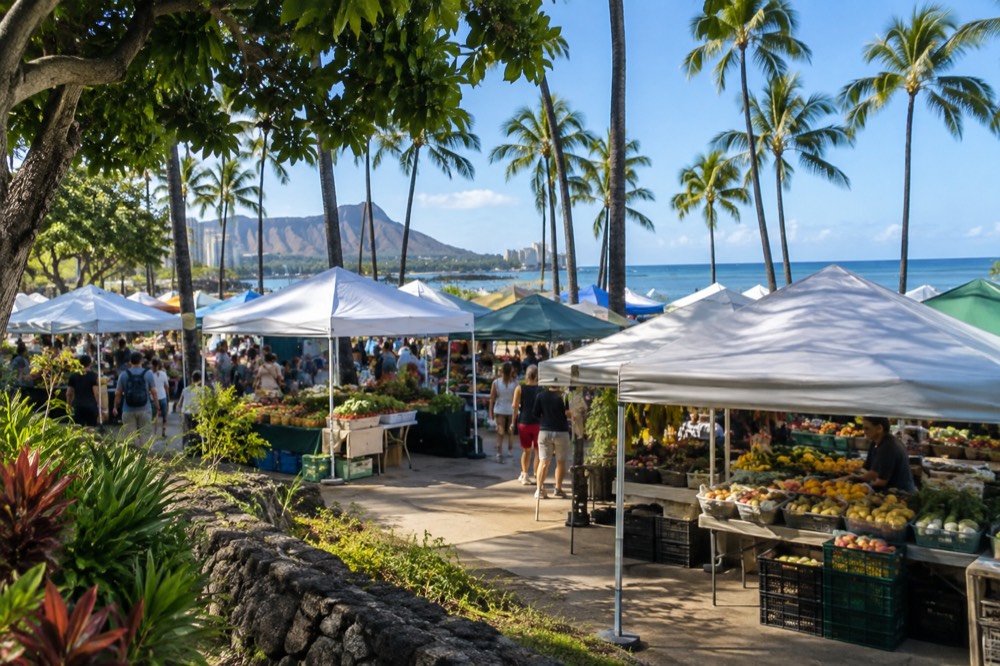
The biggest farmers market in Oahu is the Saturday Farmers Market at Kapiʻolani Community College, held on the campus at the foot of Lēʻahi, the crater signposted as Diamond Head. It is the island's largest by stall count and by reputation, the one chefs shop at before service and the one most guidebooks mean when they say "the KCC market." If your question is simply which market to put on a Saturday itinerary, that is the answer, and the rest of this article explains what you will find there and how to reach it without a car.
The market matters to more than food shoppers. It sits inside the densest visitor corridor on the island, between Waikīkī and Diamond Head State Monument, which makes it one of the few genuinely local experiences you can walk to from a resort hotel. The Oahu Travel Guide covers markets across the island in a dedicated roundup, and this page answers the specific question of which one is biggest and whether biggest means best for you.
What Is The Biggest Farmers Market In Oahu?
The biggest farmers market in Oahu is the Kapiʻolani Community College Saturday Farmers Market, held on the KCC campus on the slopes of Lēʻahi at the eastern edge of Waikīkī. It is the largest market on the island by number of vendors and by attendance, and it has become the flagship Saturday morning stop for residents, chefs and visitors alike. No other market on Oahu matches its scale.
The campus setting is part of why it grew so large. Kapiʻolani Community College sits on a hillside off Monsarrat Avenue, a few minutes from the Waikīkī hotel strip, with the crater wall of Lēʻahi rising directly behind the stalls. The site gives the market room to spread out across parking lots and lawns, which a street market in a town like Haleʻiwa simply cannot do. Scale is the honest answer here, and scale is what separates the KCC market from the smaller, quieter markets scattered around the island.
It is worth being clear about what "biggest" buys you and what it does not. A large market means more vendors, more variety and more prepared food to eat on the spot. It also means crowds, lines at the popular stalls and a parking situation that gets harder as the morning goes on. Some visitors prefer a small market in a country town precisely because it is not the biggest. Later sections cover that trade-off honestly.
If you are planning a full Saturday around the market, the campus location pairs naturally with the Diamond Head hike in the early morning, a market visit mid-morning, and the beach or a luau in the evening. A few tours and passes bundle well with that shape of day.
Where And When Does The KCC Farmers Market Take Place?
The KCC Farmers Market runs on Saturday mornings on the Kapiʻolani Community College campus off Monsarrat Avenue, at the Diamond Head end of Waikīkī. Arriving early is the standard advice, both for the best produce and for the easiest parking and shortest lines. The market wraps up around midday, so treat it as a morning commitment rather than an all-day one.
The Saturday timing is not incidental. Saturday is when the market draws its full vendor roster, including the prepared-food stalls that have made it as much a breakfast destination as a shopping trip. People arrive with coolers and canvas bags, buy coffee and something grilled, and eat at the picnic tables before doing their shopping. The atmosphere is closer to a weekend institution than a tourist stop, and that character survives the visitor numbers because the produce is genuinely the point.
Getting the timing right matters more here than at a smaller market. The most popular items, the ones locals line up for, sell out before the market officially winds down. If you want the full range of what is on offer, plan to be there in the first hour or two after opening. If you mainly want the experience and some lunch, arriving later is fine, though the selection thins and the parking situation eases at exactly the same time, which is a fair trade.
The location also makes the market one of the easiest big local experiences to fold into a visitor's week. You do not need a rental car to reach it. TheBus runs along the corridor between Waikīkī and the campus, and the walk from the Diamond Head side of Waikīkī is short enough that many hotel guests do it on foot after an early hike. The section on transit below covers the fares in detail.
One practical point deserves emphasis: check the current schedule before you go. Markets occasionally shift for campus events or holidays, and the market's own channels are the place to confirm the hours for your Saturday. The market also runs a smaller additional market day during the week, but the Saturday event is the one that earns the title of biggest.
What Can You Buy At The KCC Farmers Market?
The KCC market sells island-grown produce, tropical flowers, honey, coffee, baked goods, and a wide range of prepared food cooked on site, from grilled local plates to fresh fruit drinks. Because it is the biggest market, it carries the deepest selection of any farmers market on Oahu, including items you will not reliably find at the smaller neighborhood markets. Expect to eat as much as you shop.
The produce stalls are the backbone. Depending on the season you will find apple bananas, papayas, mangoes, pineapples, leafy greens, taro, sweet potatoes, herbs and specialty crops grown by small farms from across the island. Hawaii's agriculture is diverse in a way the hotel breakfast buffet does not reveal, and the market is where that diversity is most visible. Talking to the growers is part of the experience, and many of them farm on land their families have worked for generations.
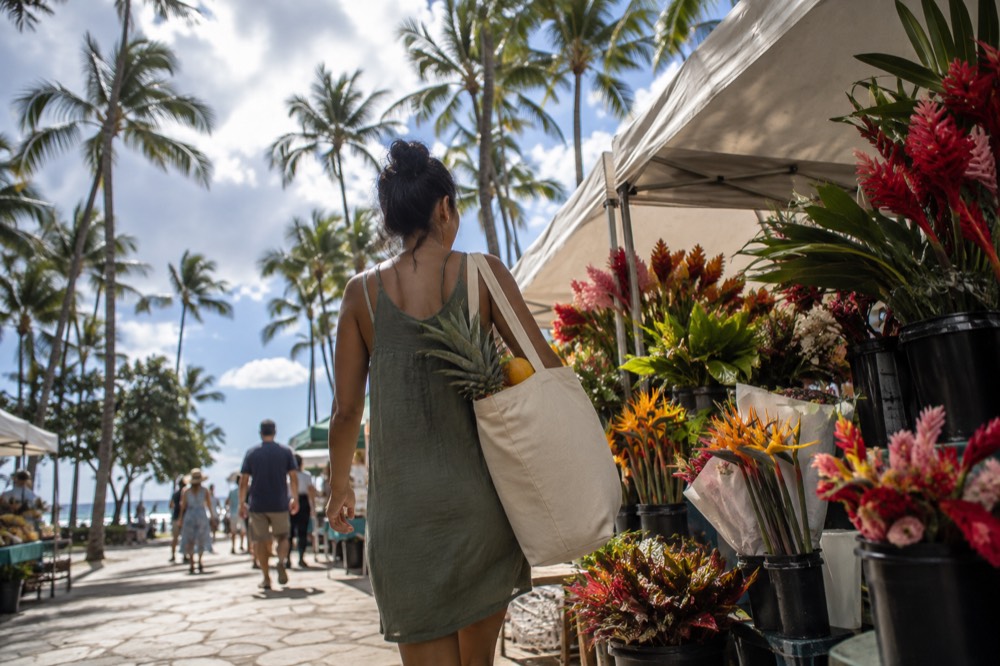
The flowers deserve a specific mention. Cut tropical flowers, ginger, heliconia and orchids show up in quantities and at prices that surprise visitors from the mainland, and they make a genuinely local purchase rather than a souvenir. Honey, jams, chocolate made from locally grown cacao, and coffee from farms across the state round out the shelf-stable options, which are the practical buys if you want to carry something home.
Then there is the food. The prepared-food section is what turns the market into a Saturday morning destination in its own right: grilled plates, noodle dishes, baked goods, shave ice, fresh juices and coffee. The usual pattern is to eat breakfast first and shop second, because the lines only grow. This is also the honest answer to whether the market is worth visiting if you have no kitchen: it absolutely is, because half of what it offers is meant to be eaten standing up.
A few etiquette points that locals will notice. Bring your own bag, since vendors may run short. Bring cash in small bills even where cards are accepted, because it keeps the lines moving. Do not handle produce you do not intend to buy, and ask before photographing people's stalls at close range. None of this is complicated, but at a market this size the difference between a considerate visitor and an oblivious one is visible from across the lawn.
How Do You Get To The KCC Farmers Market Without A Car?
You can reach the KCC market on TheBus from Waikīkī in a few minutes, or on foot from the Diamond Head end of the hotel strip, and a HOLO card makes the whole day's riding cheap. A single adult cash fare on TheBus is $3.25, while a HOLO card day caps at $7.50 no matter how many rides you take. No transfer or tour booking is needed.
The fare structure is worth knowing because it shapes the whole day. TheBus and Skyline share one fare system, and the HOLO card caps what you pay per day, so a morning at the market followed by an afternoon elsewhere on the island can cost less than parking for two hours in Waikīkī. The table below is the full fare picture from the City and County of Honolulu's transit pages.
| Fare type | Price | What it covers |
|---|---|---|
| Adult cash single ride (TheBus only) | $3.25 | One ride, no transfers, exact fare |
| HOLO card 2-hour pass | $3.00 | Two hours of unlimited transfers on TheBus and Skyline |
| 24-hour pass | $7.50 | A full day of riding from first tap |
| Daily cap on a HOLO card | $7.50 | The most you can be charged in a day, then rides are free |
| 7-day pass | $45.00 | 168 hours from first tap |
| Monthly cap | $90.00 | The monthly pass ceiling |
The walking option is underrated. From the Diamond Head end of Waikīkī the campus is a short, pleasant walk along a residential street, and combining it with an early Diamond Head hike is the classic Saturday: up the crater for sunrise, down to the market for breakfast and shopping, back to the beach by early afternoon. If you are doing that, note that Diamond Head requires a reservation for non-resident visitors, for entry and for parking, a rule in force since May 2022, so book the hike before you plan the morning around it.
For visitors who would rather not plan transit at all, the Waikīkī trolley system covers the corridor, and a hop-on hop-off day pass turns the market into one stop on a loop that also takes in Diamond Head and the Honolulu sights. The trolley is a tourist product rather than a commuter one, but for a single Saturday it solves the exact problem the market poses: getting from a hotel to the campus and back with shopping bags. See the Waikīkī trolley hop-on hop-off tour alternative below, or read the site's full roundup of farmers markets on Oahu for the smaller markets reachable on foot.
What Other Farmers Markets On Oahu Are Worth The Trip?
Oahu has a dozen or more farmers markets, and the ones most worth pairing with a visitor's plans are the Haleʻiwa market on the North Shore, the Kailua market on the windward side, and the markets around Pearl City and downtown Honolulu. None approaches the KCC market in size, but each offers something the big Saturday market cannot, especially a slower pace and a reason to see another part of the island.
The honest comparison is not about produce quality, which is high everywhere because the same small farms often sell at several markets across the week. It is about setting. The KCC market gives you scale and convenience. The country markets give you the town around them: Haleʻiwa's storefronts and shave ice, Kailua's beach-town ease, the windward coast's green cliffs behind every view. If your trip already includes a North Shore day or a Kailua morning, going to that side's market costs you nothing extra.
| Market | Area | What it offers over the KCC market |
|---|---|---|
| KCC Saturday Farmers Market | Waikīkī / Diamond Head | The biggest: most vendors, most prepared food, easiest from a hotel |
| Haleʻiwa Farmers Market | North Shore | Small-town pace, pairs with a North Shore day trip |
| Kailua market | Windward side | Beach-town setting, pairs with Kailua and Lanikai |
| Neighborhood markets islandwide | Various | Quieter, more local, better for a slow morning |
A practical way to use this: let the market follow the plan rather than driving the plan. If Saturday is your Waikīkī or Diamond Head day, do KCC. If your North Shore day falls on the right morning, do Haleʻiwa and treat the market as one stop among several. The site's North Shore Oahu guide covers the rest of that day, and the Kailua guide does the same for the windward side.
If you are staying in Waikīkī without a car and want the simplest possible Saturday, the trolley option above still applies. You can compare it against the pass products with a quick check of availability:
Is The Biggest Farmers Market The Best One For Your Trip?
The KCC market is the best choice if you want the fullest selection, the most food to eat on site, and the shortest trip from a Waikīkī hotel, but it is not automatically the best experience. A smaller market in Haleʻiwa or Kailua can be more enjoyable if your day already points that way, or if big crowds are the thing you travel to avoid. Match the market to the day, not to the title.
The trade-off is real and worth stating plainly. The KCC market on a busy Saturday is a crowd, a line and a hunt for a table. It rewards early arrivals and punishes late ones. What you get for that is the widest range of anything on the island's market calendar, and a location that costs you almost no travel time. For most visitors on a first trip, especially a short one, that package wins, and the crowds are the price of it.
For a longer trip, or a second visit, the calculus changes. The smaller markets are where you see the island's towns functioning as towns, and they pair naturally with the drives and beaches that fill a North Shore or windward day. The produce is the same produce. The shave ice nearby is the same shave ice. The difference is that the whole morning feels less like an event and more like a place.
There is also a budget angle, and the site covers it in detail elsewhere. A farmers market is one of the cheapest genuinely local meals on the island, and a pass product can compound the savings across a packed week. If your itinerary includes several paid attractions, the multi-attraction pass is worth a look alongside the market plan, since a big Saturday at KCC plus a week of sights is exactly the pattern the pass is built for. See the Go City Oahu pass context in the site's budget guide, or check availability directly:
Whichever market you choose, two habits serve you well everywhere on the island. Bring a reusable bag and small bills. Go early. Those two sentences are most of what separates a good market morning from a frustrating one, and they apply from the biggest market on the island to the smallest roadside stand.
Common Questions About Farmers Markets In Oahu
Most questions about Oahu's farmers markets come down to three things: which market to pick, how to get there without a car, and what to buy once you arrive. The KCC Saturday market answers all three comfortably for most visitors, since it is the biggest, the easiest to reach on transit, and the widest selection on the island. The details below cover the questions that come up most often.
What is the biggest farmers market in Oahu?
The Kapiʻolani Community College Saturday Farmers Market, held on the KCC campus at the Diamond Head end of Waikīkī. It is the largest market on the island by vendors and attendance, and it doubles as one of the best breakfast spots in the neighborhood on a Saturday morning.
Do I need a car to get to the KCC market?
No. TheBus serves the corridor between Waikīkī and the campus, a HOLO card day caps at $7.50, and the walk from the Diamond Head end of the hotel strip is short. Many visitors pair the market with an early Diamond Head hike and do the whole morning on foot.
Is the KCC market good for visitors without a kitchen?
Yes. Roughly half the market is prepared food meant to be eaten on site, from grilled plates to fresh fruit drinks and coffee. Locals treat it as a breakfast destination first and a shopping trip second, and you can do the same.
Should I bring cash to an Oahu farmers market?
Yes, in small bills, even at stalls that accept cards. Cash keeps the lines moving, and at the smaller neighborhood markets some vendors take nothing else. Bring your own bag as well, since vendors can run short on Saturdays.
Are the smaller markets worth visiting instead?
They are, if your day already points toward them. The Haleʻiwa and Kailua markets sell much of the same produce in a slower, small-town setting, and they pair naturally with a North Shore or windward day. Match the market to your itinerary rather than driving across the island for one.
What time should I arrive at the KCC market?
Early, within the first hour or two of opening. The popular prepared-food stalls and the best produce sell out before the market winds down around midday, and parking and lines both get harder as the morning goes on.
The short version: put the KCC Saturday market on your list, go early, eat breakfast there, and let the rest of the day flow downhill toward the beach.