Oahu Catamaran Cruise Guide: Sails, Sunset Trips And Snorkel Runs From Waikīkī
Catamarans leave Waikīkī Beach and Kewalo Basin several times a day, and the differences between them are bigger than the price tags suggest. Here is what each trip type actually delivers, when to book, and what the ocean is doing under the hull.
Short answer
Most Oahu catamaran cruises are 1.5 to 2 hours, launch from Waikīkī Beach or nearby Kewalo Basin, and split into three kinds: plain scenic sails, snorkel runs, and timed trips that chase sunset, Friday fireworks or the winter whale migration. Book the sunset and fireworks sails ahead; walk-up seats are common on midday runs.
A catamaran is the cheapest way to get off the sand and see Oʻahu from the water, and the island's sailing fleet is unusually easy to use: most trips launch straight off the beach at Waikīkī or from the small harbor at Kewalo Basin a few minutes west. The catch is that "catamaran cruise" covers several genuinely different products, from a 90-minute scenic drift to a five-hour snorkel expedition, and the calendar matters more than the brochure. Winter brings humpback whales, summer brings flat south-shore water, and Friday brings fireworks over the water off the Hilton lagoon.
This guide lays out the trip types, the departure points, the seasonal logic, and the practical rules that decide whether a given sail is worth your afternoon. The short version: pick your trip by what you want to see, book anything timed to sunset or fireworks in advance, and treat the midday scenic runs as the walk-up option.
What Is An Oahu Catamaran Cruise, Actually?
An Oahu catamaran cruise is a small-boat sailing trip, typically 1 to 2 hours, run on a twin-hulled catamaran carrying somewhere between a dozen and fifty passengers. Trips fall into three families: scenic sails with no water contact, snorkel trips that stop at a reef, and timed event sails built around sunset, Friday fireworks or the winter whale season. Most launch from Waikīkī Beach itself or from Kewalo Basin harbor just west of the beach.
The twin hulls are the whole point of the design. A catamaran is stable in the small chop that Oʻahu's leeward coast produces most days, which means less rolling than a monohull of the same size and a deck you can walk around without holding on. That stability is why these boats dominate the visitor sailing market here: they work for passengers who have never been on a boat, for small children, and for anyone prone to seasickness on a drifting hull.
The scale matters when you compare listings. Some operators run small craft where a trip might carry fifteen people; others run large cats where you will be one of forty or more. Neither is better, but they are different products, and the listing usually states the capacity. If it does not, assume the bigger number.
What almost none of these trips include is a full meal. Drinks, often one included and a cash bar after, are the norm. A dinner cruise is a separate product, typically run on larger power vessels rather than catamarans, and if your evening is really about the view rather than the boat, our best sunset spots on Oahu roundup covers the land-based alternatives too.
Where Do Catamarans Leave From On Oahu?
Waikīkī Beach and Kewalo Basin are the two main catamaran departure points, and they sit ten minutes apart at the western end of Waikīkī. Beach launches put you in the surf zone, wading out to the boat with your shoes off, while harbor launches use a dock and dry boarding. A few snorkel-oriented operators also run from Ala Wai or further afield, but the overwhelming majority of the market is these two.
Staying near the beach for an easy walk to the boat. Book a Waikiki hotel here.
The beach launch is the memorable one. The catamaran sits anchored in the shallows, the crew walks you out through knee-deep water, and you climb aboard from the sand. It is a genuinely fun start, and it is also the part of the trip that surprises people with mobility limits: if stepping through surf and climbing a boarding ladder is hard for you, choose a Kewalo Basin departure instead, where you board from a dock.
Kewalo Basin is a working small-craft harbor west of the beach, and several of the larger snorkel and dinner-adjacent boats run from there. The trade-off is simple: you lose the beach-launch romance and gain a dry walk aboard, parking in a real lot, and usually a shorter ride out to the snorkel sites.
| Departure point | Boarding style | Typical trip types | Best for |
|---|---|---|---|
| Waikīkī Beach | Wade out from the sand, climb aboard | Scenic sails, sunset sails, fireworks sails | The classic postcard experience |
| Kewalo Basin | Dock boarding, dry feet | Snorkel trips, larger vessels, dinner-adjacent cruises | Families, mobility needs, snorkelers |
| Ala Wai / other harbors | Dock boarding | Occasional specialty and private charters | Specific listings only |
One practical note on timing: beach launches are weather-dependent in a way dock launches are not. If the surf is up along the beach, a Waikīkī beach launch can be delayed or shifted, and the operator will tell you at check-in. It is rare, but it happens, and it is the reason to arrive early rather than at the minute.
Which Catamaran Trip Type Fits What You Want?
Match the trip to your goal rather than the price: a plain scenic sail is the cheapest and shortest option and works for almost anyone; a snorkel trip adds a reef stop and swimsuit logistics; a sunset sail is the same route timed to golden hour and books out first; and a fireworks or whale-season sail only exists on certain days or months. Duration, not luxury, drives most of the price difference.
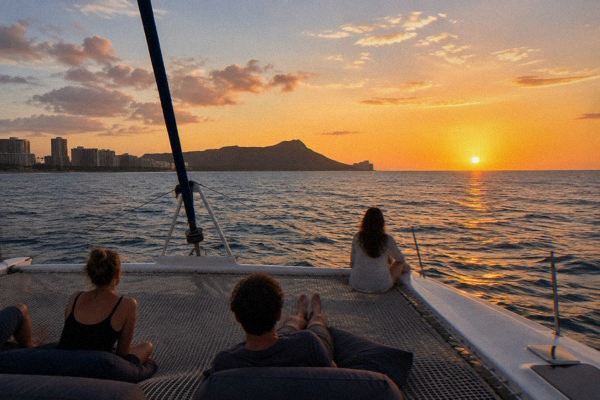
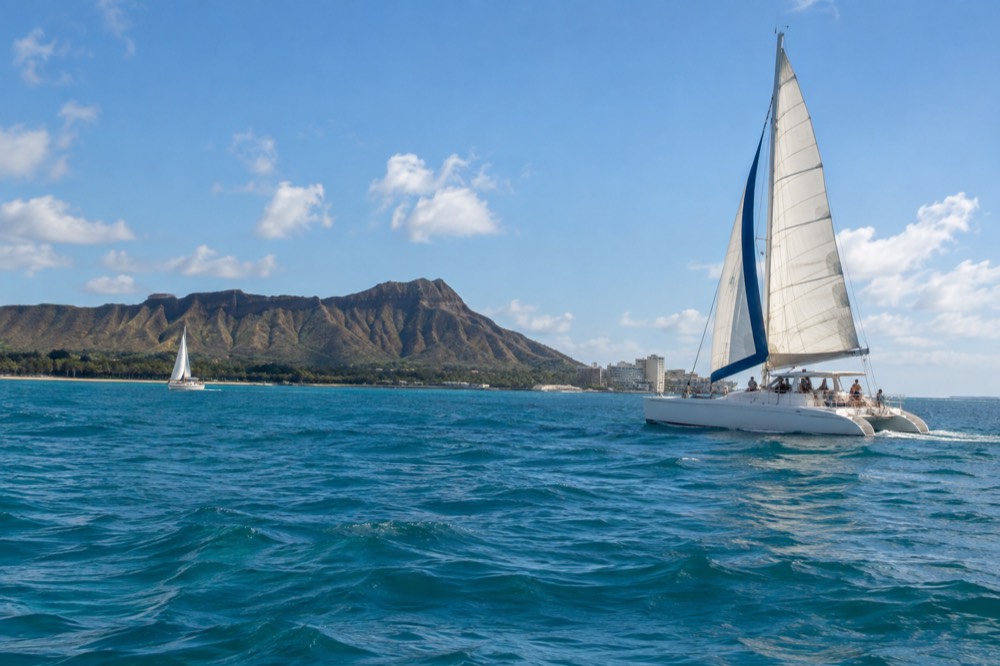
The scenic sail is the entry product: out along the coast, Diamond Head to one side, the hotels shrinking behind you, drinks on board, and back within two hours. If your question is simply "what does Waikīkī look like from the water," this is the answer, and it is the trip you can most often book same-day.
The snorkel trips go further. The classic Waikīkī snorkel run heads to Turtle Canyon, a reef area off the beach where green sea turtles, honu, gather, and several operators run there daily. Gear is included, a guide is in the water with you, and the trips run longer because the boat has to get there, anchor and give you water time. Our Oahu snorkeling guide covers the shore-based alternatives if you would rather not pay for a boat at all.
Sunset sails are the same coast run timed to the last hour of daylight. Oʻahu's sunsets are early by mainland summer standards: the latest sunset of the year, observed in early July, is about 7:17 p.m., and by winter the sun is down before 6 p.m. That means sunset trips shift their departure times through the year, and the 5 p.m. slot you book in June does not exist in December.
| Trip type | Typical duration | What is included | Book-ahead level |
|---|---|---|---|
| Scenic day sail | 1 to 2 hours | Drinks, coast views | Often same-day |
| Snorkel sail | 2 to 3 hours | Gear, guide, reef stop | A few days ahead |
| Sunset sail | 1.5 to 2 hours | Drinks, golden-hour timing | Book early, weekends especially |
| Friday fireworks sail | About 2 hours | Sunset plus the Hilton lagoon fireworks | Book well ahead, Friday only |
| Whale-watch sail (winter) | About 2 hours | Spotting from the deck, November to April | Seasonal, moderate |
The fireworks detail is worth knowing before you plan a week. The weekly fireworks display off the Hilton Hawaiian Village lagoon happens Friday evenings, and several catamarans position on the water for it. Those trips combine a sunset sail with the show and are among the first things on the island to sell out for a given week.
When Is The Best Time Of Year For A Catamaran Cruise On Oahu?
November through April is whale season, when humpbacks are present in Hawaii waters and any sail doubles as a whale watch; summer brings the calmest south-shore water and the best snorkel visibility; and Friday evenings add the fireworks sail year-round. There is no bad month for the basic scenic sail, since leeward Waikīkī sits on the island's dry side and gets the least rain on Oʻahu.
The whale season is the strongest seasonal argument. The Hawaiian Islands Humpback Whale National Marine Sanctuary states plainly that from November through April, visitors can see whales from shore and at sea, and Oʻahu's winter sails regularly spot them. No operator can promise a sighting on a given trip, but the odds in season are good enough that several boats run dedicated whale-watch cruises, and the sanctuary's rule is law: keep 100 yards from humpbacks. The crew will hold that distance, and so should you if you are on a boat of your own.
The water itself barely changes temperature. Harbour readings from the NOAA station at Honolulu, which run warm against open ocean, averaged 78.2 °F in January and 82.7 °F in August across 2025, a swing of about four degrees. You will not need a wetsuit on a summer sail and probably will not want one in winter either.
Summer is the snorkel season, and the reason is swell rather than temperature. Oʻahu's shores run out of phase: north-facing shores peak in winter, south-facing shores peak in summer, and on a September day the National Weather Service surf forecast had the south shore running larger than the north. In summer that pattern flips, and the south-shore reef areas sit calmer and clearer for the snorkel runs.
What Should You Know About Wildlife From The Deck?
Turtles are the everyday sighting on the Waikīkī snorkel runs, and the guidance is 10 feet, which is a recommendation rather than a law; humpback whales are protected by an actual legal distance of 100 yards; and Hawaiian spinner dolphins carry a 50-yard rule that prohibits swimming with them. A catamaran crew will manage all of this, but knowing the rules ahead of time keeps you from being the passenger who asks the crew to get closer.
The honu distinction matters because it is widely misstated. The 10-foot turtle distance and the 50-foot monk seal distance are guidelines; what is actually illegal is taking or harassing the animals, under federal law and Hawaii statute alike. The whale and dolphin distances, by contrast, are law. A guide that flattens the two is wrong in a way you can check, and this one will not.
In practice on a catamaran, the crew's behavior tells you the operator's standards. Reputable boats hold distance, brief passengers before the water stop, and do not chase. If a listing's photos show people touching or riding turtles, that is your signal about how that operator runs the water time.
How Much Does A Catamaran Cruise Cost On Oahu?
Catamaran trips on Oahu span roughly the low double digits for a basic scenic sail to well over a hundred for long snorkel expeditions and dinner-adjacent cruises, with sunset and fireworks trips in the middle of that range. Prices move with duration, inclusions and demand rather than with boat quality, and the live listing is the only reliable price source, since operators adjust seasonally.
What is stable is the structure: the scenic sails sit at the bottom of the range, snorkel trips cost more for the extra hours and gear, and the event sails, fireworks especially, carry a premium for the timing rather than the boat.
Two cost notes that are not on the listing. First, the beach-launch trips have no parking component if you are staying in Waikīkī, you walk to them, but if you are driving in, Waikīkī parking is its own expense and our Oahu parking guide covers the lots. Second, tipping the crew is standard on these boats, cash, and the crew you watched haul the boat onto the sand earns it.
If the fireworks timing is what sold you on the idea of a sail at all, the sunset version is the calmer cousin of that trip: same water, same coast, no show to race, and a departure time that still catches the best light of the day.
Do You Need To Book Ahead, And Can You Cancel?
Friday fireworks sails and weekend sunset trips are the two bookings that genuinely sell out and should be made days ahead; midday scenic sails usually have walk-up or same-day space; and most catamaran operators on the island sell through platforms with free cancellation windows, typically until a day or so before departure. Weather cancellations are refunded, and the operator, not you, makes that call when the surf is up.
The cancellation point deserves emphasis because it removes most of the booking anxiety. If your plans are loose, book the trip you want anyway and cancel inside the window if the day changes. The listings state the exact cutoff, and it is usually generous enough to cover a weather call made the morning of.
What you should not count on is a walk-up seat on a Friday. The fireworks sail is the single most demand-concentrated product in this market: one night a week, limited boats, and a show that starts whether or not you are aboard. Book it when you book your flights.
The whale-season math is different again. In winter there are more boats running whale watches, but also more visitors, and a calm morning in January will fill. If whales are the point of the trip, book the earliest sailing of the day: the wind is lighter, the water is calmer, and spotting is easier before the afternoon chop builds.
What Should You Bring On A Catamaran Cruise?
Bring reef-safe sunscreen applied before boarding, a light layer for the wind on the return leg, cash for the crew tip and any cash bar, and dry clothes for after if you launched from the beach and waded out. You do not need towels on a scenic sail, but you do on a snorkel trip, and anything you cannot afford to get wet should stay at the hotel.
The wind point surprises people. A sail that feels warm in the shelter of the harbor gets real breeze once the boat is out and moving, and the return leg, usually downwind into the sunset, is the moment passengers wish for a layer. A long-sleeve shirt weighs nothing and solves it.
The sunscreen point is not style advice. Hawaii law restricts the sale of sunscreens containing oxybenzone and octinoxate, and the reef you are sailing over is the reason. Apply before you board, since reapplying on a moving deck with a crowd is awkward, and pick a product labeled reef-safe rather than assuming.
For the beach launches specifically: you are wading out through surf to your knees or so, so wear something you can get wet and leave the good shoes at the hotel. The crew will have a dry bag or a spot for small items, but the rule of thumb on small boats everywhere is that whatever can go overboard eventually does.
Are Catamaran Cruises On Oahu Safe For Kids And Non-Swimmers?
Catamaran cruises are among the most family-friendly boat trips on Oahu because the hulls are stable, the leeward coast is usually calm, and the scenic and sunset sails never require anyone to enter the water; non-swimmers should choose those over snorkel trips, and on any trip, life jackets are on board and children should wear them on deck if the crew advises it. The beach launch is the one step to weigh with very small kids.
The distinction is the water contact. On a scenic sail, a non-swimmer is a normal passenger and in no way limited. On a snorkel trip, a non-swimmer is either staying on the boat or relying on floatation in the water, and while crews handle this constantly and flotation is available, it is a different experience than the one the swimmers get.
For toddlers, the honest answer is that the beach launch is the hard part: surf, a wet climb, and a boat with open rails. Some operators set age minimums, and the listing states it if they do. Kids who can follow crew instructions and swim a little are fine on nearly everything, and the turtle snorkel runs are a memorable trip for exactly that age.
Seasickness is the last variable. Catamarans are the right boats for it, the stability is real, but a small percentage of passengers still feel it, and the standard advice holds: take a remedy the night before and the morning of rather than on the deck, stay mid-ship, and look at the horizon rather than the cabin.
Common Questions About Oahu Catamaran Cruises
Most questions about Oahu catamaran cruises come down to four things: which departure point suits your group, whether the date lands in whale season, how far ahead the Friday fireworks sail needs to be booked, and what actually happens at a beach launch. The trips themselves are simple, stable and short, and the planning questions are all answered by matching the trip type to the day you have.
Do catamaran cruises leave right off Waikīkī Beach?
Yes, several do. Those operators anchor in the shallows and walk passengers out through knee-deep water to board. Others use the dock at Kewalo Basin harbor just west of the beach, which is the dry-foot option and the better one for mobility needs.
Can you see whales from a catamaran on Oahu?
From November through April, yes, humpbacks are present in Hawaii waters and regularly spotted from Oahu sails, per the national marine sanctuary. No operator can guarantee a sighting on a given trip, but winter boats run dedicated whale-watch cruises and the odds are good. The legal approach distance is 100 yards.
What is the Friday fireworks catamaran cruise?
It is a sunset sail timed to the weekly fireworks display off the Hilton Hawaiian Village lagoon on Friday evenings, with the boat positioned on the water for the show. It runs Friday only and is one of the fastest-selling trips on the island, so book it well ahead.
Do you need to book a catamaran cruise in advance on Oahu?
For the Friday fireworks sail and weekend sunset trips, yes, days ahead. For midday scenic sails, same-day or walk-up space is usually available. Most bookings carry a free cancellation window until shortly before departure, so booking early costs you flexibility only if you forget to cancel.
Will you get wet on a catamaran cruise?
On a beach launch, yes, to about the knees, boarding and disembarking. On a dock launch, no, unless the trip includes a snorkel stop. Some spray can come aboard on any sailing day, so keep phones and cameras in something protected.
Is a catamaran cruise good if you get seasick?
It is the best boat type for it, since the twin hulls roll far less than a monohull. If you are prone to motion sickness, take a remedy the night before and the morning of, sit mid-ship, and pick a morning sailing when the wind is lighter.
The fleet is the easy part of planning a Waikīkī day; the calendar is the part that takes thought. Pick the trip that matches what you want from the water, respect the distances when the wildlife shows up, and book anything with fireworks in its name before you leave home. For everything else to do with the island, our Oahu Travel Guide homepage and the full things to do in Oahu roundup carry the rest of the itinerary.