What Is The Best Waterfall On Oahu?
The honest answer to which Oahu waterfall is worth your time: Mānoa Falls versus Waimea Falls, access, timing, costs and the tours that get you there.
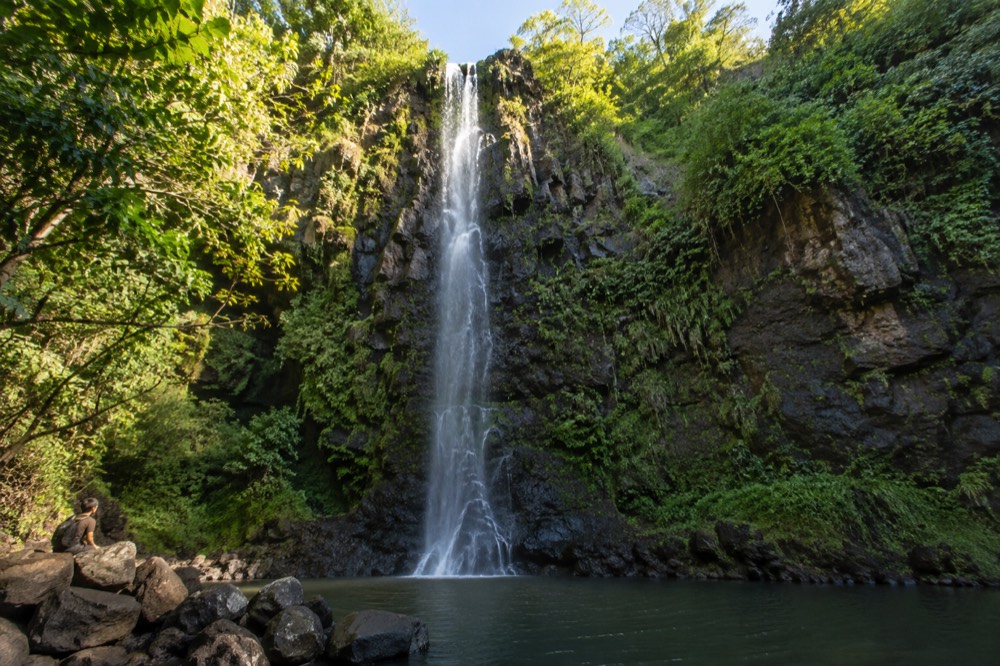
Mānoa Falls is the best waterfall on Oahu for most visitors. The roughly 150-foot cascade sits at the head of the Mānoa valley, a working rainforest five miles inland from Waikīkī, and the trail to reach it is free to walk. Its maintained public trail can fit a half-day plan when access and weather permit. Waimea Falls on the North Shore is the strong alternative, and the better one if swimming is the point of your trip.
That is the short version. The longer version is that "best" depends on what you actually want from a waterfall morning, and the two leading candidates could hardly be more different from each other. One is a wild, muddy, rain-soaked jungle walk to a falls you look at and do not swim under. The other is a landscaped botanical garden walk to a falls whose pool may or may not be open on any given day. Getting this distinction right before you commit a morning is the difference between the waterfall trip you imagined and a hot, disappointed bus ride back to your hotel.
What Is The Best Waterfall On Oahu?
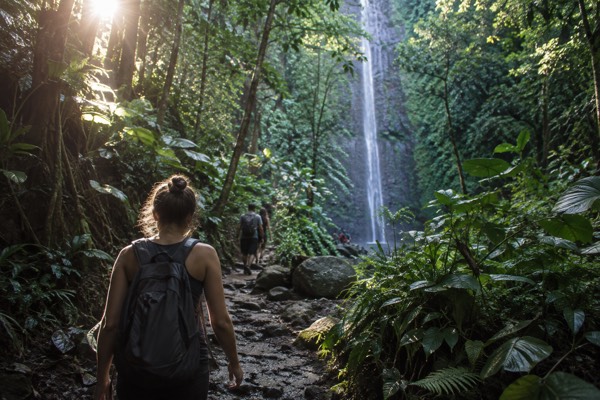
For a first visit, Mānoa Falls is the best waterfall on Oahu, and it is not especially close. It combines height, accessibility and scenery in a way no other falls on the island matches, with a trailhead reachable from Waikīkī without a rental car and a walk through genuine rainforest rather than a planted garden. Waimea Falls, on the North Shore, is the runner-up and the better choice for families, limited mobility, or anyone hoping to swim. The trailhead sits in a residential valley reachable from Waikīkī without a rental car, the walk passes through genuine rainforest rather than a planted garden, and the falls itself drops in a single ribbon down a dark basalt face. The trade-offs are real: the path is often muddy, the pool at the base is off-limits for swimming, and you cannot get behind or beside the water. You look, you photograph, you leave, and for most visitors that is enough.
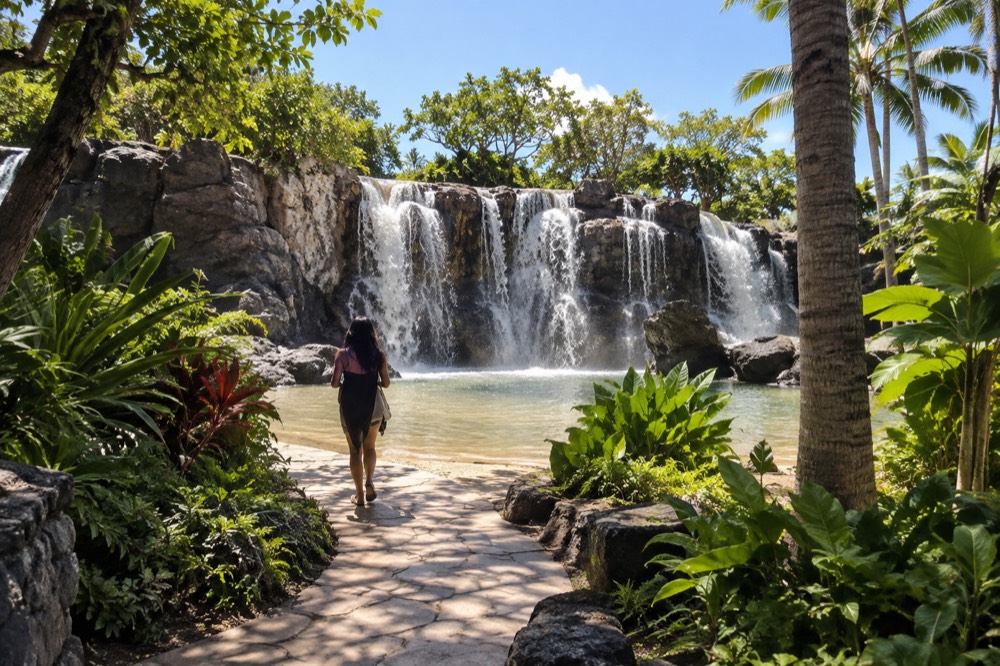
Waimea Falls, inside Waimea Valley on the North Shore, is the runner-up and the right choice for a different traveller. The walk is flat, paved and shaded, the valley is a managed botanical and historical site rather than wild trail, and the falls drops into a large pool that is sometimes, but not always, open for swimming. Adults pay $26 to enter. If you are travelling with small children, anyone with limited mobility, or a group that wants a swim more than a scramble, Waimea is the better waterfall. If you want the jungle, take Mānoa.
There is a third honest answer worth naming: the best waterfall on Oahu is whichever one fits the weather. The island's falls are rain-fed, and the same valley that is brown trickle in a dry August week is thundering white after three days of trade-wind showers. Timing matters more than the choice between the two, and we will come back to it.
Here is the two-way comparison in one place:
| Mānoa Falls | Waimea Falls | |
|---|---|---|
| Location | Mānoa valley, inland from Waikīkī | Waimea Valley, North Shore |
| Walk | State trail map: 1.6 miles round trip, plus approach walking; dirt and rock, often muddy | ¾ mile each way, paved |
| Entry cost | Free to walk the trail | $26 adult, $20 senior/student, $18 child 4–12 |
| Parking | Private lot at trailhead, operator fee | Valley parking charged separately for non-kamaʻāina; check current rate |
| Swimming | Not permitted at the pool | Supervised swim when the lifeguard opens it, never guaranteed |
| Access schedule | Check trail notices before setting out | Check seasonal opening days |
| Best for | Jungle scenery, height, budget visits | Families, accessibility, the possibility of a swim |
Why Does Mānoa Falls Beat Every Other Waterfall On Oahu?
Mānoa Falls wins on three grounds: it drops roughly 150 feet, a distinctive sight at the end of a maintained trail; it sits in real rainforest with some of the state's highest rainfall; and with no entry gate or admission charge, the only cost is reaching the trailhead. The cascade drops roughly 150 feet in one sheet, at the end of a maintained public trail. The valley around it records some of the highest rainfall in the state, which is why the trail is lined with bamboo, giant ferns and liana you would otherwise associate with much less accessible places. And unlike nearly every other notable Oahu waterfall, there is no entry gate and no admission charge, so the only real cost is getting to the trailhead.
The numbers behind that rainforest claim are worth pausing on, because they explain what you are actually walking into. The 1991 to 2020 climate normals from NOAA put Honolulu International Airport, on the leeward coast, at 16.41 inches of rain per year. The Lyon Arboretum station, five miles up the Mānoa valley from Waikīkī, records 150.96 inches per year. Every single month at the arboretum, including its driest, is wetter than the airport's wettest month. That is why the falls exists, why the trail is muddy in a way Waikīkī visitors never expect, and why the jungle canopy overhead stays green through a drought.
The practical shape of a visit is simple. The trail is roughly 1.6 miles round trip, plus the approach walk on a well-marked path that climbs gently, crossing a couple of footbridges before the final stretch of rock steps up to the viewing area. Most people take between ninety minutes and two hours at a relaxed pace. The falls is viewed from a roped-off platform, and the pool below is closed to swimmers, both for safety and because the area is culturally and ecologically sensitive. Respect the barriers. The rocks at the base are slick, and flash floods are a documented hazard in this valley; if you are visiting in wet season, read up on the conditions before you go, and our Mānoa Falls trail guide covers the route in detail.
If you drive, parking is a separate cost alongside any rental and fuel. The trailhead lot is privately operated, and the fee is charged by the operator rather than the city, so check the current rate on the day rather than trusting a number copied from a forum. Street parking in the surrounding residential streets is limited and not always welcome to visitors, and the neighbourhood carries real visitor pressure, so the lot is the honest option. A round-trip Waikiki shuttle is an alternative if you want transport arranged; the walk remains self-guided and the trail remains free.
Is Waimea Falls A Better Choice For Swimming?
Waimea Falls is the only major Oahu waterfall where swimming is on the table at all, but it is a daily decision made by the lifeguard on duty, not a guarantee you can book against. The falls drops into a substantial pool inside Waimea Valley, and when conditions allow, the site runs a supervised swim with required life vests. When rainfall raises the water or reduces visibility, swimming is closed. When swimming closes, the falls remains part of the botanical-garden visit. The admission page for the valley does not promise swimming, and any tour or article that promises it to you is ahead of the facts. Plan for the garden, treat the swim as a bonus.
The entry fees are published and current: adults pay $26, seniors and students $20, children 4 to 12 pay $18, and kamaʻāina and military visitors pay reduced rates of $10, $8 and $6 respectively. The valley is open Tuesday through Sunday, 9 a.m. to 4 p.m., with seasonal variations. The walk to the falls is on a flat paved path of ¾ mile each way through the botanical collection, which is genuinely excellent, with cultivated plants, heiau sites and historical exhibits along the route. You could spend the full day in the valley and not run out of things to look at.
The cultural weight of the place deserves a sentence before the logistics. Waimea Valley is not just a park; it is a living Hawaiian site with a heiau, and the stream and falls are part of a landscape local families have used continuously. The staff are explicit about staying on the path, not disturbing the stones, and following posted rules at the falls. This is easy to do and makes the visit better, not worse. Our Waimea Valley and Waimea Falls guide goes deeper on the history, the botanical collection and how to structure a visit.
So who should pick Waimea over Mānoa? Families with children too small for a muddy root-strewn trail, anyone for whom a paved flat path is the difference between going and not going, and visitors who want the possibility of a swim and accept that it may be closed. If your heart is set on jungle rather than garden, or you are working to a tight budget, Waimea's admission and the drive to the North Shore both count against it.
What Other Waterfalls On Oahu Are Worth Knowing About?
Beyond Mānoa and Waimea, most named Oahu waterfalls fall into two groups: small streamside cascades that are pleasant rather than spectacular, and larger falls on private or restricted land that you cannot legally reach. The Koʻolau range is riddled with streams and falls, but most of the impressive ones sit behind private fences, on land with unmarked burials, or on routes local agencies ask visitors to avoid. The honest state of play is that Oahu is not a big-waterfall island in the way the neighbour islands are, and a lot of online content pushes readers toward falls that are either underwhelming or effectively closed. Kualoa Ranch, for example, contains dramatic valley scenery, but its valleys and movie sites can only be visited on a paid guided tour because the land is private; there is no public waterfall walk there. The legal menu is shorter than the internet suggests.
This matters because "secret waterfall" content about Oahu is, in a large share of cases, directions to trespass. The Koʻolau range is riddled with streams and falls, and most of the impressive ones sit behind private fences, on land with unmarked burials, or on routes that cross areas local agencies ask visitors to stay out of. We do not publish access routes to private land, and we would rather tell you plainly that the two big public falls are the two big public falls than hand you a hike that ends at a gate and an unhappy landowner. For what is legitimately on the menu, our best waterfalls on Oahu overview lists the legal, reachable options with honest descriptions.
The practical takeaway for a visitor planning a waterfall day is to treat Mānoa and Waimea as the two anchors and build around them. Mānoa pairs naturally with a morning in Waikīkī or a visit to the nearby Lyon Arboretum, and Waimea pairs with a North Shore day: the valley sits just inland from Waimea Bay, and the same drive passes Sharks Cove, Sunset Beach and the food trucks of Haleʻiwa. If you have only one day and want the North Shore without driving yourself, compare an itinerary with a confirmed Waimea Valley stop and admission rather than assuming a circle-island tour includes it.
When Is The Best Time Of Year To Visit An Oahu Waterfall?
Choose a day when trail access and weather permit. Recent rain can increase waterfall flow but also flood danger and slippery footing; a morning start does not make hazardous conditions safe. Waterfalls here are fed by valley streams, not springs, and their volume tracks the rainfall directly. The Mānoa valley's climate record shows rain in every month of the year, with July, counterintuitively, among the wettest at the arboretum station, so the falls rarely dries to nothing. But a dry spell thins it, and a wet week swells it. You cannot book rain, but you can check the forecast the night before and pick your day, and morning light on the falls is better for photographs anyway.
The seasonal picture is more nuanced than most guides admit. The leeward coast around Waikīkī and the airport is genuinely dry, with March the wettest month at 2.36 inches on the 30-year normals. The windward valleys are a different climate entirely, and this is the fact that surprises visitors: you can leave a sunny beach and walk into dripping rainforest twenty minutes later. That contrast is not marketing, it is measured. It also means a waterfall visit is a reasonable plan on a day when the beach forecast looks grey, because the valley is wet and green regardless, and light rain in the valley is normal rather than a washout.
Mornings beat afternoons for three reasons. The trailhead lots fill, the Mānoa trail gets busy with both visitors and local runners as the day goes on, and afternoon clouds build over the Koʻolaus, which dims the light on the falls for photography. Waimea Valley is calmer early too, and its last admission window means a late start can cost you the visit. If sunrise photography is your thing, note that Oahu's day length swings only about two and a half hours across the year, with sunset never later than about 7:17 p.m., so there are no long summer evenings to rescue a late start.
One safety note that belongs here rather than in a footnote: flash floods are a real hazard in Oahu's narrow valleys, and the state and city both warn against entering streams during or after heavy rain. Never cross a flooded footbridge, and if the water is brown and moving fast, the falls will still be there tomorrow. Our Oahu flash flood safety guide explains how to read the conditions.
How Do You Actually Get To Mānoa Falls Without A Car?
You can reach the Mānoa Falls trailhead from Waikīkī by public bus, by rideshare, or by a shuttle package, and the choice comes down to cost, time and how much of your morning you want to spend on logistics. The valley is served by city bus routes that stop within walking distance of the trailhead, and TheBus uses the same fare structure as the Skyline rail, with a TheBus cash single ride at $3.25 and a HOLO card day cap at $7.50, so the transit option costs very little. The trade is time and a short uphill walk from the stop to the trailhead through a residential neighbourhood. Rideshare is faster but harder to arrange for the return leg, and the shuttle arranges a scheduled transfer at a price, with a pickup location and time to confirm.
The transit arithmetic is worth spelling out, because it is cheaper than most visitors expect:
| Option | Cost | Trade-off |
|---|---|---|
| TheBus from Waikīkī | $3.25 cash single ride, or $3.00 on a HOLO card with 2 hours of transfers | Slowest option, plus a walk from the stop to the trailhead |
| HOLO card day cap | $7.50 maximum per day, then free rides | Good value if the falls is one of several bus trips that day |
| Rideshare each way | Set by the app, varies by time of day | Door to door, but pickup in the valley can be unreliable |
| Shuttle package | Priced on the operator's live listing | Transfer handled, walk at your own pace |
Rideshare is the middle option: quick, door to door, and priced by the app rather than anything we could honestly quote here. The complication is the return leg, because cell coverage and driver availability in the valley are uneven, and you may end up walking back toward the main road to get picked up. That is fine in sunshine and annoying in a downpour, and Mānoa downpours arrive without much warning.
The third option is a package that bundles the transfer with the walk. Check the official trail information for access details. A self-guided shuttle provides transport from Waikīkī without a hiking guide. Whether it is worth it over the bus depends on your group and your schedule; the current price and departure times are on the operator's live listing rather than repeated here.
If the waterfall is one stop inside a bigger day, the arithmetic changes. A North Shore itinerary must explicitly include Waimea Valley if that is your priority. The North Shore and Waimea day compared here includes valley entry and selected Waikiki pickups. Other circle-island tours may only pass through the area and cannot be assumed to provide time for the waterfall walk.
Is A Waterfall On Oahu Worth The Trip At All?
Yes, if you pick the right falls for your group and go with the right expectations, and Mānoa Falls in particular is one of the best half-days on the island for the money: a free rainforest walk to a 150-foot cascade, minutes from a resort district, that first-time visitors consistently rank among their trip highlights. A free rainforest walk to a 150-foot cascade, minutes from a resort district, is not an experience most destinations can offer, and first-time visitors consistently rank it among their trip highlights. The failure cases are predictable and avoidable: expecting to swim at Mānoa, expecting a guaranteed swim at Waimea, arriving mid-afternoon to full lots, or wearing smooth-soled shoes on a muddy trail. Plan those details, then let current access and weather conditions determine the day.
Set expectations honestly and both falls deliver. Mānoa is a look-and-leave falls in a wild valley, worth an early start when trail and weather conditions permit, and best in footwear you do not mind dirtying. Waimea is a garden destination with a falls at the end, best for families and accessibility, with a swim that is a bonus rather than a promise. Do one or the other, not both on the same day, and build the rest of the day around the side of the island you are already on.
For a wider view of how a waterfall morning fits into a full trip plan, the Oahu Travel Guide homepage pulls the whole island together, and our itinerary pages show where a falls walk slots into one, three or five days. The rainforest is the part of Oahu most visitors under-plan for, and it is the part they talk about when they get home.
Common Questions About The Best Waterfall On Oahu
Most questions about the best waterfall on Oahu come down to three things: whether you can swim, what it costs, and how to get there. Mānoa Falls is free to walk to, Waimea Falls charges admission of $26 for adults, and both are reachable without a rental car and better in the morning. Mānoa Falls is free to walk to, charges only for parking at the private trailhead lot, and does not permit swimming at its pool under any conditions. Waimea Falls charges admission of $26 for adults, has seasonally varying opening days, and allows swimming only when the lifeguard opens it on the day. Both are reachable without a rental car, both are better in the morning, and the choice between them is really a choice about what kind of walk you want. Everything else, from footwear to weather, is a detail of execution rather than a different answer.
What is the best waterfall on Oahu?
Mānoa Falls is the best waterfall on Oahu for most visitors: it has a maintained public trail, it sits inside genuine rainforest minutes from Waikīkī, and the walk is free. Waimea Falls is the better choice if you want a flat paved walk and the possibility of a swim.
Can you swim at Mānoa Falls?
No. The pool at the base of Mānoa Falls is closed to swimmers, and the viewing area is roped off. The rocks are slick, the water quality is poor after rain, and flash floods are a hazard in the valley. Assess any alternative swimming location separately, using posted warnings and lifeguard advice.
Can you swim at Waimea Falls?
Sometimes. The pool at Waimea Falls is open for supervised swimming with required life vests when the lifeguard on duty judges conditions safe, and closed after heavy rain or when visibility in the water drops. It is a daily decision, not a guarantee.
How much does it cost to visit Waimea Falls?
Waimea Valley admission is $26 for adults, $20 for seniors and students, and $18 for children 4 to 12, with reduced kamaʻāina and military rates of $10, $8 and $6. The valley is open Tuesday through Sunday with seasonal variations.
How long is the Mānoa Falls hike?
The Mānoa Falls trail is roughly 1.6 miles round trip, plus the approach walk on a maintained path with a gentle climb and some rock steps near the end. Most visitors take between ninety minutes and two hours, not counting the walk from parking to the trailhead.
What should I wear to an Oahu waterfall hike?
Wear shoes with real grip. The Mānoa trail is frequently muddy, and smooth soles can slip on wet rock steps. Bring a light rain layer, since the valley records some of the highest rainfall in the state and showers arrive quickly.
The honest summary is that Oahu's waterfall scene is smaller than the internet implies but better than its reputation: two genuinely good falls, one wild and one gardened, both reachable, both worth a morning. Pick the one that matches your group, go early, and let the rainforest do the rest.
Choose Your Waterfall Outing
Compare a Manoa shuttle for a self-guided hike with Waimea garden admission or a North Shore day that includes it. These are alternatives, not a combined package.
Manoa Falls Self-Guided Hike With Waikiki Shuttle
Confirm your pickup and review the operator’s hiking requirements. You pay for transport, not entry to the free trail, and hike without a guide.
Round-trip Waikiki shuttle for a self-guided hike; no hiking guide. The rocky trail requires moderate fitness. Review age and health restrictions and confirm pickup. Book only if you need transport; swimming is not permitted.
Compare Independent Manoa Travel With A Shuttle
Use USD totals for the same party and date. Enter public fares, rideshares or rental costs, then only additional parking/fuel. Compare with the shuttle quote for everyone. Manoa trail entry is free. This compares transport to Manoa, not the different Waimea or luau experiences.
Select dates and everyone travelling on the provider’s website, then review the final price and booking conditions.