Is $1000 Enough For A Week In Oahu, Hawaii?
A direct, sourced answer on Is $1000 Enough for a Week in Hawaii, with real Oahu attraction fees, transit fares and a sample budget built from verified figures.
Is $1000 Enough For A Week In Oahu, Hawaii?
Yes, $1000 can cover a week in Hawaii, but only if the question is really about Oahu, only if your accommodation is already paid for or priced separately, and only if you spend deliberately. That figure does not include airfare. It works for food, local transport, attraction fees and one or two paid experiences, provided you ride TheBus instead of renting a car and lean on the island's large stock of free beaches and trails. Get those conditions right and the week is genuinely comfortable rather than a survival exercise.
The question gets asked a lot, and most answers online are vague because Hawaii costs are genuinely lumpy. A single luau can eat a fifth of this budget. A rental car plus Waikīkī hotel parking can quietly eat more. Meanwhile the best things on the island, the beaches, the lookouts and several of the trails, cost nothing at all. The honest answer is that $1000 is workable on Oahu with the right shape of week, and this page breaks that shape down with verified figures rather than guesses.
This site, Oahu Travel Guide, is built around exactly this kind of question, and the numbers below come from official sources: state tax announcements, City and County transit fares, DLNR state park pages and the National Park Service.
Is $1000 Enough For A Week In Hawaii?
On Oahu, yes, if your lodging is not paid out of the $1000 and you accept a mostly car-free week: food stays the largest daily line, the HOLO card's cap keeps transit to about $7.50 a day, and the rest funds one or two big paid days out. On the neighbor islands the car is effectively mandatory, pushing a week past $1000 before food. A realistic plan keeps food as the largest daily line, holds transit to about $7.50 a day at most thanks to the HOLO card's cap, pays the small state park fees as they come, and puts the rest into one flagship tour plus a cushion. That leaves slack for shave ice, a mistake or two, and an unplanned plate lunch. It is a real week, not a starvation budget.
The reason the answer is Oahu-specific is that Oahu is the only island where you can credibly skip the rental car. TheBus network is dense, the rail line now reaches the airport, and a HOLO card caps your daily spending automatically. On the neighbor islands the car is effectively mandatory, and that alone pushes a week past $1000 before food.
It also matters that Oahu's headline sites skew cheap or free. The USS Arizona Memorial program at Pearl Harbor is free, with only a $1 per-ticket management fee when you reserve on recreation.gov. Diamond Head costs $5 per non-resident plus $10 to park, and less if you walk in. Hanauma Bay is the priciest common stop at $25, and it is also the one place on this list a first-time visitor might call unmissable.
So the honest framing is not "can it be done" but "what does it cost you in comfort." You will not eat at a resort every night. You will ride the bus. You will spend evenings on the sand at Ala Moana instead of at a paid sunset show. Plenty of travellers would choose that week over an expensive one anyway.
What Does $1000 Actually Have To Cover On Oahu?
Assuming airfare and lodging are handled separately, $1000 for seven days on Oahu needs to cover four things: food, which is the biggest line and the one people underestimate; getting around, the smallest line, capped by the HOLO card at $7.50 per day; attraction fees, which are small and fixed; and your paid experiences, the flexible middle where planning earns its money. Food is the biggest line, and it is the one people underestimate, because restaurant dinners in Waikīkī cost a multiple of what a plate lunch or a grocery poke counter charges. Transit is the smallest line, capped automatically by the HOLO card. Fees are small and fixed. Tours are the flexible middle, and that is where planning earns its money.
Start with food, because it is the line people get wrong. A plate lunch from a food truck or local counter is a full meal at a modest price, and Oahu's food truck scene is genuinely good rather than a compromise. Grocery stores, especially the local chains, sell poke and ready meals at prices that make hotel breakfasts look absurd. Two meals out a day plus a grocery breakfast lands most solo travellers in a defensible range.
If you are still deciding where to stay on Oahu, book a hotel search here.
Transit is the line where Oahu rewards you. TheBus and the Skyline rail line share one fare structure: a HOLO card costs $2, a single ride with two hours of transfers is $3.00, and the card caps you at $7.50 per day no matter how much you ride. A week of heavy bus use therefore costs about what a single day of rental car plus parking can cost at some hotels. There is no Skyline station in Waikīkī, so budget a transfer, but the W Line bus connects the rail to the visitor district.
The flexible middle is fees and tours. This is where the budget either breathes or dies, and it deserves its own section below.
The One-ticket Trick for a Tight Budget
The single most efficient move for a $1000 week is putting your sightseeing into one big guided day instead of five small paid stops. A circle-island tour bundles the drive, the commentary and a run through Haleʻiwa town into one ticket, and it replaces both a rental car and several separate fees. Our full Oahu circle island tour rundown covers what the day includes.
How Much Do Oahu's Main Attractions Actually Cost?
The headline sites on Oahu are mostly cheap or free: the USS Arizona Memorial program is free with a $1 per-ticket reservation fee, Diamond Head is $5 per non-resident plus $10 to park, Hanauma Bay is $25, and the beaches, lookouts and many trails cost nothing. That is why a $1000 week is feasible at all. The expensive items are the optional ones, luaus, helicopter flights and boat tours, and a tight budget simply picks one or two of those instead of all of them.
| Site | Non-resident cost | Reservation rule |
|---|---|---|
| USS Arizona Memorial, Pearl Harbor | Free program, $1 fee per ticket on recreation.gov | Reserve ahead; parking $7 per day |
| Diamond Head State Monument (Lēʻahi) | $5 per person, $10 per vehicle | Required for non-residents, up to 30 days ahead, card only |
| Hanauma Bay Nature Preserve | $25, children 12 and under free | Opens 2 days ahead at 7 a.m. HST; closed Mondays and Tuesdays |
| Waimea Valley | $26 adult | Closed Mondays |
| TheBus and Skyline | $3.00 per ride with transfers, $7.50 daily cap | HOLO card, $2 |
Two things in that table deserve emphasis. First, the reservation rules are the real planning problem on Oahu now, not the prices. Hanauma Bay's booking window opens exactly two days ahead at 7 a.m. HST, and it closes Mondays and Tuesdays. Diamond Head has required non-resident reservations since May 2022, with no on-site sales. Miss the window and no amount of money fixes it that day.
Second, kamaʻāina pricing is real and wide. Hawaii residents enter Diamond Head and Hanauma Bay free, and Waimea Valley charges residents $10 instead of $26. If anyone in your travelling party qualifies with a Hawaii ID, the budget math changes meaningfully.
Pearl Harbor deserves its own note. The memorial is a war grave, and the program is free because the National Park Service treats it that way. Bags of any kind are prohibited, storage near the entrance costs a small fee, and the only fixed charge beyond the $1 reservation fee is $7 per day parking. A guided tour here buys logistics and interpretation, not entry, and our Pearl Harbor day trip planner explains the trade-offs.
How Do You Get Around Oahu Without A Rental Car?
You get around on TheBus and the Skyline rail line, which share one fare system: $3.00 per ride with two hours of transfers on a HOLO card, a $7.50 daily cap, and a $90 monthly ceiling. The bus reaches every part of the island a visitor needs, including the North Shore, and the rail serves the airport with bus transfers onward to Waikīkī. The bus network reaches every part of the island a visitor needs, including the North Shore, and the rail line now serves the airport with bus transfers onward to Waikīkī. A car-free week is the single biggest thing that makes $1000 work, because it removes both the rental and the parking, the two quietest budget killers on the island.
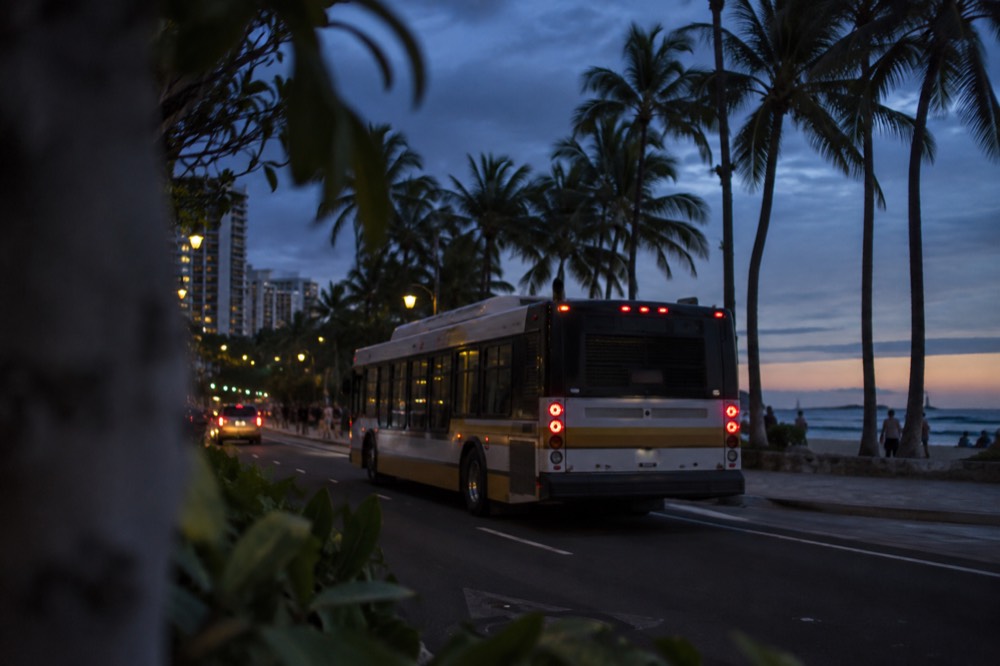
The practical detail that trips people up: there is no Skyline station in Waikīkī. The rail's value to a visitor is the airport leg and the connection toward Pearl Harbor, with the W Line bus bridging to Waikīkī. For everything along the south shore, the bus is the tool. Our TheBus on Oahu guide has the routes that matter, and the Honolulu Skyline rail guide covers the airport transfer.
The trade-off is time. Buses run often on the trunk routes but a North Shore day by bus is a commitment, and that is exactly why the one-big-tour strategy works: a circle-island tour day is a day you do not need the bus to go far. Alternate bus days with tour days and a car-free week stops feeling like a constraint.
Where Does A $1000 Week Usually Go Wrong?
The budget breaks in three predictable places: a rental car sitting parked most of the week while you pay for hotel parking, nightly restaurant dinners in Waikīkī, and stacking paid experiences on consecutive days. Any one of these can add hundreds of dollars to a week that was otherwise on track, and all three together can roughly double a workable $1000 plan. Any one of those can add hundreds of dollars to a week that was otherwise on track. All three together take a workable $1000 plan and roughly double it, which is why so many people come home convinced Hawaii is unaffordable when Oahu specifically did not have to be. The pattern is common enough that you can plan against it in advance.
The car is the biggest trap because it feels like a necessity. It is not, on this island. Between the bus, the rail and one or two tour days, a car sits parked most of the week, and parking is where the quiet bleed happens.
Dining is the second trap, and it is entirely a Waikīkī phenomenon. Walk two blocks inland from the beach and the price of a meal drops sharply. The plate lunch, the poke counter and the shrimp truck are not budget compromises, they are the food many residents actually eat, and our best food on Oahu guide maps where to find it.
The third trap is stacking. A luau, a catamaran sail, a snorkel tour and a helicopter flight in one week is a great week and an impossible budget. Pick one or two. A luau is the most common single splurge and it is a defensible one, and our best luau on Oahu comparison shows the spread of options.
What Can You Do On Oahu For Free?
More than on almost any other island destination: every beach in Hawaii is public below the vegetation line, from Ala Moana Beach Park to Waimānalo, Kailua and the North Shore; the lookouts are free; trails like Koko Head, the Mākapuʻu lighthouse trail and the Mānoa Falls path cost nothing to walk; and the Pearl Harbor program is free as well. Add the free Pearl Harbor program, free live music traditions in Waikīkī, and beach after beach with no gate and no fee, and the free list is long enough to fill every gap between your paid days. On most islands the free layer is thin; on Oahu it is the backbone of a budget week.
The beaches alone carry a week. Ala Moana Beach Park, Waimānalo, Kailua and the North Shore's Sunset Beach and Sharks Cove area are all public and all free. Our free things to do on Oahu page is the full catalogue, and it is the single most useful page on this site for a $1000 week.
The trails are the second free tier. The Mānoa Falls trail is free to walk, with parking charged by a private lot if you drive, which is another argument for the bus. The Koko Head summit trail is free. The Mākapuʻu lighthouse trail is free and paved. Diamond Head is the one near-free exception at $5, and it is worth every cent of that five.
One caution that matters more than money: check closures before you plan a lookouts day. As of the Department of Land and Natural Resources notice dated 9 September 2026, Nuʻuanu Pali State Wayside and Kaʻena Point State Park's Mokuleʻia and Keawaʻula sections are closed until further notice for repairs after Hurricane Lowell. Free does not mean always open.
Common Questions About A $1000 Week In Hawaii
Most questions about whether $1000 covers a week in Hawaii come down to three things: whether lodging is inside or outside the budget, whether a rental car is avoidable, and how many paid experiences the week stacks. Get those three right, lodging separate, no car, one or two paid days, and $1000 is a genuinely comfortable Oahu week with room for a splurge. Get any one wrong and the budget roughly doubles, which is why the answers below keep returning to the same three levers rather than spreading advice thin.
Is $1000 enough for a week in Hawaii?
On Oahu, yes, if airfare and lodging are separate and you go car-free. Food is the biggest daily line, transit is capped at $7.50 a day on a HOLO card, the main attraction fees are small and fixed, and one flagship tour fits inside $1000 with a cushion left over. On the neighbor islands it is much harder, because a rental car is effectively required there.
Does the $1000 include the hotel?
No, and it cannot. Hawaii taxes accommodation heavily: the state Transient Accommodations Tax rose to 11.00% on 1 January 2026, on top of county surcharges and general excise tax. Price rooms with tax included, and treat lodging as its own budget line before you judge whether $1000 covers the rest.
Can you do Oahu without a rental car?
Yes, and doing so is what makes a $1000 week possible. TheBus and the Skyline rail share fares, a HOLO card caps spending at $7.50 per day, and the bus reaches the North Shore. There is no rail station in Waikīkī, so you transfer to a bus, but the network covers everything a visitor needs.
What is the single best way to spend money on a tight Oahu week?
One big guided day, usually a circle-island tour. It replaces the rental car for the day you want to cover distance, bundles several stops into one ticket, and leaves the rest of the week free and cheap. Pair it with free beaches and trails and the free Pearl Harbor program.
How much should food cost per day?
Plan on plate lunch counters, food trucks and grocery poke bars for most meals, which keeps the daily food line the cheapest part of the trip relative to what you get. Restaurant dinners in Waikīkī cost a multiple of that, so the budget survives by walking a couple of blocks inland for most meals and treating the beachfront dinner as a once-or-twice splurge.
Are the big attractions expensive?
No, and that is the pleasant surprise. The USS Arizona Memorial program is free with a $1 reservation fee, Diamond Head is $5 per non-resident, Hanauma Bay is $25, and the beaches and most trails cost nothing. The expensive items, luaus, flights and boat tours, are choices, not requirements.
The short version: $1000 is a real budget for a real week on Oahu, provided the room is paid for separately, the car is skipped, and the paid experiences are chosen rather than collected. Spend on one good tour day, eat where locals eat, let the HOLO card cap your transit, and the island's free layer does the rest.