Where Does Guy Fieri Eat In Oahu?
An honest, sourced answer to where Guy Fieri eats in Oahu, plus how to chase the same plate lunches, shrimp trucks and shave ice the food shows highlight, with verified planning facts.
Where Does Guy Fieri Eat In Oahu?
The honest answer is that there is no single fixed list: his programmes have filmed across Oahu over multiple seasons, and the line-up changes each time a crew returns. What stays constant is the kind of food: plate lunch, garlic shrimp from the North Shore trucks, shave ice, poke and the island's older diners and noodle houses. Rather than print a list we cannot source, this page shows you how to chase those categories yourself, with verified planning facts.
That framing is deliberate. Search results for this question return confident lists of restaurants, but almost none of them cite the episode, the season or the air date, and the lists disagree with each other. Some name spots in Waikīkī, some send you to Haleʻiwa, and a few include places that closed years before the article was written. A food TV feature is also a snapshot: a restaurant featured in one season may have a new owner, a new location or a queue that changes the experience entirely by the time you land.
There is a second reason to be careful, and it is one this site applies to every page it publishes. A year, a named individual or an institution is a fact that needs a primary source, and an unsourced claim about which restaurant a celebrity visited is exactly the kind of statement that circulates for years after it stops being true. What we can do is better for your trip anyway.
What we can say with confidence is what the shows highlight everywhere they go on this island, because those categories are the same food that locals eat every week and that our own food coverage documents. Plate lunch, the two-scoops-of-rice, mac-salad format, is the backbone. Garlic shrimp from the trucks between Haleʻiwa and the North Shore beaches is the single most filmed dish. Shave ice, poke and the older noodle and diner institutions of Honolulu round out the picture.
If you want to eat your way through the same territory, the practical version is a North Shore day built around the shrimp trucks, a Honolulu day built around plate lunch and Chinatown, and a windward or leeward stop wherever your route takes you. A circle island tour covers the geography in one guided day if you would rather not drive it yourself, and we come back to that below.
What Kind Of Food Do The Shows Highlight On Oahu?
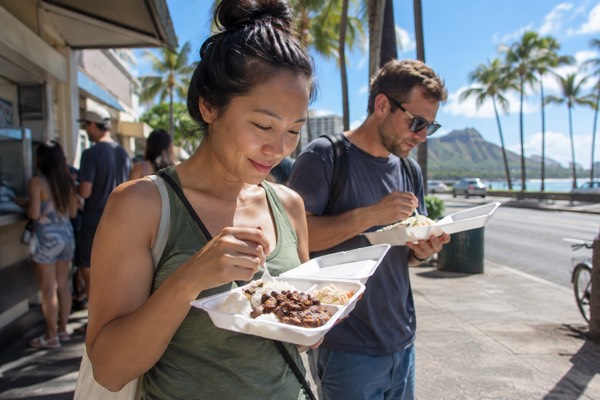
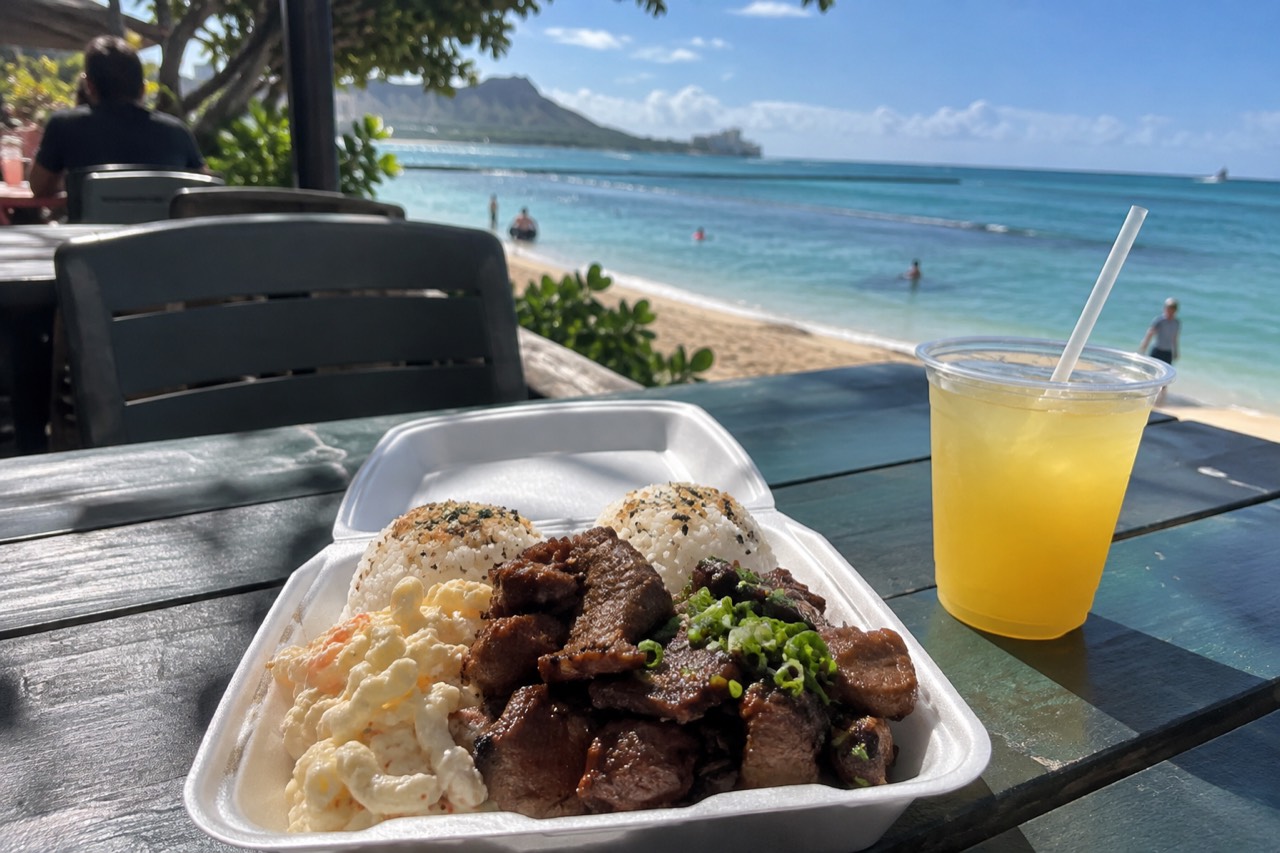
Plate lunch is the core: an entree with two scoops of rice and macaroni salad, sold from strip-mall counters island-wide. Around it sit garlic shrimp from the North Shore trucks, shave ice, poke bowls, and the old Honolulu institutions, diners, noodle houses and bakery counters. Every one of those categories has a dedicated guide on this site, so instead of naming one restaurant we can point you to the whole category, honestly sourced.
Start with the plate lunch. It is the island's default lunch, it costs less than most visitor dining, and it is exactly the kind of unglamorous, high-volume counter food that food television loves: a window, a steam table, a line of locals. Kalua pork, chicken katsu, teriyaki beef and the daily fish special are the standard entries. You will find plate lunch counters in every neighbourhood, not just Waikīkī, and the ones worth queuing for are in the residential strips, which is why our best food on Oahu guide organises the island by neighbourhood rather than by tourist zone.
The format itself has a history worth a sentence. Plate lunch descends from the plantation era, when workers from Japan, China, Korea, the Philippines and Portugal ate side by side in the fields, and the two-scoops-and-mac-salad shape is the descendant of those shared lunches. That is why the category is called local food rather than Hawaiian food, a distinction we return to near the end of this page, because it is the single most common mistake in visitor food writing.
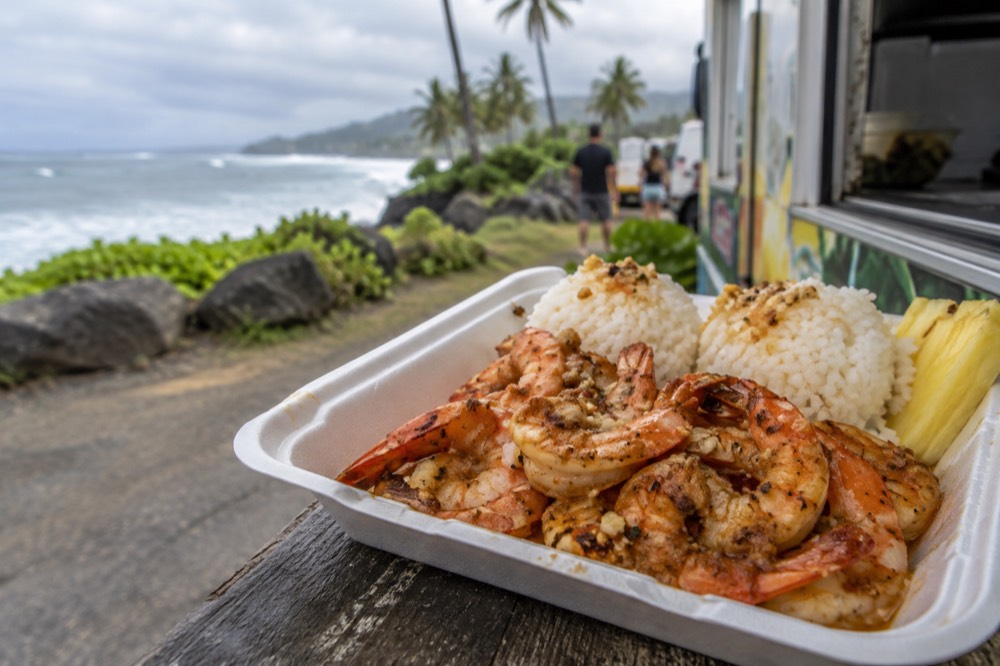
Garlic shrimp is the dish most associated with the North Shore on television, and the trucks are the reason. They sit along the two-lane highway between Haleʻiwa and Sunset Beach, they serve shrimp by the half or full plate, and they are a working part of a working community. Our North Shore shrimp trucks guide covers where the trucks cluster, what to expect to pay in the range sense, and how to plan around beach parking, which is the part first-time visitors get wrong. The shrimp are farmed, not wild-caught, and the butter-garlic sauce that the trucks are famous for is a North Shore invention of the last few decades, not an ancient dish, which is worth knowing before you build a whole cultural narrative around a paper plate.
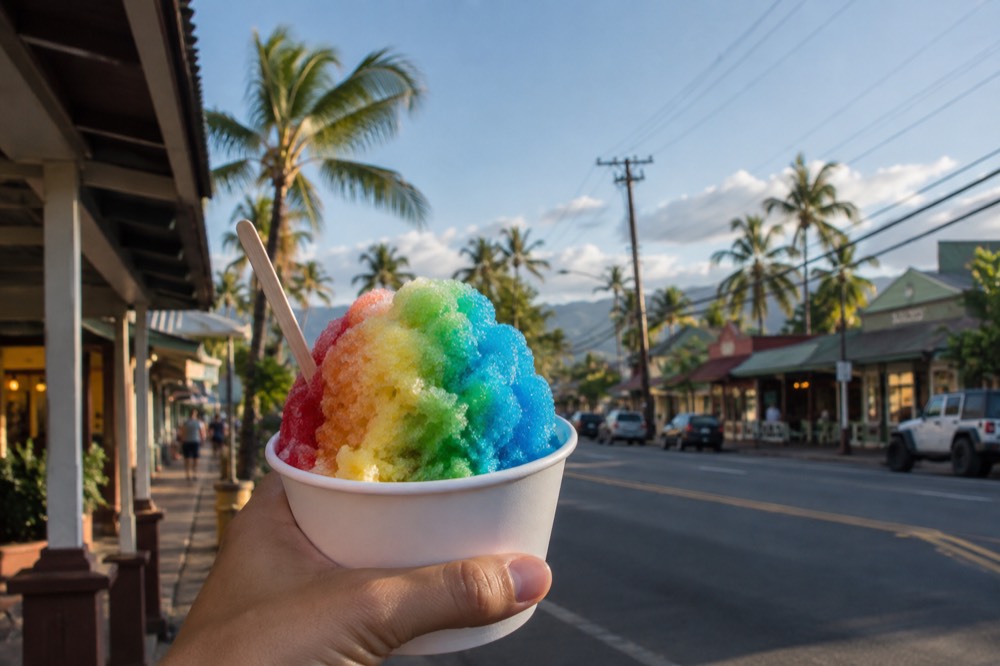
Shave ice is the dessert, and it is not a snow cone: the ice is shaved fine enough that the syrup stays in the cup instead of pooling at the bottom. The machines matter, the flavours matter, and the queue in Haleʻiwa on a summer afternoon is a real planning factor. Azuki beans and ice cream under the ice are the local upgrades, and the details, including the difference between shave ice and the mainland imitations, are in our shave ice coverage.
Poke, raw cubed tuna seasoned with salt, soy, onion or spice, began as a supermarket counter item and is now sold everywhere from grocery chains to dedicated bars. It is also the easiest of these categories to get right: buy it where the fish counter is busy, eat it the same day, and do not drive it around the island in a hot car. The original form was salted fish with seaweed and inamona, roasted kukui nut, and the soy-sauce versions most visitors know are a later evolution, but both are legitimately local.
How Do You Build A Fieri-Style Eating Day On Oahu?
Pick one region per day and eat two or three stops in it, rather than crossing the island for a single dish. A North Shore day pairs a morning beach stop with shrimp trucks and shave ice in Haleʻiwa; a Honolulu day pairs a plate lunch counter with Chinatown noodles and a bakery; a windward day adds Kailua or Kāneʻohe. Driving times on Oahu are unpredictable, so geography, not a list, is the real planning tool.
What we can say is structural: the eating day that works is the one where lunch and dessert are fifteen minutes apart, not ninety.
A sample shape for the North Shore, the single most filmed food region on the island:
| Stop | What it is | When to go | Watch out for |
|---|---|---|---|
| Morning beach or lookout | Sunset Beach, Waimea Bay area | Before the crowds build | Parking fills early on high-surf days |
| Shrimp truck lunch | Garlic or lemon-pepper shrimp plate | Late morning, before the noon rush | Cash expectations vary by truck, check before ordering |
| Haleʻiwa town | Shave ice, galleries, the old town | Early afternoon | The shave ice queue peaks mid-afternoon |
| Way back | Stop only where parking is legal | Late afternoon | Do not stop in travel lanes near turtle beaches |
That last row is not filler. The North Shore is a working community on a two-lane highway carrying enormous visitor pressure, and the difference between a good eating day and a bad one is often just parking legally and not treating a residential street as overflow. The town of Haleʻiwa itself is small, walkable and worth an hour beyond the shave ice line; our Haleʻiwa town guide covers what else is there.
For the Honolulu version of the day, the shape is different because the distances are short and the transit is good. A plate lunch counter in Kaimukī or Mōʻiliʻili, a Chinatown noodle stop, and a bakery before it sells out makes a full day that never requires a car, and the whole thing can be done on a capped transit fare. The Chinatown Honolulu guide is the anchor for the middle of that route.
If you would rather have someone else handle the driving, this is exactly what the big circle island tours do: they run the coast road, stop in Haleʻiwa, and hand you the geography in one day. It is also worth knowing that a guided food walk in Honolulu exists, run by a local operator, which covers the off-Waikīkī side of the island's food scene that television rarely shows.
Rather have someone else handle the route? Book a Honolulu food tour here.
Between the two options, the choice is really about how much of your day you want to spend eating versus travelling. The food walk is a three-hour commitment inside Honolulu, close to your hotel if you are staying in Waikīkī, and it buys you a guide who can tell you which counter to come back to tomorrow. The circle island day is a much bigger commitment, a full loop of the island with the North Shore food stops built in, but it converts the driving you would otherwise do yourself into time you can spend looking out the window. Some visitors do both on different days, and that combination is honestly the closest thing to a complete answer to this page's question.
Can You Visit The Shrimp Trucks And Food Trucks Without A Car?
Yes, but it takes planning. The shrimp trucks sit on a highway with no rail service and thin bus coverage, so most visitors reach them by rental car, guided tour or rideshare. Within Honolulu, the food truck and plate lunch scene is far more accessible, and TheBus and Skyline share one fare system that caps a day of riding at a set price, which makes a city eating day genuinely cheap to move around.
The transit numbers are verified and worth knowing. TheBus and Skyline use the same fare structure: a single adult cash ride on TheBus is $3.25 with no transfers, a HOLO card two-hour pass with transfers is $3.00, and the daily cap is $7.50, after which the rest of the day's rides are free. A monthly pass is $90. The full fare table is on the City and County's transit fares page.
| Fare | Price | Notes |
|---|---|---|
| TheBus adult cash, single ride | $3.25 | No transfers, exact fare |
| HOLO 2-hour pass | $3.00 | Unlimited transfers, bus and rail |
| Daily cap | $7.50 | Max charged per day, then free |
| 7-day pass | $45.00 | 168 hours from first tap |
| Monthly pass | $90.00 | Month cap |
Two caveats matter for an eating day. Skyline, the rail line, reaches the airport and the edge of Pearl Harbor but has no Waikīkī station, so a rail-based food day still starts with a bus transfer. And the North Shore trucks are effectively car or tour territory; a bus exists but it is slow and infrequent enough that we would not build a shrimp-truck lunch around it.
For the city side, our food trucks on Oahu guide covers where the truck clusters actually are, including the ones locals use on lunch breaks, which is a different list from the ones that appear on television. The truck scene on Oahu is genuinely strong: it grew out of the same wave of young cooks and low-overhead formats that drove the mainland truck boom, and the island's version leans heavily on local plate lunch formats, garlic shrimp and poke rather than fusion tacos, which makes it a good place to eat the categories this page is about at street prices.
One more practical note if you are combining transit with eating: carry a cooler bag in the car or skip the raw-fish stops on hot days. Poke bought at midday and driven around the island is a bad idea by late afternoon, and no television feature will tell you that.
What Does An Eating-Focused Trip Cost On Oahu?
The food itself is the cheapest part of an Oahu trip: a plate lunch runs less than a resort breakfast, and the trucks and counters that television highlights are priced for residents, not visitors. The costs that add up are the activities around the food, the tours, the attractions and the transport, and those are where planning saves real money. A guided food walk and a circle island tour are the two purchases that most directly serve an eating trip.
We do not publish specific restaurant prices, because they change faster than a guide can track, and the honest framing is the range: plate lunch counters and trucks are the cheap tier, sit-down Honolulu dining is mid-tier, and resort dining is the top tier, exactly as anywhere else. What we can be specific about is the tour layer, because those prices render from live listings.
A practical budget split for a food-focused day, using the categories rather than invented prices:
| Spend category | Typical share of the day | How to keep it down |
|---|---|---|
| Lunch, plate lunch or truck | Low | Eat where the queue is locals |
| Dessert, shave ice | Low | One stop, not three |
| Transport | Low to mid | HOLO day cap in the city; carpool or tour up north |
| One paid tour | Mid | Book one, not four |
| Extra activities | Mid to high | Check whether a pass covers them |
That last row is where the attraction pass earns its place: a multi-attraction pass can cover several paid stops around the island, which matters when your eating day is anchored by a circle island loop and you want a zipline or a ranch stop in the middle of it. The details of what the pass includes render on the live listing, so check the current attraction list there rather than trusting any article, ours included, to be current.
It is also worth being honest about what a food-focused trip does not need. You do not need a rental car for every day of a week-long stay; you need one for the North Shore day and can cap your transit spending at $7.50 a day the rest of the time. You do not need more than one luau, and you do not need a reservation at a resort restaurant to eat well. The island's best food is counter food, and counter food does not take reservations.
Is The Food The Shows Feature Actually The Best Food On Oahu?
Sometimes yes, often no. A television feature selects for a good story and a photogenic owner as much as for the food, and the island's most reliable meals are frequently the unmarked counter a block from the beach. The honest strategy is to treat the televised spots as one input among several, alongside where locals queue, our neighbourhood guides, and the simple test of turnover: a busy counter with local customers is almost never wrong.
The turnover test deserves a sentence of explanation. Raw fish and plate lunch are both foods where volume is quality: high turnover means fresh fish and fresh oil, and an empty dining room at noon tells you something no review can. This is also why the categories beat the celebrity list over time: the shrimp truck that was featured in one season may be the best one, or may simply have been the one with a parking lot big enough for a camera crew.
The other honest point is that the shows under-represent whole sections of the island's food. Chinatown's noodle houses and lunch counters, the Kalihi and Kaimukī strips, and the windward side's neighbourhood plate lunch spots barely appear, because filming logistics favour places with parking and an owner who wants the exposure. Our coverage deliberately covers those gaps: the Chinatown guide and the neighbourhood food guide are the places to start if the televised version of the island feels thin.
One cultural note, because it matters. The dishes television frames as "Hawaiian" are mostly local food, a mix of Japanese, Chinese, Korean, Filipino, Portuguese and Native Hawaiian traditions, and the word "Hawaiian" itself refers to Native Hawaiian people and their cuisine specifically: kalo, poke in its original form, kalua pig, poi. Calling a plate lunch "Hawaiian food" is the single most common error in visitor food writing, and getting it right costs nothing. If you want the real thing, look for restaurants that serve traditional Hawaiian dishes, and if you want what the food shows eat, look for the local food counters, which is most of them.
Common Questions About Guy Fieri's Oahu Food Stops
Most questions about where Guy Fieri eats in Oahu come down to three things: the list changes every filming season and cannot be verified without citing the episode, the food categories he highlights are stable and easy to chase yourself, and the real planning problem is geography, not information, because the island's best eating is spread across three regions. This page answers the specific questions below with what can be sourced and says plainly where it cannot.
Where does Guy Fieri eat in Oahu?
His programmes have filmed across the island over multiple seasons, and the specific restaurants change each time. The stable answer is the food: plate lunch, North Shore garlic shrimp, shave ice, poke and Honolulu's older diners and noodle houses. Any article naming a fixed list of his stops should cite the episode, and most do not.
Are the shrimp trucks he features on the North Shore?
The garlic shrimp trucks that food television highlights on Oahu are on the North Shore, clustered along the highway between Haleʻiwa and Sunset Beach. Our North Shore shrimp trucks guide covers the clusters and how to plan a day around them, including parking, which is the part most visitors underestimate.
Can I do an eating tour of Oahu without a car?
Within Honolulu, yes, easily: TheBus and Skyline share a fare system with a $7.50 daily cap on a HOLO card. The North Shore trucks are harder without a car, and most visitors reach them by rental car, a circle island tour or rideshare.
Is the food on his shows the best food on Oahu?
Not necessarily. Television selects for story and access as much as quality, and the island's most reliable meals are often busy neighbourhood counters that never get filmed. Use the televised spots as one input, alongside where locals queue and our neighbourhood guides.
What is actually Hawaiian food versus local food on Oahu?
Hawaiian food is the cuisine of Native Hawaiian people: kalo, poi, kalua pig, poke in its original form. Plate lunch, garlic shrimp and most of what food television features is local food, a mix of Japanese, Chinese, Korean, Filipino, Portuguese and Hawaiian traditions. Both are worth eating, and they are not the same thing.
The honest summary: chase the categories, not the celebrity, and let one guided day handle the driving if you would rather spend your attention on the plate in front of you.
For everything the food shows skip, the neighbourhood guides on Oahu Travel Guide cover the island the way residents actually eat it, and that is the better map to travel with.