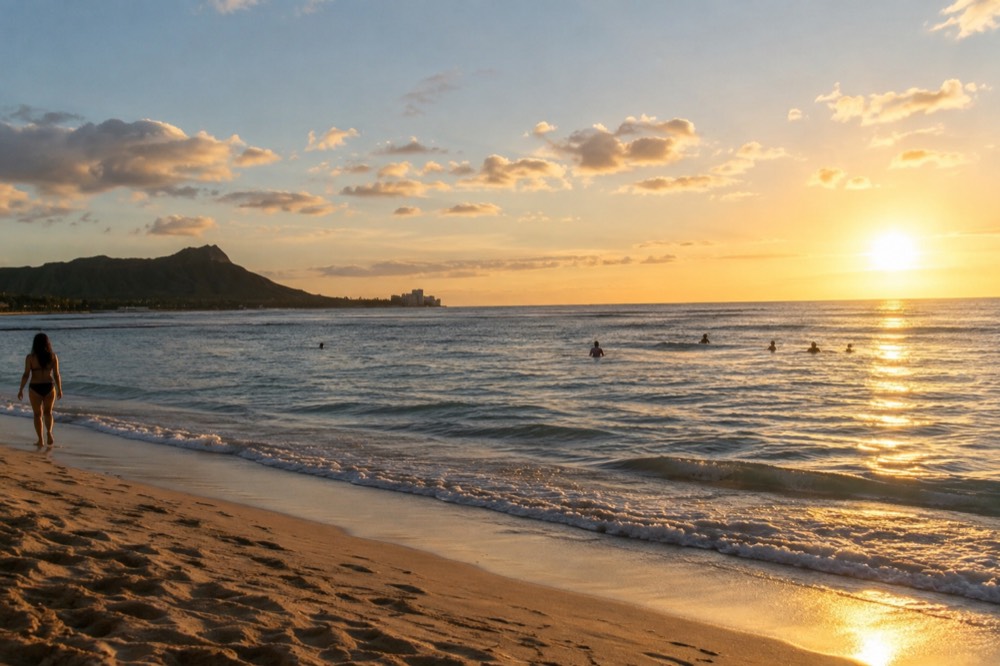
What's The Cheapest Month To Fly To Oahu?
A sourced answer to what's the cheapest month to fly to Oahu, using DBEDT visitor arrivals, rainfall normals and reservation rules rather than guesswork.
February is the cheapest month to fly to Oahu in a typical year, with the late-summer shoulder from mid-September into early October close behind. The reason is demand, and demand is measurable: February 2026 was the weakest month for Oahu arrivals in the state's visitor workbook, at 436,756 visitors by air against 527,241 in January. Airlines price to those troughs. This page walks through what the data supports, what the trade-offs are, and how to book around them.
One honest note before anything else. What is verified is the demand side, from the Hawaii DBEDT monthly visitor statistics, plus the tax, weather and reservation rules that shape what a cheap-month trip actually costs once you land. The conclusion below follows from that evidence, not from a scraped fare table.
Want your phone working the moment you land? Book a travel eSIM here.
What's The Cheapest Month To Fly To Oahu?
February is the cheapest month to fly to Oahu in most years, because it is the weakest month for visitor demand: the state counted 436,756 air visitors to the island in February 2026, the lowest month in the workbook, against 527,241 in January. The next-best window is mid-September through early October. Fares generally follow demand, so those troughs are where the low prices sit.
The demand picture comes straight from the DBEDT monthly workbooks, which count visitors by air to each island. January 2026 was the strongest month so far that year at 527,241, and February fell hard from it, a drop of more than a sixth of the island's monthly arrivals in a single month. That kind of cliff is what airlines see too, and it is why the post-holiday weeks are reliably the softest pricing period for Honolulu routes.
Why does February sag? The holidays are over, school terms are back in session across the mainland, and the Pacific weather conversation turns to rain, which scares off a share of travellers who never check what Oahu rain actually looks like. The result is an island that is fully open, staffed for a crowd that has gone home, and priced accordingly.
The September-to-early-October shoulder works the same way. Summer holidays end, the family traffic disappears, and Oahu sits in a quiet gap before the December wave. The one thing to check for that window is the Hawaii tax change: Act 96 raised the Transient Accommodations Tax from 10.25% to 11.00% effective 1 January 2026, so lodging tax is slightly higher than in trip reports written before that date.
If you want a single rule: avoid the two demand spikes, mid-December through early January and the June-to-August school holiday run, and aim at the troughs either side of them.
Why Do Fares To Honolulu Follow The Demand Calendar?
Airlines set Honolulu prices by load factor, and Oahu's load factors swing with the school calendar and the winter holiday calendar, both of which show up in the state's own arrival counts. The DBEDT workbook puts January 2026 at 527,241 visitors by air and February at 436,756, so the market loses roughly a sixth of its volume in one month. Empty seats in February are sold cheap.
That is the whole mechanism, and it is worth stating plainly because most "cheapest month" advice online is folklore repeated from a fare-aggregator blog post. Here the claim is narrower and checkable: the months with the fewest arrivals are the months where airlines have the most seats to fill, and fares respond.
There is a second, quieter effect worth knowing. Oahu took 5,679,047 visitors by air in calendar 2025, down about 2% from 5,794,854 in 2024, per the preliminary DBEDT figures. A softening market does not automatically mean cheaper tickets, but it does mean operators, hotels and tour desks are hungrier in the trough months, and the ground-cost savings often exceed the airfare savings.
It also helps to understand how dominant Oahu is as a gateway. The island took roughly 59.8% of statewide visitor arrivals in 2025, which means the mainland-to-Honolulu routes carry the bulk of Hawaii's air traffic. High-volume routes attract competition, and competition keeps even the peak-season fares from running away entirely. The trough months are where that competition bites hardest, because every airline is fighting for the same shrunken pool of passengers.
Is The Cheapest Month A Good Month To Be There?
Yes, with two qualifications. February sits inside Oahu's wetter season, but the rain is wildly uneven across the island: the airport station averages 16.41 inches a year while Mānoa's Lyon Arboretum, five miles from Waikīkī, averages 150.96 inches, so a leeward-base trip in February is often mostly sunny. The September shoulder sits inside hurricane season, so insurance and a flexible ticket are sensible. Neither trade-off closes the island.
The rainfall contrast is the single most useful planning fact on this site, and it is grounded in the NOAA 1991-2020 climate normals, not in vibes. Honolulu International Airport, representative of the leeward south shore where Waikīkī sits, averages 16.41 inches of rain a year, with March its wettest month at 2.36 inches. The Lyon Arboretum station in Mānoa Valley averages 150.96 inches, and every single month there is wetter than the airport's wettest month. Five miles apart.
The practical consequence for a cheap-month trip: base yourself on the leeward side in February and the odds are strongly in your favour, and if it does rain, the rainy day activities on Oahu list is long, from Bishop Museum to the zoo and aquarium.
Day length is the other thing people over-worry about. Oahu's day length varies by roughly 2 hours 35 minutes across the whole year, between about 10 hours 51 minutes at the December solstice and about 13 hours 26 minutes in June. Sunset never gets later than about 7:17 p.m. in Waikīkī, per the US Naval Observatory data. In February you lose a little evening, but you gain a beach that is not shoulder-to-shoulder.
| Trade-off | February | Mid-Sept to early Oct |
|---|---|---|
| Demand for flights | Lowest month in the 2026 workbook (436,756 arrivals) | Low shoulder between summer and holidays |
| Typical weather | Wettest on paper; leeward coast still mostly dry | Warm and drier; hurricane-season tail risk |
| Ocean temperature | Harbour readings about 78°F in Jan-Feb | Harbour readings about 82.4°F in September |
| Surf | North shore near its seasonal quiet | South shore still carrying summer swell |
| Crowds at major sites | Lowest of the year | Low, rising toward late October |
The ocean figures in that table come from NOAA's Honolulu Harbor station, computed from 8,758 hourly readings across 2025. They run warm against open water off Waikīkī, so treat them as a harbour reading, which is what they are.
The surf line deserves a word of explanation, because it is a genuinely underused planning fact. Oahu's shores run out of phase by aspect: north-facing shores peak in winter and south-facing shores peak in summer. On a September day in 2026 the National Weather Service surf forecast had the south shore running larger than the north shore, the exact inversion of the winter pattern. A February trip gets a quiet north shore; a September trip gets a quiet north shore too, with the summer swell still working the south.
Which Months Are The Most Expensive, And Why?
Mid-December through early January is the most expensive window to fly to Oahu, followed by the June-to-August school-holiday run. January 2026 was the strongest month in the state's workbook at 527,241 air visitors, and that figure is inflated by the December-to-New Year travel that spills into it. Summer follows the mainland school calendar almost exactly. Fares in these windows are priced against full planes, not against value.
The December spike has a second cost that travellers routinely miss: everything on the ground is busier. Hanauma Bay reservations, which open only two days ahead at 7:00 a.m. HST, are hardest to win in peak weeks. Diamond Head requires a reservation for non-residents, for entry and parking both, and has required one since 12 May 2022 with no on-site sales. In February the same systems are quietly easy.
That is the real argument for the cheap months beyond the fare itself. The island's scarce things, reservation slots and parking, are scarce because of visitor volume. Buy the trough, and the whole trip gets easier, not just cheaper.
It is worth naming the shoulder-adjacent weeks to avoid too. Late October into November sits between the two cheap windows and is not a bad time on price, but Thanksgiving week is a genuine spike, and the whole November-to-December ramp climbs steadily toward the Christmas peak. If your dates are flexible, the weeks immediately after a holiday are almost always softer than the weeks immediately before one.
How Should You Actually Book A Cheap-Season Flight?
Book the trough, not a magic number of days ahead, and stay flexible inside it: the difference between early and late February, or between mid-September and the first week of October, is usually worth more than any booking-timing formula. Fly midweek rather than Friday or Sunday, and check the fare against what the low month saves you on the ground. There is no verified public dataset on booking windows, so treat all such claims with suspicion.
What can be said with sources: demand is lowest in February and the September shoulder, airlines respond to low demand with lower fares, and Oahu's ground costs, from luaus to tours, discount or at least run less sold-out in those same weeks. What cannot be said honestly: a specific number of days before departure, a specific fare, or a "cheapest day to book" claim. Nobody has published a verified Honolulu-specific study of that.
A few structural points do hold. Oahu is the state's dominant air gateway, taking roughly 59.8% of statewide visitor arrivals in 2025, so competition on mainland routes to Honolulu is real and year-round. And most visitors treat it as the whole trip: 387,063 of July 2026's 499,197 Oahu arrivals visited only Oahu, which means interisland connections are not a necessary cost for the typical traveller.
Flexibility inside the month matters more than most people expect. A Tuesday or Wednesday departure in the second or third week of February combines the seasonal trough with the weekly trough, and the same trick works in the September shoulder. Weekend departures in any month carry a premium, because that is when the short-break market flies.
One more booking-stage check that is specific to Hawaii: the Transient Accommodations Tax now sits at 11.00% on lodging, and it also applies to cruise-ship fares since 1 January 2026 under Act 96. If you are comparing a hotel week against a cruise out of Honolulu, price both with the current tax in mind, not with figures from an older guide.
What Does A Cheap-Month Trip Cost Once You Land?
Less, mostly because the island's biggest paid experiences loosen in the low season, and because Oahu's best-known natural sights are free or nearly free. Diamond Head costs $5 per non-resident plus $10 to park, Hanauma Bay is $25 with children 12 and under free, and Waikīkī, Ala Moana and the North Shore beaches cost nothing. The troughs also mean tour seats and luau tables are easier to get at short notice.
The reservation rules are the one place where a cheap trip can go wrong. Hanauma Bay opens bookings two days ahead at 7:00 a.m. HST and closes Mondays and Tuesdays. Diamond Head takes non-resident reservations up to 30 days ahead, entry and parking separately, credit card only. Get those two right and the rest of a low-season week is forgiving.
For paid experiences, a pass can make sense in the quiet months precisely because you have the time to use it. The Go City Oahu All-Inclusive Pass covers more than 40 attractions over a 2 to 7 day window, and in February or September the scheduling pressure that makes passes risky in peak weeks largely disappears.
The bus system is the other budget lever. TheBus and Skyline share one fare structure: $3.25 cash for a single bus ride with no transfers, a HOLO card 2-hour pass at $3.00 with transfers, and a $7.50 daily cap that makes a heavy sightseeing day effectively a day pass. A month of tapping caps at $90. There is no Skyline station in Waikīkī, so a transfer is part of any rail trip, but the bus network reaches most of what a first visit wants.
| Typical low-season day cost | Item | What to budget |
|---|---|---|
| Free | Waikīkī Beach, Ala Moana, North Shore beaches | $0 |
| $3.00 | HOLO 2-hour pass with transfers | a morning of bus hops |
| $7.50 | Daily fare cap | unlimited bus and rail for the day |
| $5 + $10 | Diamond Head entry and parking, per non-resident | book up to 30 days ahead |
| $25 | Hanauma Bay entry, children 12 and under free | booking opens 2 days ahead, 7 a.m. HST |
Add those rows up and the shape of a cheap-month trip becomes clear: the island's headline experiences are either free or cost less than a mainland dinner, and the money you saved on the fare can go to the things that genuinely cost, like a luau, a snorkel boat or a circle-island day.
Common Questions About The Cheapest Time To Fly To Oahu
Most questions about cheap Oahu flights come down to three things: which month has the least demand, what that month's weather actually does, and whether the savings survive the booking process. February wins the first on the data, the second is manageable if you base leeward, and the third is a matter of flexibility rather than a secret booking window. The questions below cover the specific versions travellers ask.
What's the cheapest month to fly to Oahu?
February, in most years. It was the lowest-demand month in the DBEDT visitor workbook for 2026 to date, at 436,756 air visitors against 527,241 in January, and fares generally track that trough. Mid-September through early October is the next-best window.
Is September cheaper than February for Oahu?
Both are low-demand windows, and neither has a verified public fare dataset behind it. February shows the lower arrival count in the state data, so it is the safer bet on price, while September offers warmer water and drier weather with a small hurricane-season tail risk.
Does it rain all month in February?
No. The leeward south shore, where Waikīkī sits, averages about 16.41 inches of rain a year, wettest in March at 2.36 inches. The huge rainfall totals people quote for Oahu belong to the windward valleys: Mānoa's Lyon Arboretum averages 150.96 inches a year, five miles from Waikīkī. Base leeward and February is mostly a sunny-month trip.
Are Christmas and summer really that much more expensive?
They are the two demand peaks, and January 2026's 527,241 arrivals, the highest month in the workbook, show the holiday spillover directly. Summer follows the mainland school calendar. In both windows you are also competing for Hanauma Bay slots and Diamond Head reservations, which are strictly limited year-round.
Do I need a rental car in the cheap months?
Not necessarily. TheBus and Skyline share fares, with a $7.50 daily cap on a HOLO card, and demand for rental cars is softer in the troughs. The full case for and against is laid out in our [do you need a car on Oahu](/guides/do-you-need-a-car-on-oahu/) guide.
Will the low season save money on luaus and tours too?
It saves something less direct than a discount: availability. In February and the September shoulder, luau tables, tour seats and attraction slots are easier to book at short notice, so you are not pushed into premium advance packages, and multi-attraction passes like Go City become easier to use fully.
What about flying in November or early December?
Those weeks sit on the ramp up to Christmas, so they are softer than the peak but not trough-level. Thanksgiving week itself is a genuine spike. If you want the quietest possible island outside February, aim at the first three weeks of December before the holiday wave builds.
The short version: fly in February if price is the whole point, fly in the September shoulder if you want cheap and warm together, and in either month spend the savings on the things Oahu does best, which are mostly free anyway. The demand data, the rainfall normals and the reservation rules all point the same direction, and a trip planned around them costs less and runs smoother than the same trip in the peaks. More on the island's full range is in Oahu Travel Guide's main collection.